Power needed to keep conveyor belt moving at constant speed

Click For Summary
The discussion focuses on the power required to maintain a constant speed of a conveyor belt transporting sand. It highlights that while the kinetic energy of the sand increases according to the equation K.E = 1/2 mv², this alone does not account for the necessary power, as it would imply infinite acceleration for each grain of sand. The issue arises from the assumption that each grain accelerates instantaneously from rest to speed v, violating physical laws. This misunderstanding emphasizes the need to consider the gradual acceleration of the sand rather than an instantaneous change. Understanding these principles is crucial for accurately calculating the power needed for the conveyor system.
Janiceleong26
Messages
276
Reaction score
4
1. The problem statement, all variables and given/known
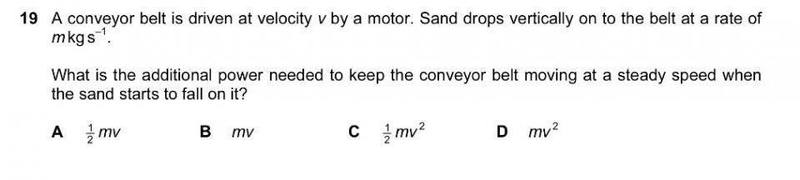
image.jpg


Homework Equations


P=Fv
K.E = 1/2 mv2

The Attempt at a Solution


This is the examiner report:
the kinetic energy of the sand does increase by 1/2 mv2 but this cannot be the only power involved (it would imply an infinite acceleration for every grain of sand landing on the belt)
Why infinite acceleration? Is it because the mass is too small?
 
Last edited:
Physics news on Phys.org
Janiceleong26 said:
Why infinite acceleration? Is it because the mass is too small?
It is assuming that every grain of sand (each of which has a non-zero mass) immediately goes from rest to v without passing through any intermediate speeds. This would require an instantaneous velocity change of a mass by a finite amount, which would be breaking (or at best ignoring) the actual laws of physics.
 
  • Like
Likes Janiceleong26 and phoenix95
gneill said:
It is assuming that every grain of sand (each of which has a non-zero mass) immediately goes from rest to v without passing through any intermediate speeds. This would require an instantaneous velocity change of a mass by a finite amount, which would be breaking (or at best ignoring) the actual laws of physics.
Oh I see, thanks very much
 
Thread 'Correct statement about size of wire to produce larger extension'
The answer is (B) but I don't really understand why. Based on formula of Young Modulus: $$x=\frac{FL}{AE}$$ The second wire made of the same material so it means they have same Young Modulus. Larger extension means larger value of ##x## so to get larger value of ##x## we can increase ##F## and ##L## and decrease ##A## I am not sure whether there is change in ##F## for first and second wire so I will just assume ##F## does not change. It leaves (B) and (C) as possible options so why is (C)...

Similar threads

  • · Replies 19 ·
Replies
19
Views
3K
  • · Replies 8 ·
Replies
8
Views
3K
  • · Replies 4 ·
Replies
4
Views
1K
  • · Replies 9 ·
Replies
9
Views
2K
Replies
7
Views
4K
Replies
8
Views
2K
  • · Replies 5 ·
Replies
5
Views
5K
  • · Replies 4 ·
Replies
4
Views
3K
Replies
2
Views
3K
  • · Replies 63 ·
3
Replies
63
Views
4K