Power transformed when resistance is zero and infinite

Click For Summary

Homework Help Overview

The discussion revolves around the concept of power in electrical circuits, specifically examining scenarios with zero and infinite resistance. Participants explore the implications of these conditions on power calculations using relevant equations.

Discussion Character

  • Conceptual clarification, Assumption checking, Mathematical reasoning

Approaches and Questions Raised

  • Participants attempt to apply different power equations (P=IV, P=I²R, P=V²/R) to scenarios of zero and infinite resistance, raising questions about the validity of these applications. Some express confusion about when to use each equation and the implications of undefined forms like "0/0".

Discussion Status

The discussion is active, with participants questioning assumptions about voltage and resistance relationships. Some guidance is offered regarding the conditions under which certain equations are applicable, and there is exploration of the concept of current in relation to infinite resistance.

Contextual Notes

Participants are navigating the complexities of electrical theory, particularly the behavior of voltage and current under extreme resistance conditions. There is an acknowledgment of the limitations of certain equations when faced with undefined scenarios.

Janiceleong26
Messages
276
Reaction score
4
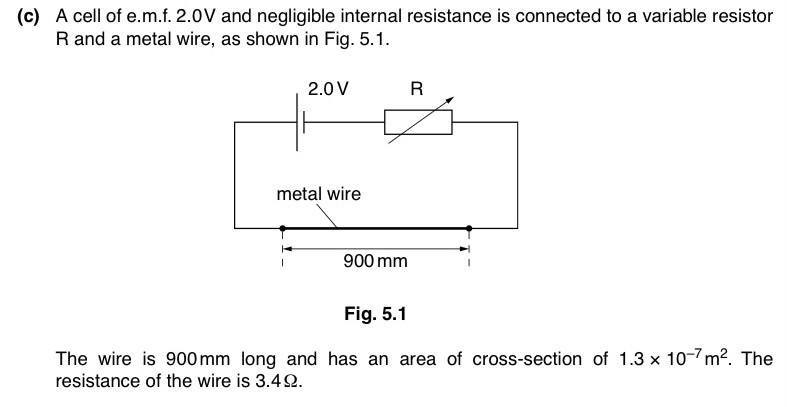
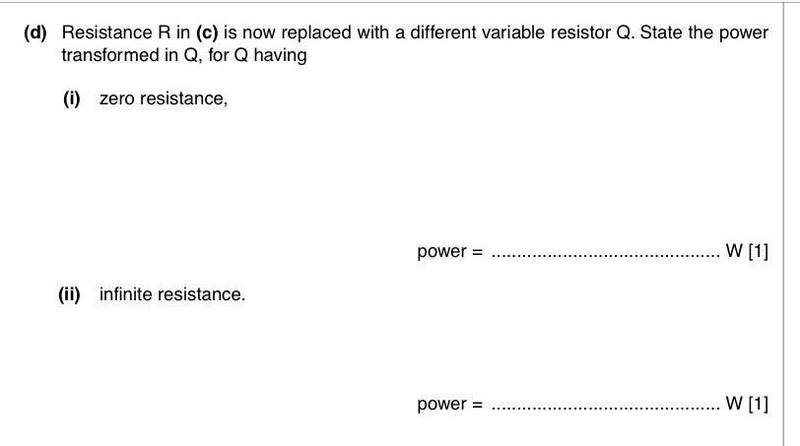
1. Homework Statement
image.jpg

image.jpg

Homework Equations


P=IV,
=I2R
=V2/R

The Attempt at a Solution


For zero resistance, I used P=V2/R formula, and sub. R=0 , power would be infinite. But if I sub. Into P=I2R, power will be zero. The correct answer should be zero. But why do we need to use the second relevant equation I typed above?
For infinite resistance, I used P=V2/R and so will result in power tending to zero.
I am confused on when to we use which equations to calculate power
 
Physics news on Phys.org
Janiceleong26 said:
For zero resistance, I used P=V2/R formula, and sub. R=0 , power would be infinite.
Both R and V go to zero, so you have "0/0" which is undefined. You cannot use this formula.
 
mfb said:
Both R and V go to zero, so you have "0/0" which is undefined. You cannot use this formula.
Oh I see.. Thanks
 
mfb said:
Both R and V go to zero, so you have "0/0" which is undefined. You cannot use this formula.
But if resistance is infinite, then shouldn't voltage be infinite too?
 
No. Why do you expect this?
 
mfb said:
No. Why do you expect this?
Because V=IR, V α R, though I feel that it doesn't make sense to have an infinite voltage..
 
Remember we are talking about the voltage drop across Q.
 
Janiceleong26 said:
Because V=IR, V α R, though I feel that it doesn't make sense to have an infinite voltage..
V α R is only true at fixed current.
What is the current you expect for infinite resistance?
And, as cross-check, can the voltage at the resistor exceed the source voltage?
 
mfb said:
V α R is only true at fixed current.
What is the current you expect for infinite resistance?
And, as cross-check, can the voltage at the resistor exceed the source voltage?
Zero current :biggrin:
Oh yeah.. Never thought of that too, thanks!
 

Similar threads

Replies
5
Views
2K
  • · Replies 3 ·
Replies
3
Views
1K
  • · Replies 3 ·
Replies
3
Views
2K
Replies
10
Views
3K
  • · Replies 42 ·
2
Replies
42
Views
6K
  • · Replies 24 ·
Replies
24
Views
6K
Replies
1
Views
2K
  • · Replies 1 ·
Replies
1
Views
2K
  • · Replies 11 ·
Replies
11
Views
6K
Replies
2
Views
1K