Discussion Overview
The discussion revolves around powering multiple devices in a low-voltage DC circuit, specifically for a shutter-speed testing device. Participants explore how to supply different voltage requirements from a single DC source, addressing theoretical and practical aspects of circuit design.
Discussion Character
- Exploratory
- Technical explanation
- Debate/contested
- Mathematical reasoning
Main Points Raised
- One participant inquires about powering multiple devices with slightly different voltage requirements from a single DC source, emphasizing that no device requires more than 5 volts DC.
- Another participant suggests that devices with different voltage requirements typically need separate power supplies, but acknowledges that "slightly different" voltages might be acceptable.
- It is proposed that Low Dropout Regulators (LDOs) can be used to derive lower voltages from a higher DC source, with a caution about their power requirements and the need for heatsinks.
- A participant mentions that linear regulators can also be used for this purpose, noting their suitability for low power applications.
- There is a discussion about the differences between LDOs and standard linear regulators, highlighting cost, voltage drop, and stability requirements.
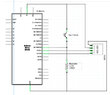
- One participant shares specific voltage and current requirements for an LED and other components in the circuit, prompting further discussion on how to power them effectively.
- Another participant suggests using a resistor to limit current for the LED instead of a regulator, provided the LED operates within a certain voltage range.
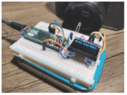
- Questions arise about the overall design of the shutter-speed testing device, including the measurement method and the role of the OLED display.
Areas of Agreement / Disagreement
Participants express differing views on whether separate power supplies are necessary for devices with slightly different voltage requirements. While some suggest using LDOs or linear regulators, others propose simpler solutions like using resistors for LEDs. The discussion remains unresolved regarding the best approach for the specific circuit design.
Contextual Notes
Participants note the importance of understanding power requirements and the characteristics of components like LDOs and linear regulators. There is also mention of potential limitations related to power dissipation and the need for heatsinks.
Who May Find This Useful
This discussion may be useful for electronics enthusiasts, hobbyists working on low-voltage DC circuits, and those interested in power supply design for devices with varying voltage needs.