Pressure and Force - Fluid Dynamics

Join the discussion
Ask a follow-up here, or get your own question answered by working scientists, mathematicians and engineers — people, not an autocomplete.
Real named experts · corrections over time · the nuance an AI answer skips
2 replies · 2K views
jc911
Messages
7
Reaction score
0
HI All,

I have been out of education a long time and am now back at college.

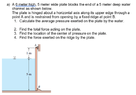
One of my modules is Fluid Dynamics and I am beginning to struggle with the basics and could really use your help. I have attached a snip from one of the example questions below given to me by my lecturer.

For part 1:
I got the average pressure by using the formula, Pressure = density x gravity x height => 1.2 x 9.81 x 6m = 70.6Pa
Is this correct for the average pressure? Or should I have used half the height instead of the full height?

For Part 2:
I got force by, Force = Pressure x area = 70.6 x (6x5) = 2118N

For Part 3 and 4
I am unsure how to get these answers?

Any advice is greatly appreciated as I do not only just want the answer but I want to be able to understand the entire mathematical process.

Thanks in advance.

By the way, if this is the incorrect site for this I would be grateful if you could advise on another site
 

Attachments
  • Capture.PNG
    Capture.PNG
    15.5 KB · Views: 140
Last edited:
Mathematics news on Phys.org
"1.2 x 9.81 x 6m" is the pressure at the bottom of the plate, with the full weight of water on it. Since the pressure is a linear function if depth, you can find the average pressure by finding the (arithmetic) average at top and bottom. Of course, the pressure at the top is 0 so the average pressure is, as you suggest, half of your answer, 35.3 N per square m..

You don't say what level mathematics you can use but a more rigorous way to find the total force on the plate is to integrate the pressure function, times the width of the plate, from top to bottom $$5\int_0^6(1.2)(9.81)x dx= 11.772\int_0^6 xdx= 11.772\left[\frac{1}{2}x^2\right]_0^6= 1059.84$$ N, approximately half of what you have. The "average pressure" then would be that divided by the area of the plate, 30 sq. m., to give 35.3 N per square meter (Pascals), again, half of your answer.

To find the vertical coordinate of the center of the plate, you will need to use integration- integrate the pressure function times x from 0 to 6, then divide that by the total force on the plate:
[math]\frac{\int_0^6x dx}{\int_0^x x^2dx}[/math] (the constants cancel). The center of pressure is in the geometric center horizontally but will be below the geometric center because there is more pressure lower.

To find "the force exerted on the ridge by the plate" you need to apportion the total force between the hinge at the top and the ridge.
 
Country Boy said:
"1.2 x 9.81 x 6m" is the pressure at the bottom of the plate, with the full weight of water on it. Since the pressure is a linear function if depth, you can find the average pressure by finding the (arithmetic) average at top and bottom. Of course, the pressure at the top is 0 so the average pressure is, as you suggest, half of your answer, 35.3 N per square m..

You don't say what level mathematics you can use but a more rigorous way to find the total force on the plate is to integrate the pressure function, times the width of the plate, from top to bottom $$5\int_0^6(1.2)(9.81)x dx= 11.772\int_0^6 xdx= 11.772\left[\frac{1}{2}x^2\right]_0^6= 1059.84$$ N, approximately half of what you have. The "average pressure" then would be that divided by the area of the plate, 30 sq. m., to give 35.3 N per square meter (Pascals), again, half of your answer.

To find the vertical coordinate of the center of the plate, you will need to use integration- integrate the pressure function times x from 0 to 6, then divide that by the total force on the plate:
[math]\frac{\int_0^6x dx}{\int_0^x x^2dx}[/math] (the constants cancel). The center of pressure is in the geometric center horizontally but will be below the geometric center because there is more pressure lower.

To find "the force exerted on the ridge by the plate" you need to apportion the total force between the hinge at the top and the ridge.
Thank you very much for the reply. It is a level 7 degree (an ordinary bachelors engineering degree), so we have not just yet touched on integration, but I am sure this will come.

How I did it was for the average pressure I got Pavg = density x gravity x (height/2)

I then got the force by F = Pavg x CSA of plate

I assume this is another correct method?