Pressure volume curve for lung doesn't make sense?

Click For Summary
SUMMARY

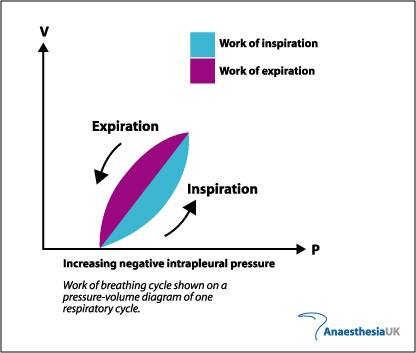
The discussion centers on the interpretation of the pressure-volume curve for the lungs, specifically regarding intrapleural pressure (Pi) during inhalation and exhalation. It is established that Pi is typically negative, around -5 cm H2O at rest, and becomes more negative (around -8 cm H2O) during inhalation due to the diaphragm's action. The pressure in the alveoli (PA) equilibrates with atmospheric pressure at rest and can become slightly negative during inhalation. The discussion also highlights that during forced expiration, Pi can reach positive values, but PA remains higher than Pi due to the elastic recoil of the lungs, even in conditions like emphysema.

PREREQUISITES
  • Understanding of intrapleural pressure (Pi) and its role in respiration.
  • Knowledge of alveolar pressure (PA) and its relationship with atmospheric pressure.
  • Familiarity with the mechanics of breathing, including diaphragm and chest wall muscle functions.
  • Basic concepts of lung compliance and elastic recoil in respiratory physiology.
NEXT STEPS
  • Study the mechanics of breathing and the role of the diaphragm in lung expansion.
  • Research the effects of pulmonary surfactant on alveolar stability and surface tension.
  • Explore the implications of conditions like emphysema and pulmonary edema on lung pressures.
  • Learn about the flow-volume loop and its significance in assessing respiratory function.
USEFUL FOR

Medical students, respiratory therapists, and healthcare professionals interested in understanding lung mechanics and pressure dynamics during respiration.

sameeralord
Messages
659
Reaction score
3
Hello everyone,

work_of_breathing.jpg


Now at higher lung volumes intrapleural pressure must be positive. But according to the graph as inspiration increases intrapleural pressure is becoming more negative?

Please help! Thanks :smile:
 
Biology news on Phys.org
sameeralord said:
Hello everyone,

work_of_breathing.jpg


Now at higher lung volumes intrapleural pressure must be positive. But according to the graph as inspiration increases intrapleural pressure is becoming more negative?

Please help! Thanks :smile:

Why? If pressures were positive, how could inspiration occur? The chest cavity is actively expanded by the action of the diaphragm and chest wall muscles creating a negative transmural (between the outside and inside of the chest wall) pressure gradient allowing inspiration. When the inspiration part of the cycle peaks, the muscles relax and the chest cavity shrinks passively by elastic recoil (mostly) creating a positive expiratory pressure gradient. Unforced expiration is mostly a passive process.
 
Last edited:
sameeralord said:
Hello everyone,

work_of_breathing.jpg


Now at higher lung volumes intrapleural pressure must be positive. But according to the graph as inspiration increases intrapleural pressure is becoming more negative?

Please help! Thanks :smile:


No intrapleural pressure (Pi) is negative, as in subatmospheric (atmospheric defined as 0). It's normally around -5, during inhalation it goes to around -8.

The pressure in alveoli (PA) is equilibriated with Patm at resting position and goes to -1 to -2 during inhalation.

As the diaphragm pulls down it expands the thoracic cavity making the Pi more subatmospheric. Since the parietal pleura (which lines the thoracic wall) is adhered to the visceral pleura the distending forces (Pi becoming more subatm) overcome the collapsing forces (the surface tension on the surface of the alveoli, which is also why you have pulmonary surfactant there) and lungs expand.

The transmural pressure, Pt, which is the difference between PA and Pi, so during resting position;

0-(-5)=5, during inhalation;

-1-(-8)=7.

Expiration is normally a passive event and relies on the recoil of the thoracic cavity and collapsing pressure of the alveoli (when the radius of alveoli get large, the wall tension can overcome the relief provided by pulmonary surfactant and aid in lung recoil).

During forced expiration (mostly through the work of your abdominal muscles and inner intercostals muscles) you can actually create very high positive Pi and PA, around 25 and 30 respectively.

In parts the Pi can actually equal the PA which means the Pt (when 0 or negative) favors collapse of that portion of the tracheobronchial tree, but cartilage rings hold it open.


So for your graph, you see that Pi is actually becoming more negative (more subatmospheric) when we inhale and less subatmospheric (even positive at times) when exhale.

Remember what's important though the pressure gradients and transmural pressure across the alveoli (which distends/collapse the alveoli) wall that matter for breathing.


As a side note; I swear Sameeralord everytime you ask a question, you're like my subconscious reminding me of stuff I need to review for boards, lol:biggrin:
 
bobze - you are spot on apart from the PIP ever getting as high as PA during forced expiration. The elastic recoil of the lung sums with the positive PIP during forced expiration so that PA is always higher than PIP - even in disease states where elastic recoil is drastically reduced, e.g. emphysema. Down in the airway certainly the airway pressure falls below PIP - leading to dynamic compression and reduced flow - the lower airways do compress since there is little cartilagenous support. It all explains why there is a flow independent portion of the flow volume loop during forced expiration. But this does not happen at the alveolar level.

BTW sameelord - PIP is always negative except during forced expiration. Since these are staic compliance curves you always consider PA to be zero and therefore PIP and PTP are the same magnitude - just PIP is the negative sign of PTP.
 
mtc1973 said:
bobze - you are spot on apart from the PIP ever getting as high as PA during forced expiration. The elastic recoil of the lung sums with the positive PIP during forced expiration so that PA is always higher than PIP - even in disease states where elastic recoil is drastically reduced, e.g. emphysema. Down in the airway certainly the airway pressure falls below PIP - leading to dynamic compression and reduced flow - the lower airways do compress since there is little cartilagenous support. It all explains why there is a flow independent portion of the flow volume loop during forced expiration. But this does not happen at the alveolar level.

BTW sameelord - PIP is always negative except during forced expiration. Since these are staic compliance curves you always consider PA to be zero and therefore PIP and PTP are the same magnitude - just PIP is the negative sign of PTP.


Right, so sorry I don't think I was very clear about that. What I was pointing out was the Pi in other parts of the tracheobronchial tree can equal the PA, which would give you a Pt of 0 (collapse of that portion of the tree), this doesn't happen because those areas of the tracheobronchial tree which PA to Pi gradients "cross paths" contain cartilage to keep them from collapse.

Maybe an illustration will help clarify what I'm talking about;

[PLAIN]http://img137.imageshack.us/img137/6734/1resp.jpg

So this is modified by Bob (I added the red box with my awesome paint skills, the diagram comes from West's Respiratory physiology, 5th edition)


Anyway, my point was that in certain areas of the tracheobronchial tree during forced expiration (not in the alveoli themselves, in earlier portions of the tree--before the 16th generation or so) Pi can equal PA, but this isn't a problem because of the cartilage found within. That's really not an important point and I probably would have been better to leave it out for a layman's explanation of inspiration/expiration :biggrin:
 
Last edited by a moderator:
mtc1973 said:
bobze - you are spot on apart from the PIP ever getting as high as PA during forced expiration. The elastic recoil of the lung sums with the positive PIP during forced expiration so that PA is always higher than PIP - even in disease states where elastic recoil is drastically reduced, e.g. emphysema. Down in the airway certainly the airway pressure falls below PIP - leading to dynamic compression and reduced flow - the lower airways do compress since there is little cartilagenous support. It all explains why there is a flow independent portion of the flow volume loop during forced expiration. But this does not happen at the alveolar level.

BTW sameelord - PIP is always negative except during forced expiration. Since these are staic compliance curves you always consider PA to be zero and therefore PIP and PTP are the same magnitude - just PIP is the negative sign of PTP.
Just wanted to add (for accuracies sake) in regards to the boldface. That actually isn't always true. During obstructive disease states like emphysema, it is correct as you have pointed out.

However, during other disease states it is possible for the Pi to exceed or equal the PA (specifically during the end tidal volume, ie; the end of inspiration/expiration).

For instance, in pulmonary edema the fluid increases Pi (a quick reminder for others reading along Pi is the intrapleural pressure) such that it can exceed PA.

Remember we calculate Pt as PA-Pi, and since Pi is normally negative Pt is normally positive (a negative or 0 Pt results in collapse). When Pi increases (becomes less negative) in the case of pulmonary edema then Pt→0 or even a negative number (small still).

You can get the case here of what clinicians/doctors call "rales" which the alveoli collapse because of the edema, but upon inhalation (PA becoming subatmospheric, while the work exerted by inspiratory muscles can return the Pi temporally to negative numbers) Pt returns to a positive number and the alveoli "pop" open.

If you listen to a patients lungs while they breath you hear this "popping" or "crackling" noise (most often at the base of the lung, where the edemic fluid tends to accumulate during the supine position) from the thousands of alveoli opening during inspiration and collapsing at the end of the inspiratory phase (when PA would again be 0).Also, another common and important emergent situation is during pneumothorax, when the parietal pleura has been punctured and Pi equilibriates with Patm (consequently what PA is at during rest, the periods between inspiration and expiration). During a pneumothorax, once the patient ceases a cycle of inspiration/expiration and PA returns to 0 the lung collapses (because the Pi is now 0, thus the Pt is 0).

This is obviously a very emergent situation because once the lung collapses in this case it cannot "re-inflate" on its own.

It can be further complicated by skin flaps, which allow air "in but not out" and create what we call a tension pneumothorax, but that's a story for another day as I need to get back to studying :-p
 
Last edited:
bobze said:
As a side note; I swear Sameeralord everytime you ask a question, you're like my subconscious reminding me of stuff I need to review for boards, lol:biggrin:

Thanks I'll take it as a compliment :smile:

Thanks Bobze, mtc1973 and SW VandeCarr for correcting my misunderstanding. I'm so bad at these respiratory stuff. I have more questions.
 
bobze said:
Just wanted to add (for accuracies sake) in regards to the boldface. That actually isn't always true. During obstructive disease states like emphysema, it is correct as you have pointed out. :-p

Well not just obstructive. The EPP is more distal in obstructive disease due to the lower recoil and more proximal in fibrotic disease due to higher recoil - and in normal somewhere in between. So it really applies to normal lungs and lungs where pathophysiological alteration of recoil has happened. Not just obstructive, some obstructive diseases have normal recoil and hence the EPP development would be less altered.

Good point about pleural effusion and edema - haven't checked out much literature on the effects on pulmonary pressures.
 
mtc1973 said:
Well not just obstructive. The EPP is more distal in obstructive disease due to the lower recoil and more proximal in fibrotic disease due to higher recoil - and in normal somewhere in between. So it really applies to normal lungs and lungs where pathophysiological alteration of recoil has happened. Not just obstructive, some obstructive diseases have normal recoil and hence the EPP development would be less altered.

Good point about pleural effusion and edema - haven't checked out much literature on the effects on pulmonary pressures.


Your right, during restrictive disorders as well, like fibrosis.

So I suppose, the only ones I can think of would be like pneumothorax or different pulmonary edemas.
 

Similar threads

Replies
1
Views
4K
  • · Replies 1 ·
Replies
1
Views
4K
  • · Replies 24 ·
Replies
24
Views
11K
  • · Replies 35 ·
2
Replies
35
Views
5K
  • · Replies 6 ·
Replies
6
Views
23K
  • · Replies 4 ·
Replies
4
Views
7K
  • · Replies 11 ·
Replies
11
Views
36K
Replies
11
Views
4K
  • · Replies 7 ·
Replies
7
Views
9K
Replies
5
Views
2K