Pressurized air in aluminum block help so it doesnt explode

Click For Summary
SUMMARY

The discussion focuses on the design of an air valve block made from 6061-T6 aluminum, specifically addressing the placement and spacing of holes for pressurized air at a maximum of 110 psi. Key considerations include the yield stress of 6061-T6, which is 40,000 psi, and the importance of wall thickness to safely contain the pressure. Calculations indicate that a wall thickness of over 1 mm is advisable for safety, despite initial calculations suggesting a minimum of 0.024 mm. The conversation emphasizes the need for finite element modeling to accurately assess stress distribution around holes in the block.

PREREQUISITES
  • Understanding of material properties, specifically yield stress of 6061-T6 aluminum.
  • Knowledge of pressure vessel design principles.
  • Familiarity with finite element analysis (FEA) for stress testing.
  • Basic calculations for wall thickness in pressurized systems.
NEXT STEPS
  • Research "Finite Element Analysis for pressure vessels" to understand stress distribution.
  • Learn about "Material properties of 6061-T6 aluminum" for better design decisions.
  • Explore "Pressure vessel design codes and standards" for compliance and safety.
  • Investigate "Calculating wall thickness for circular holes under pressure" for practical applications.
USEFUL FOR

Engineers, designers, and hobbyists involved in mechanical design, specifically those working with pressurized systems and materials like aluminum. This discussion is particularly beneficial for anyone designing air valve blocks or similar components requiring precise calculations for safety and performance.

Guilty Spark
Messages
31
Reaction score
0
Pressurized air in aluminum block.. help so it doesn't explode!

Hey everybody! Need some help with a design I'm coming up with for myself- it's an air valve block.

What I'm having trouble with is figuring out how close I can make the holes to each other?

I don't have any computing software that does this sort of thing or calcuations so I whiped up something in MS paint to show you:
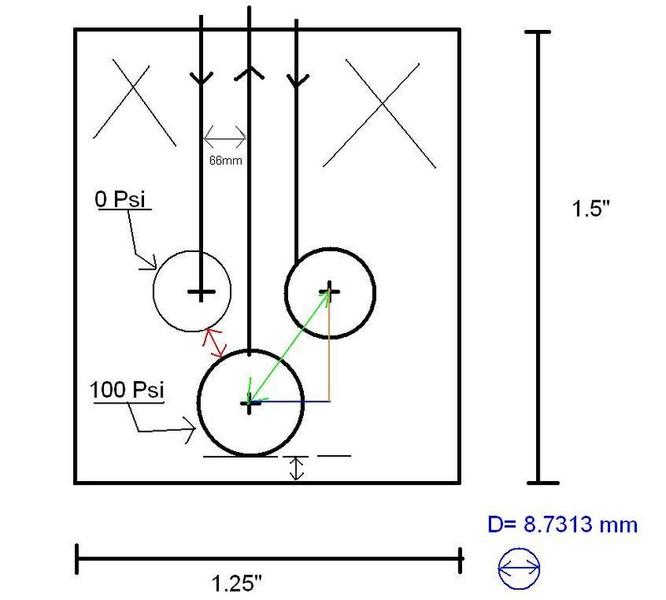
schemh.jpg


The diameter in mm is there, max psi will be 100 (maybe 110 to be safe..).

The center hole is in the exact center of the block with one passage. The other two passages are 66mm on each side.

The passages for the air are fixed, but the holes can be moved off center (I think?) as they are just exhausting to atmosphere. Shouldn't affect it right?

Material is 6061-T6 Aluminum.. I would find a value for you in regards to pressure rating but I don't know which one I am looking for?

----

Summary:
All holes same diameter. Able to offcenter the two from their passages.

Looking to keep holes as far down as possible to allow for more stuff in the top of the block.

-How far off bottom should the hole be?

-How close can the other two holes be to the pressurized one, and it's pressurized air passage.
(Give green line value if you can, as I want to trace a line with a compass off the center mark of the bottom one)

-Assuming 110psi including safety margin.

---

Thx, and any questions feel free to post!
 
Engineering news on Phys.org


Considering the yield stress of 6061-T6 is 40,000 psi, I don't think there is anything to worry about for 100 psi pressure, unless you want to make the gap between the holes a fraction of a millimeter for some reason.


But the needed material is a function of the pressure that it holds back correct?

For example it will be more for 20,000psi, thicker will be needed for more pressure//

I just need the value for thickness at 110psi but I'm not sure how to do it with the circular hole..

**Whoops that should say 6.6mm not 66! Only 31.75mm to work with.
 
Last edited:


Guilty Spark said:
But the needed material is a function of the pressure that it holds back correct?

Obsiously, but we aren't mind readers. If you said 100 psi, we assume that's what you were interested in.

If you just consider a circular pipe with 100 psi pressure, the minimum wall thickness to contain the pressure would be (100/40,000) of the radius, which is much smaller than any real design would be.

For example it will be more for 20,000psi, thicker will be needed for more pressure//

That's a completely different ballgame, because the stress around just one hole in a large block is getting close to the elastic limit of the material. You would need to make a finite element model (including the material nonlinearity) to check that out.


So to get a rough idea I will use the fact that the corners of the block are not my limiting point- the sides will fail before anything else does..

pipe.jpg


ff.jpg

http://miutj.files.wordpress.com/2009/02/manual_recipientes_sometidos_presion.pdf

Using that web info for pressure cylinders I plug some values in and I came up with:

t(inches) = ((110Psi)*(0.34375 inch))/((40,000*1)-(0.6*110))=

0.0009468748 inch * (25.4mm/1inch) = 0.0240503 mm

So assuming the material is made to spec (which it's not really..it's unknown quality but seems ok) anything over 1 mm should be aces?

It's just so hard to believe one little mm is enough.. this stuff cuts like butter! :O
 
Last edited by a moderator:


That's because metals are much weaker in shear (cutting). In this case you are applying a very distributed load on one side (well net force for those people who want to be funny)...


True, I see now why aircraft are constructed out of it.. very strong stuff if you use it the right way!

One thing to note though is that it may be shifting from say 30 psi to 100 psi, rather suddenly if the device needs to use more force all of a sudden.

That shift might cause a blast of pressure, so I will be going with the max amount of wall thickness I can get away with!


Guilty Spark said:
very strong stuff if you use it the right way!

IMO one of the problems with "strength of materials" courses is the amount of time people spend analysing cantilever beams. Sure beams are important, but it's easy to lose sight of the fact that supporting a load by BENDING some material is very inefficient compared with STRETCHING the same amount of material.

You could squash your 0.02mm thick tube flat (i.e. bend it so it is no longer circular) with no trouble at all, but trying to increase the diameter by plugging one end and blowing it up like a balloon is a lot harder to do.
 

Similar threads

  • · Replies 26 ·
Replies
26
Views
3K
Replies
3
Views
2K
  • · Replies 13 ·
Replies
13
Views
2K
  • · Replies 45 ·
2
Replies
45
Views
6K
  • · Replies 12 ·
Replies
12
Views
4K
Replies
9
Views
3K
  • · Replies 7 ·
Replies
7
Views
2K
  • · Replies 3 ·
Replies
3
Views
2K
  • · Replies 7 ·
Replies
7
Views
3K
Replies
10
Views
3K