Probability density functions for velocity and position

Click For Summary

Discussion Overview

The discussion revolves around the conditions under which probability density functions (PDFs) can model the velocity and position of a particle, with references to the Heisenberg Uncertainty Principle (HUP) and the nature of these distributions. Participants explore theoretical implications, statistical laws, and the relationship between different types of distributions in quantum mechanics.

Discussion Character

  • Exploratory
  • Technical explanation
  • Debate/contested
  • Mathematical reasoning

Main Points Raised

  • Some participants question the conditions necessary to model velocity and position using specific PDFs, referencing Feynman's lectures.
  • There is a discussion about whether the HUP applies only to electrons and smaller particles, with varying opinions on its scope.
  • Participants assert that the HUP relates the variance of position and momentum measurements, emphasizing that knowing a particle's state defines its position and momentum PDFs without implying definite values.
  • Some participants argue that the PDFs for position and momentum are not necessarily normal distributions, suggesting that the position PDF can take various forms.
  • There is speculation about Feynman's use of normal distributions, particularly in relation to the Maxwell distribution of velocities and its implications for applying the HUP.
  • One participant expresses uncertainty about whether observing momentum based on the Maxwell Distribution of Velocity results in a normal distribution.
  • Another participant suggests that as the mean velocity increases, the Maxwell distribution approaches a normal distribution, linking velocity and momentum through Fourier transforms.
  • Some participants clarify that measuring momentum involves analyzing a large number of identically prepared systems, which may yield a normal distribution due to the law of large numbers.
  • There is a discussion about the statistical nature of quantum mechanics and the implications of the HUP for measurement outcomes.

Areas of Agreement / Disagreement

Participants express a mix of agreement and disagreement regarding the nature of PDFs for position and momentum, the application of the HUP, and the implications of Feynman's assertions. The discussion remains unresolved on several points, particularly concerning the relationship between different types of distributions.

Contextual Notes

Participants note that the discussion involves assumptions about the nature of PDFs and the statistical interpretation of quantum mechanics, which may not be universally applicable. The relationship between position and momentum distributions is also dependent on specific conditions and definitions.

Aleoa
Messages
128
Reaction score
5
In the first volume of his lectures (cap. 6-5) Feynman asserts that these 2 can be the PDF of velocity and position of a particle.
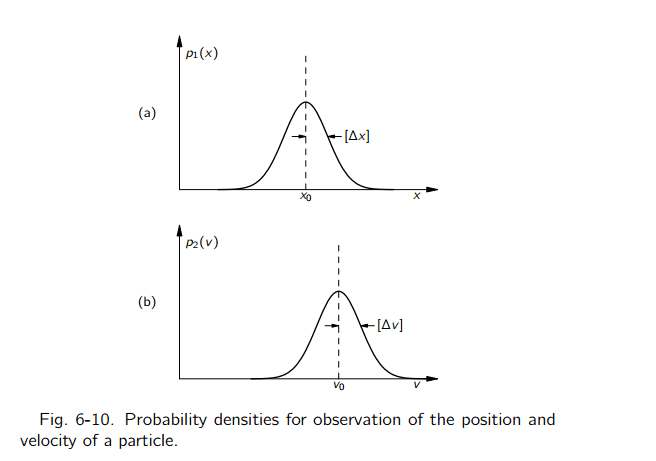
Screenshot 2018-08-03 11:22:42.png


Under which conditions it's possible to model velocity and position of a particle using these particular PDFs ?

ps: Is the "Heisenberg uncertainty principle" applied only in the study of electrons and smaller particles ?

pps: Feynman also asserts that the \Delta x and the \Delta v in the "Heisenberg uncertainty principle" formula are two variances. Is this correct and accurate ?
 

Attachments

  • Screenshot 2018-08-03 11:22:42.png
    Screenshot 2018-08-03 11:22:42.png
    8.1 KB · Views: 1,015
Last edited:
Physics news on Phys.org
Aleoa said:
Under which conditions it's possible to model velocity and position of a particle using these particular PDFs ?

ps: Is the "Heisenberg uncertainty principle" applied only in the study of electrons and smaller particles ?

pps: Feynman also asserts that the \Delta x and the \Delta v in the "Heisenberg uncertainty principle" formula are two variances. Is this correct and accurate ?

The Heisenberg Uncertainty Principle is a statistical law that relates the variance of measurements of position and the variance of measurements of momentum of a particle in a given state.

If you know the state of a particle then that defines the position and momentum pdf's. But, those pdf's do not imply a definifite value for either position or momentum. There is always a non-zero variance for both. Then, the HUP says that:
$$\Delta x \Delta p \ge \frac{\hbar}{2}$$
Strictly speaking ##\Delta## here denotes the standard deviation, which is the square root of the variance.
 
PeroK said:
The Heisenberg Uncertainty Principle is a statistical law that relates the variance of measurements of position and the variance of measurements of momentum of a particle in a given state.

If you know the state of a particle then that defines the position and momentum pdf's. But, those pdf's do not imply a definifite value for either position or momentum. There is always a non-zero variance for both. Then, the HUP says that:
$$\Delta x \Delta p \ge \frac{\hbar}{2}$$
Strictly speaking ##\Delta## here denotes the standard deviation, which is the square root of the variance.

But the PDF that describes the position and velocity of a particle are always normal ?
 
Aleoa said:
But the PDF that describes the position and velocity of a particle are always normal ?

Not always normal distributions, no. In theory the pdf of position can be anything. And, the pdf of momentum is the Fourier Transform of this.
 
PeroK said:
Not always normal distributions, no. In theory the pdf of position can be anything. And, the pdf of momentum is the Fourier Transform of this.

Is it possible that Feynman use normal PDF since in the previous paragraph he introduced the Maxwell distribution of velocities of particles in a container, consequently he imagines to apply the HUP to the particles in the container ?
 
Aleoa said:
Is it possible that Feynman use normal PDF since in the previous paragraph he introduced the Maxwell distribution of velocities of particles in a container, consequently he imagines to apply the HUP to the particles in the container ?

I'm guessing that he intended nothing other than to illustrate the concept of a pdf and its standard deviation/variance.
 
PeroK said:
I'm guessing that he intended nothing other than to illustrate the concept of a pdf and its standard deviation/variance.

But, if i observe the momentum of a particle based on the Maxwell Distribution of Velocity PDF, do i obtain a normal distribution ?
 
Aleoa said:
But, if i observe the momentum of a particle based on the Maxwell Distribution of Velocity PDF, do i obtain a normal distribution ?

I don't know.
 
PeroK said:
I don't know.

What i think is that if i observe the momentum of a particle based on the Maxwell Distribution of Velocity PDF i don't obtain a normal distribution, but i get the Maxwell Distribution of Velocity PDF. So i still don't understand why Feynman use normal distributions of the observation of position and velocity of a particle...

image1390.gif
 

Attachments

  • image1390.gif
    image1390.gif
    5.1 KB · Views: 760
  • #10
Aleoa said:
What i think is that if i observe the momentum of a particle based on the Maxwell Distribution of Velocity PDF i don't obtain a normal distribution, but i get the Maxwell Distribution of Velocity PDF. So i still don't understand why Feynman use normal distributions of the observation of position and velocity of a particle...
As the mean velocity increases the Maxwell distribution gets ever closer to the normal distribution.
I think the point is that velocity and momentum become probability distributions linked by a FT. The Gaussian is a convenient pdf to use as the first example.
 
  • #11
Aleoa said:
if i observe the momentum of a particle based on the Maxwell Distribution of Velocity PDF

What does this even mean? You don't observe "based on" any PDF. You just measure the momentum of a large number of identically prepared systems. Then, by looking at the set of measurement results, you find out what the PDF is for momentum for systems prepared that way.
 
  • #12
Aleoa said:
i still don't understand why Feynman use normal distributions of the observation of position and velocity of a particle...

If one is a normal distribution, the other has to be, because the Fourier transform of a Gaussian is a Gaussian. So we can reduce this question to why Feynman picked a normal distribution for one of the two. The easier one to see is probably momentum, because in real experiments momentum of quantum systems is more often measured than position. And if you measure the momentum of a large number of identically prepared systems, unless the preparation process is unusual in some way, you are most likely to get a normal distribution of results simply by the law of large numbers. And Gaussians have a number of convenient mathematical properties. Those are probably the main reasons why Feynman used normal distributions.
 
  • #13
PeterDonis said:
And if you measure the momentum of a large number of identically prepared systems, unless the preparation process is unusual in some way, you are most likely to get a normal distribution of results simply by the law of large numbers.

So usually the momentum is measured as the average of many experiments in the same conditions ?
 
  • #14
Aleoa said:
So usually the momentum is measured as the average of many experiments in the same conditions ?

The theory of QM is, generally, a statistical theory. The state of a system does not, in general, tell you what single value will result from a measurement, but the distribution of measurement values.

And If you ask whether there is a state that tells you precisely what you will measure for a set of observables, then in general there is no such state. The HUP quantifies this for position and momentum and the generalised UP quantifies it for any pair of observables.
 
Last edited:
  • Like
Likes   Reactions: vanhees71

Similar threads

  • · Replies 4 ·
Replies
4
Views
2K
  • · Replies 6 ·
Replies
6
Views
4K
  • · Replies 32 ·
2
Replies
32
Views
4K
  • · Replies 10 ·
Replies
10
Views
3K
  • · Replies 21 ·
Replies
21
Views
2K
  • · Replies 8 ·
Replies
8
Views
3K
  • · Replies 2 ·
Replies
2
Views
2K
  • · Replies 27 ·
Replies
27
Views
4K
  • · Replies 4 ·
Replies
4
Views
2K
  • · Replies 10 ·
Replies
10
Views
3K