Probability/entropy of spontaneous event

  • Thread starter Thread starter so_gr_lo
  • Start date Start date
  • Tags Tags
    Spontaneous
Click For Summary
SUMMARY

The discussion focuses on the probability of a 10g pencil spontaneously springing 10cm into the air due to thermal energy at 15°C. Participants conclude that while the probability is theoretically 100%, practical constraints, such as the lifetime of the universe, limit this occurrence. Key concepts include the relationship between molecular motion, gravitational potential energy, and entropy, with relevant equations being dS = dQ/T and U = mgh. The conversation emphasizes the need to understand the energy partition function and Boltzmann factor for a complete analysis.

PREREQUISITES
  • Understanding of thermodynamics, specifically entropy and energy equations
  • Familiarity with the Boltzmann factor and energy partition function
  • Basic knowledge of gravitational potential energy calculations
  • Concepts of molecular motion and statistical mechanics
NEXT STEPS
  • Study the Boltzmann factor and its application in statistical mechanics
  • Learn about the energy partition function and its significance in thermodynamics
  • Explore the relationship between entropy and probability in physical systems
  • Investigate gravitational potential energy calculations in various contexts
USEFUL FOR

This discussion is beneficial for physics students, thermodynamics researchers, and anyone interested in the statistical mechanics of spontaneous events and entropy. It provides insights into the theoretical underpinnings of molecular behavior and energy transformations.
so_gr_lo
Messages
69
Reaction score
10
Homework Statement
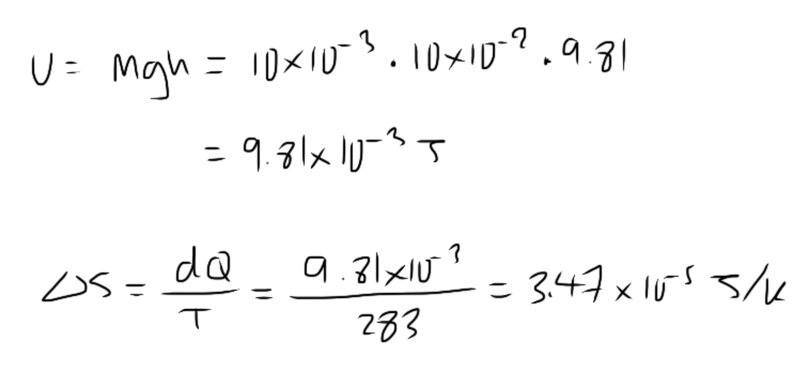
What is the probability that a 10g pencil lying on a table will spring spontaneously 10cm into the air at the expense of thermal energy of its surroundings which are at 15°C. What do you conclude from your result?

I’m guessing I’m supposed to calculate the gravitational potential energy, which comes from the thermal energy of the surroundings, but I’m not sure how that relates to probability. In my course I’ve only been given entropy equations, not sure how it relates to probability
Relevant Equations
dS = dQ/T

U = mgh
I
FCAE2500-1A8C-47E6-81A7-39A96487CD82.jpeg
 
Physics news on Phys.org
What is the difference in how the molecules of the pencil are moving between when it is lying at rest at 15C and when it is springing up in the air?
 
so_gr_lo said:
Homework Statement:: What is the probability that a 10g pencil lying on a table will spring spontaneously 10cm into the air at the expense of thermal energy of its surroundings which are at 15°C. What do you conclude from your result?
Without calculating anything, the immediate answer is 100 percent. If it is permissible, it will happen. Eventually.

Probably the intent is to ask about leaving the system alone for a suitably long time and then inspecting it to see whether the pencil is or is not 10 cm in the air.
 
jbriggs444 said:
Eventually
Unless that exceeds the lifetime of the universe.
 
haruspex said:
What is the difference in how the molecules of the pencil are moving between when it is lying at rest at 15C and when it is springing up in the air?
The molecules have zero velocity at rest but a velocity in the air?
 
so_gr_lo said:
The molecules have zero velocity at rest
Not if the pencil is at 15C.
 
so_gr_lo said:
Homework Statement:: What is the probability that a 10g pencil lying on a table will spring spontaneously 10cm into the air at the expense of thermal energy of its surroundings which are at 15°C. What do you conclude from your result?

I’m guessing I’m supposed to calculate the gravitational potential energy, which comes from the thermal energy of the surroundings, but I’m not sure how that relates to probability. In my course I’ve only been given entropy equations, not sure how it relates to probability
Relevant Equations:: dS = dQ/T

U = mgh

IView attachment 300690
Entropy change is correct. For probability, you need to go back and look up your lecture note/book on energy partition function and Boltzmann factor.
 
These are the equations I have in my notes, are they the ones your referring to?

5667E96D-C603-4872-95E6-EB80C003F49A.jpeg
 

Similar threads

  • · Replies 23 ·
Replies
23
Views
2K
  • · Replies 14 ·
Replies
14
Views
5K
Replies
10
Views
3K
Replies
6
Views
669
Replies
10
Views
2K
  • · Replies 6 ·
Replies
6
Views
3K
  • · Replies 4 ·
Replies
4
Views
2K
  • · Replies 15 ·
Replies
15
Views
4K
  • · Replies 4 ·
Replies
4
Views
2K
  • · Replies 1 ·
Replies
1
Views
2K