Probability fun time: Proof that 1/3=1/2=1/4

Join the discussion
Ask a follow-up here, or get your own question answered by working scientists, mathematicians and engineers — people, not an autocomplete.
Real named experts · corrections over time · the nuance an AI answer skips
2 replies · 1K views
Frabjous
Gold Member
Messages
1,973
Reaction score
2,440
Forgive me, I am not a probability guy, so I am unsure how well known this is. I was trying to figure something out and found this. I found it cool.

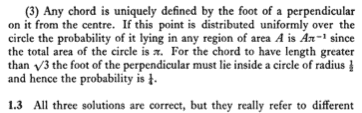
Screen Shot 2021-04-02 at 5.48.46 AM.png
Screen Shot 2021-04-02 at 5.49.32 AM.png


Here's the explanation.

Screen Shot 2021-04-02 at 5.49.48 AM.png

The first solution is a fraction (damn scanner!)

Oops! From Kendall Geometrical Probability (1963)
 
Last edited:
Physics news on Phys.org
The basic idea is reasonably well-known. For example, if we have two concentric circles of radii ##1## and ##2## and we pick a point "at random" in the larger circle, what is the probability it is in the smaller circle?

If we choose Cartesian coordinates uniformly, then the probability is ##1/4##. But, if we choose polar coordinates, then the probability is ##1/2##.