Probability fun time: Proof that 1/3=1/2=1/4

Join the discussion
Registration is free. Ask a follow-up in this thread, or start your own.
2 replies · 1K views · last reply
Frabjous
Gold Member
Messages
1,983
Reaction score
2,457
Forgive me, I am not a probability guy, so I am unsure how well known this is. I was trying to figure something out and found this. I found it cool.

Scanned page of text titled 'The probability measure of geometrical elements', with a circle containing an inscribed equilateral triangle (Fig. 1.1) and text on Bertrand's chord paradox.
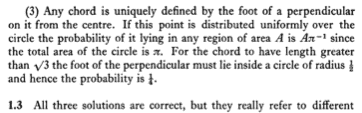
Scanned printed page of a probability solution: item (3) on chords of a circle with area A = πr^{-1}, the chord-length-greater-than-√3 condition, and item 1.3 noting three solutions each refer to different setups.


Here's the explanation.

Printed page of a textbook section on geometrical probability, explaining that the three Bertrand paradox solutions are all correct because they define 'at random' differently, with equations for the joint probability density of theta and p.

The first solution is a fraction (damn scanner!)

Oops! From Kendall Geometrical Probability (1963)
 
Last edited:
Physics news on Phys.org
The basic idea is reasonably well-known. For example, if we have two concentric circles of radii ##1## and ##2## and we pick a point "at random" in the larger circle, what is the probability it is in the smaller circle?

If we choose Cartesian coordinates uniformly, then the probability is ##1/4##. But, if we choose polar coordinates, then the probability is ##1/2##.
 
When you use polar coordinates, the correct was (equal area) is uniform in angle and uniform in ##r^2## (not in ##r##).