Discussion Overview
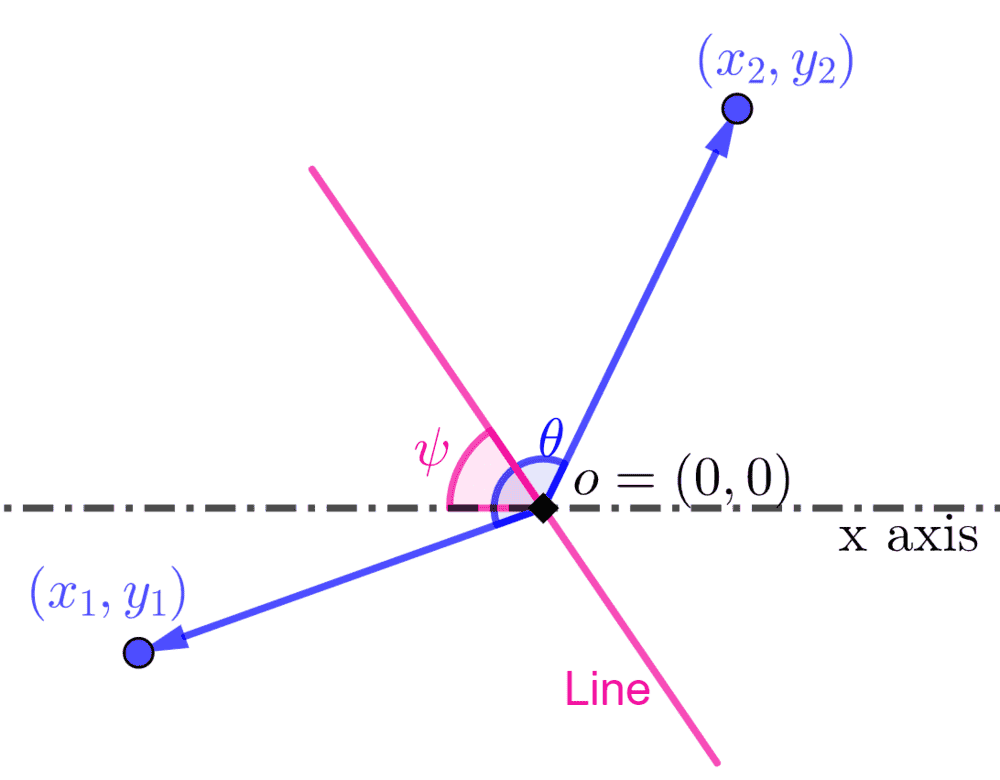
The discussion centers on determining the probability that two points, represented as coordinates, lie on opposite sides of a line that passes through the origin and makes an angle with the x-axis. The angle is uniformly distributed, and participants explore the implications of this setup, including the need for additional information and the conventions used in measuring angles.
Discussion Character
- Exploratory
- Technical explanation
- Debate/contested
- Mathematical reasoning
Main Points Raised
- One participant proposes that the probability of the two points being on opposite sides of the line is given by the ratio of the angle $\theta$ to $\pi$, assuming $\theta$ is fixed.
- Another participant questions the sufficiency of the provided information, suggesting that additional angles or distributions are necessary for a complete analysis.
- Some participants express confusion regarding the notation and conventions used, particularly the clockwise measurement of angles, and suggest adhering to standard practices.
- There is a suggestion that if $\theta$ is uniformly distributed between $0$ and $2\pi$, the points would be on opposite sides of the line half the time.
- A participant indicates that the variable $\rho$ is a dummy variable representing the random variable $\theta$, and expresses uncertainty about the implications of $\theta$ being in the range $(0, 2\pi)$.
- Another participant emphasizes the importance of clearly defining the problem to facilitate progress in the discussion.
Areas of Agreement / Disagreement
Participants express differing views on the sufficiency of the information provided and the conventions for measuring angles. There is no consensus on the correct approach or the implications of the assumptions made regarding the angles.
Contextual Notes
Participants note the potential confusion arising from the notation used and the need for clarity in defining the problem. The discussion reflects varying interpretations of the angle distributions and their implications for the probability calculation.