Problem during finding <x> in p space

  • Level: Undergrad 
  • Thread starter Shell_E
  • Start date
  • Tags Tags
    Space
4 replies · 1K views · last reply
Shell_E
Messages
3
Reaction score
1
Thank you advance for help!

So the problem is find <x> in P space.
The solution's logic is use formula:
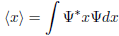
Expectation value of x written as the integral of Psi-star times x times Psi dx, equal to the angle-bracket x angle-bracket expression.
The submit with
Equation: Psi(x, t) = (1 / sqrt(2 pi hbar)) times the integral from minus infinity to infinity of e^(ipx/hbar) Phi(p, t) dp.
Then one will get the integral
Equation for the expectation value of x written as an integral over x of Psi-star times x times Psi, rewritten with Psi expressed as Fourier integrals over p with exponentials e^(-ip'x/h) and e^(+ipx/h) and a factor 1/sqrt(2 pi h).


by noticing that
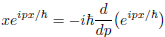
Equation: x e^(ipx/h) = -i h (d/dp)(e^(ipx/h)), with h denoting reduced Planck constant.
, one can replace xeipx/ħ in the integral

so that

Equation: x times the integral of e^(ipx/h) Phi dp equals the integral of (h/i) d/dp applied to e^(ipx/h) times Phi dp, which equals the integral of e^(ipx/h) times [-(h/i) partial Phi(p,t)/partial p] dp.


and then after solving the integral one can find the expectation value for x.

The part I don't understand is why

Equation: integral of (ħ/i)(d/dp)(e^(ipx/ħ)) Φ(p) dp equals integral of e^(ipx/ħ) [-(ħ/i)(∂/∂p)Φ(p,t)] dp.
, firstly I am not sure where is the minus sign comes from. Next I don't think I can just change the order of eipx/ħ and Φ because the term d/dp.

Could anyone help me figure the integral out?

Thank you everybody.
Shell
 
Attachments
  • Equation: <x> = integral of Ψ* x Ψ dx, written in Dirac bra-ket style with the expectation value of x on the left.
    upload_2016-10-18_9-33-44.png
    1.7 KB · Views: 456
  • Equation: angle bracket x angle bracket equals the integral of Psi-star times x times Psi, dx.
    upload_2016-10-18_9-33-58.png
    1.4 KB · Views: 478
I think that integration by parts comes into this one.
 
  • Like
Likes   Reactions: Shell_E and DrClaude
It comes about because momentum is a Hermitian operator: http://www.colby.edu/chemistry/PChem/notes/MomentumHermitian.pdf
 
  • Like
Likes   Reactions: Shell_E
@Jilang @DrClaude Thank you for help! I mislead by the integral sign to think it gained by doing some rearrangement inside the integral. Everything become clear if I do integral by part and use the fact that momentum operator is hermitian. Thanks a lot!
 
The tacit assumption is that any wave function decreases at infinity slower than any polynomial, thus can be safely assumed to be a Schwartz test function. The Schwartz space is invariant under the Fourier transform and provides a domain of essential self-adjointness for the momentum operator over the entire real line.
Because of this explanation, you can use partial integration in the improper definite integral and discard the so-called "surface term" (a misnomer, because we're in 1D).
 
Last edited:
  • Like
Likes   Reactions: vanhees71