[Problem] Elastic potential energy

Click For Summary

Homework Help Overview

The discussion revolves around a physics assignment related to elastic potential energy, specifically focusing on a contraption powered by rubber bands. The original poster describes their setup, which involves using rubber bands in series to launch a weight, and seeks to understand the potential energy involved in the system.

Discussion Character

  • Exploratory, Assumption checking, Conceptual clarification

Approaches and Questions Raised

  • The original poster attempts to calculate the spring constant and potential energy of their setup, expressing skepticism about their results. Participants question the implications of using rubber bands in series and how it affects the spring constant and energy transfer. There are discussions about friction and its impact on performance.

Discussion Status

Participants have provided feedback on the calculations and raised further questions about the setup. There is an ongoing exploration of how the arrangement of rubber bands influences energy storage and transfer, as well as considerations of friction and acceleration. The original poster has conducted experiments and shared results, indicating a productive exchange of ideas.

Contextual Notes

The assignment constraints include a limit of 6 Joules of potential energy, and there are specific rules regarding the use of gravitational acceleration in calculations. The original poster has also noted the time constraints related to the assignment.

AmirT
Messages
4
Reaction score
0
Hi, I'm a second year Design Engineering student. This year we're having some basic physics class. We're doing projects on potential energy at this moment. I'm having a problem with the following;

The assignment:

The teacher assigned us that only 6 Joules of potential energy may be used to make a contraption move as far as possible, this can be anything, a car, a paper plane, etc..

1. Homework Statement


I connected 5 rubber bands in series with on one side a weight (15 grams), on the other side some duct tape.
The duct tape sticks to the ground while the weight is being tentioned. I let loose of the weight and the whole contraption (including rubber bands and duct tape) shoots away.

I need to get to know the potential energy of a shot.

Homework Equations


[/B]
I calculated the spring constant by hanging a bottle of with water (545 grams) to the rubber bands in series, the rubber bands stretched out 25cm (50cm - 25cm)
F= kx
k= F/x
k= 5,5N/0,25
k= 22Nm

The Attempt at a Solution


[/B]
Then I calculated the PE. This is my ACTUAL PROBLEM, I'm very sceptic about this one because it's seems too little.. (I'm not the best with physics or maths)

PE= 1/2*k*x²
PE= 0,5*22Nm*(0.25m)²

PE= 0,6875 J

A picture of the setup
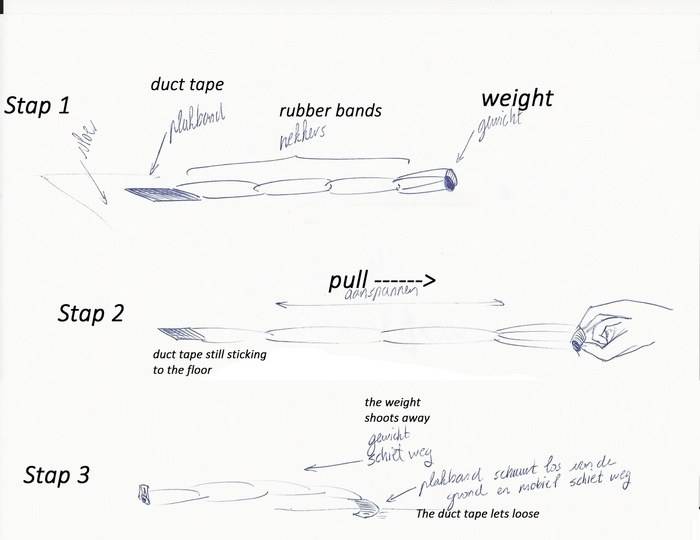
14l6olk.jpg
Is this a realistic/plausible result?

Am I doing this right?

The rubber bands I'm using are the typical office rubber bands.
It would be nice if someone could help me out with this one.Thank you.
 
Last edited:
Physics news on Phys.org
Where you wrote Nm for the spring constant units, you mean N/m. Other than that, your working looks correct. The result is reasonable. In descending 0.25m the bottle lost a bit over 1J of gravitational PE. If allowed to fall freely it would have had some KE at the equilibrium point, so the PE in the elastic at that point must be less than 1J (in fact, half the lost gravitational PE).
 
haruspex said:
Where you wrote Nm for the spring constant units, you mean N/m. Other than that, your working looks correct. The result is reasonable. In descending 0.25m the bottle lost a bit over 1J of gravitational PE. If allowed to fall freely it would have had some KE at the equilibrium point, so the PE in the elastic at that point must be less than 1J (in fact, half the lost gravitational PE).

Hi,

Thanks for your answer, I really appreciate it!Another thing popped up in my head now.
Does the fact that the rubber bands are in series makes any difference?

I'm also wondering if there's any way to calculate the the best ratio of maximum travel distance and amount of rubber bands?
Adding more bands gives the contraption more power, but also adds lots of friction.

Perhaps I should stay with 5 ~ 7 bands and stretch it as far as I can?

Thank you
 
AmirT said:
Does the fact that the rubber bands are in series makes any difference?
It affects the spring constant. You should be able to work out in what way.
AmirT said:
Adding more bands gives the contraption more power, but also adds lots of friction
It doesn't simply store more energy. It also affects the rate at which the energy is transferred to the projectile and the distance over which it happens.
Do you think the same total energy is transferred from a given amount of energy stored by one band or N bands?
Explain a bit more your thoughts on how it affects frictional losses.
 
haruspex said:
It affects the spring constant. You should be able to work out in what way.

It doesn't simply store more energy. It also affects the rate at which the energy is transferred to the projectile and the distance over which it happens.
Do you think the same total energy is transferred from a given amount of energy stored by one band or N bands?
Explain a bit more your thoughts on how it affects frictional losses.

Hi,

You have very good points there!
I didn't thought about that..

Isn't the serie of rubber bands acts as one big band?
Did I made a mistake when calculating the spring constant with a bottle of water?

About the friction;

I had this feeling that if there's more loose material, there's more friction.
 
AmirT said:
Isn't the serie of rubber bands acts as one big band?
Yes, but the spring constant changes. If I put two springs of constant k in series and apply a tension T, what will the total extension be? What does that make the spring constant for the combination?
AmirT said:
Did I made a mistake when calculating the spring constant with a bottle of water?
No, it was about right, though it could be a little more accurate. I guess you took g = 10ms-2, not 9.8. Keep at least 3 significant figures through the working.
AmirT said:
About the friction;

I had this feeling that if there's more loose material, there's more friction.
That's possible - not sure. How will you prevent the object from snagging on the bands ahead of it?
Some things to think about:
When the object loses contact with the elastic bands, you want as much of the energy as possible in the KE of the object. Where else will there be energy?
More bands means a slower but longer acceleration. How will that affect losses due to drag?

Do you have the opportunity to experiment?
 
haruspex said:
Yes, but the spring constant changes. If I put two springs of constant k in series and apply a tension T, what will the total extension be? What does that make the spring constant for the combination?

No, it was about right, though it could be a little more accurate. I guess you took g = 10ms-2, not 9.8. Keep at least 3 significant figures through the working.

That's possible - not sure. How will you prevent the object from snagging on the bands ahead of it?
Some things to think about:
When the object loses contact with the elastic bands, you want as much of the energy as possible in the KE of the object. Where else will there be energy?
More bands means a slower but longer acceleration. How will that affect losses due to drag?

Do you have the opportunity to experiment?

I took g=10ms because the docent told us that we "have" to use it. At high school I've learned it's 9,81 but for some reason we may just use 10.

Today I've had the chance to experiment at school before the lesson began (my hall at home is not long enough). This assignment was due today (we had to work it out in the weekend).

I was able to shoot this contraption about 25m (?) which surprised me, as well as the others. The other students made cars with mousetrap or weights. 90% didn't even get the half of my distance for some reason (a lot more weight + friction)

I've also seen that at the beginning of the movement, the weight flew in the air for a bit and made the bands fly along. So there was not much friction, although it landed almost halfway and deaccelerated from then.

All in all the teacher said it was okay!

I've did look up some information regarding the rubber bands in series. There was this article saying that you have to calculate this in a simillar manner as you would do with resistors in a electrical circuit.

All in all, thank you very much for your replies! I really do appreciate it!
 

Similar threads

Replies
16
Views
4K
  • · Replies 16 ·
Replies
16
Views
7K
  • · Replies 12 ·
Replies
12
Views
3K
  • · Replies 4 ·
Replies
4
Views
3K
  • · Replies 5 ·
Replies
5
Views
2K
  • · Replies 2 ·
Replies
2
Views
2K
Replies
9
Views
6K
  • · Replies 4 ·
Replies
4
Views
5K
  • · Replies 3 ·
Replies
3
Views
9K
  • · Replies 1 ·
Replies
1
Views
10K