Problem in finding the radius of convergence of a series

Click For Summary
The discussion focuses on determining the radius of convergence for a series, specifically addressing why 2^(n/2) is little o of 3^(n/3). It is established that 2^(n/2) grows slower than 3^(n/3) as n approaches infinity, supported by the comparison of their exponential forms. The ratio k, defined as 2^(1/2)/3^(1/3), is shown to be less than 1, reinforcing the conclusion. As n increases, the term [1 + k^n + n^7/3^(n/3)]^(1/n) approaches 1. The explanation is well-received, indicating clarity in the reasoning presented.
Amaelle
Messages
309
Reaction score
54
Homework Statement
look at the image
Relevant Equations
asymptotic behaviour, raduis of convergence
Good day
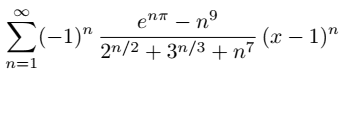
1612550922783.png

I'm trying to find the radius of this serie, and here is the solution
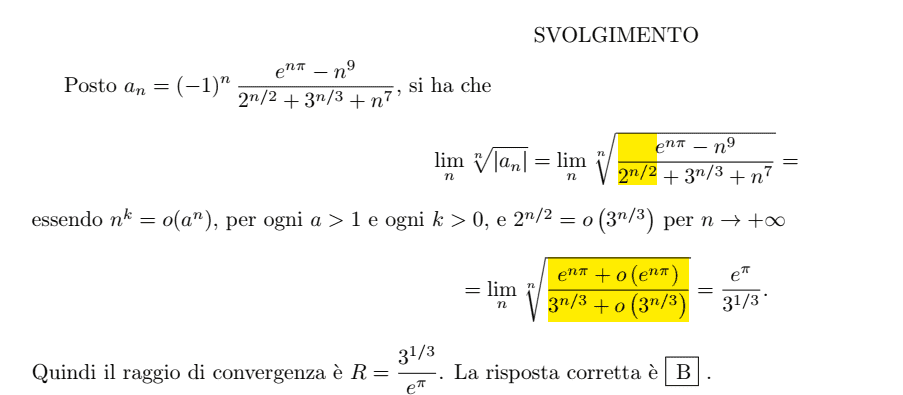
1612551034715.png

I just have problem understanding why 2^(n/2) is little o of 3^(n/3) ?

many thanks in advance

Best regards!
 
Physics news on Phys.org
Amaelle said:
why 2^(n/2) is little o of 3^(n/3)
$$2^{n/2}= 1.4142^n \qquad 3^{n/3}= 1.4442^n \quad \Rightarrow \quad 2^{n/2} < 3^{n/3}$$
 
  • Like
  • Love
Likes jim mcnamara and Amaelle
[2^{n/2}+3^{n/3}+n^7]^{1/n}=3^{1/3}[1+k^n+\frac{n^7}{3^{n/3}}]^{1/n}
where
k=\frac{2^{1/2}}{3^{1/3}}
k^6=\frac{8}{9}&lt;1
so k<1. As n##\rightarrow +\infty##
[1+k^n+\frac{n^7}{3^{n/3}}]^{1/n} \rightarrow 1
 
Last edited:
anuttarasammyak said:
[2^{n/2}+3^{n/3}+n^7]^{1/n}=3^{1/3}[1+k^n+\frac{n^7}{3^{n/3}}]^{1/n}
where
k=\frac{2^{1/2}}{3^{1/3}}
k^6=\frac{8}{9}&lt;1
so k<1. As n##\rightarrow +\infty##
[1+k^n+\frac{n^7}{3^{n/3}}]^{1/n} \rightarrow 1
So beautifully explained!, thanks a million!
 
BvU said:
$$2^{n/2}= 1.4142^n \qquad 3^{n/3}= 1.4442^n \quad \Rightarrow \quad 2^{n/2} < 3^{n/3}$$
Nice shot! thanks a million!
 
Last edited by a moderator:
Question: A clock's minute hand has length 4 and its hour hand has length 3. What is the distance between the tips at the moment when it is increasing most rapidly?(Putnam Exam Question) Answer: Making assumption that both the hands moves at constant angular velocities, the answer is ## \sqrt{7} .## But don't you think this assumption is somewhat doubtful and wrong?

Similar threads

  • · Replies 2 ·
Replies
2
Views
2K
  • · Replies 10 ·
Replies
10
Views
2K
  • · Replies 3 ·
Replies
3
Views
1K
Replies
7
Views
2K
  • · Replies 7 ·
Replies
7
Views
2K
Replies
7
Views
2K
Replies
8
Views
2K
  • · Replies 5 ·
Replies
5
Views
2K
  • · Replies 4 ·
Replies
4
Views
2K
  • · Replies 14 ·
Replies
14
Views
2K