Astraithious
- 20
- 0
first of all thanks for reading and especially thank you to people who helped with my previous question here https://www.physicsforums.com/threa...on-change-with-the-angle.798572/#post-5019349
Unfortunately i am having more problems with this instructor insisting she is right and refusing to elaborate so i am here again to ask how her solution here is correct
Example #4:
A bobsled goes into a turn (r=25m) with an banked angle of 40 degrees. Assuming no friction (pretty good assumption), a) what is the velocity of the bobslead b) what happens if the bobsled comes into the same turn above this speed? c) what happens if the bobsled comes into the same turn below this speed?
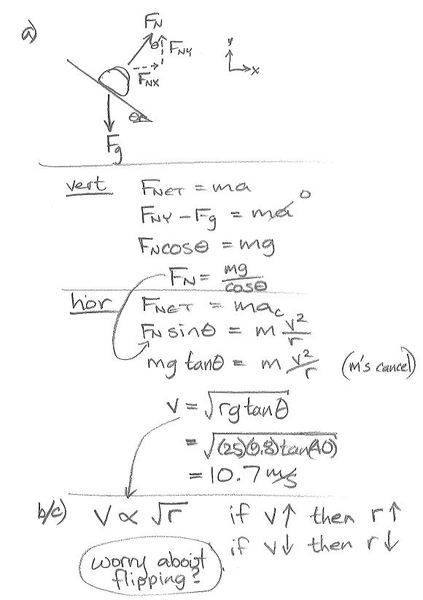
F=ma
centripetal acceleration = v2/R
Force of static friction = µs * N
I have found through another diagram
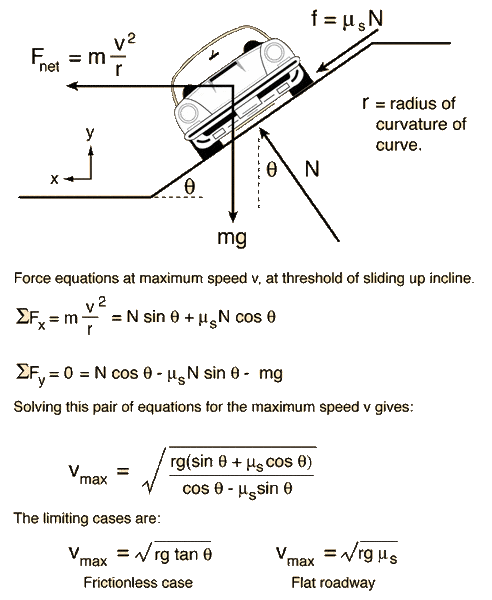
however i am unfamiliar with how to get
that vmax from the x and y and would love some help there deriving it.
either way though using that vmax for frictionless i get 14.3ms. I think the answer she gets is just not using the right order of operations
Unfortunately i am having more problems with this instructor insisting she is right and refusing to elaborate so i am here again to ask how her solution here is correct
Example #4:
A bobsled goes into a turn (r=25m) with an banked angle of 40 degrees. Assuming no friction (pretty good assumption), a) what is the velocity of the bobslead b) what happens if the bobsled comes into the same turn above this speed? c) what happens if the bobsled comes into the same turn below this speed?
Homework Equations
F=ma
centripetal acceleration = v2/R
Force of static friction = µs * N
The Attempt at a Solution
I have found through another diagram
however i am unfamiliar with how to get
that vmax from the x and y and would love some help there deriving it.
either way though using that vmax for frictionless i get 14.3ms. I think the answer she gets is just not using the right order of operations