Nal
- 4
- 0
EDIT: The question has been answered, and I don't need help anymore. Thanks a lot everybody!
Hi. This is something that has been puzzling me for a while, probably just due to my own stupidity. It seems to me that this should be really simple, but I don't know what I'm doing wrong though, so now I'm putting it out here.
Imagine an object with a mass of 1 kg being accelerated at a rate of 1 m/s^2 over 10 seconds.
We can then calculate the force being applied to the object
F=1*1=1 N
We can also calculate how far the object has moved over these 10 seconds
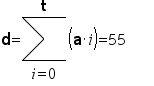
According to Wikipedia, the work (W) is the product of a force times the distance through which is acts, measured in Joules, so
W=F*d=m*a*d=55 J
The velocity v at which the object moves is t*a=10 m/s
Then we can calculate the kinetic energy E
E=0.5*m*v^2=50 J
But shouldn't E and W be the same?
For example, if we take the object, now with the kinetic energy E and make it go up a hill on a planet where the gravitational acceleration is 1 1m/s^2 (which is =a from before, of course) we will convert the kinetic energy to potential energy, and we can calculate how far up the hill the object will go, as E(kin)+E(pot) is constant
0.5*m*v^2=m*a*h
0.5*1*10^2=1*1*h
h=50 m
But shouldn't h be 55 metres, as that was the distance the object moved when we accelerated it?
I hope you understood what I meant, I'm absolutely horrible at explaining my thoughts.
Thanks in advance! :)
Hi. This is something that has been puzzling me for a while, probably just due to my own stupidity. It seems to me that this should be really simple, but I don't know what I'm doing wrong though, so now I'm putting it out here.
Imagine an object with a mass of 1 kg being accelerated at a rate of 1 m/s^2 over 10 seconds.
We can then calculate the force being applied to the object
F=1*1=1 N
We can also calculate how far the object has moved over these 10 seconds
According to Wikipedia, the work (W) is the product of a force times the distance through which is acts, measured in Joules, so
W=F*d=m*a*d=55 J
The velocity v at which the object moves is t*a=10 m/s
Then we can calculate the kinetic energy E
E=0.5*m*v^2=50 J
But shouldn't E and W be the same?
For example, if we take the object, now with the kinetic energy E and make it go up a hill on a planet where the gravitational acceleration is 1 1m/s^2 (which is =a from before, of course) we will convert the kinetic energy to potential energy, and we can calculate how far up the hill the object will go, as E(kin)+E(pot) is constant
0.5*m*v^2=m*a*h
0.5*1*10^2=1*1*h
h=50 m
But shouldn't h be 55 metres, as that was the distance the object moved when we accelerated it?
I hope you understood what I meant, I'm absolutely horrible at explaining my thoughts.
Thanks in advance! :)
Last edited: