Produce a resonance curve for this circuit between 6 kHz and 10 kHz

  • Context: Engineering 
  • Thread starter Thread starter leejohnson222
  • Start date Start date
  • Tags Tags
    Circuit Curve Resonance
Click For Summary

Discussion Overview

The discussion revolves around producing a resonance curve for a specific circuit within the frequency range of 6 kHz to 10 kHz. Participants explore methods for obtaining this curve, including AC sweeps and circuit simulations.

Discussion Character

  • Exploratory, Technical explanation, Debate/contested, Experimental/applied

Main Points Raised

  • One participant shares their initial attempt at creating a resonance curve but expresses uncertainty about the process.
  • Another participant inquires about the voltage measurement and the location of the ground node in the circuit.
  • A participant mentions measuring 20V at 5 kHz and questions whether they should focus on current measurements instead.
  • Concerns are raised about the magnitude scale of the resonance curve, with one participant stating that at resonance, the current should be calculated as ##I = V1/R1## due to the cancellation of complex impedances.
  • There is a discussion about the expected peaking at resonance, with a participant correcting themselves regarding the interpretation of the plot and suggesting familiarity with a log(f) scale for clarity.
  • Another participant suggests that plotting the magnitude of impedance Z could enhance understanding of the circuit's behavior at resonance and proposes experimenting with different LRC values in parallel.
  • One participant expresses a desire to download LTSPICE for circuit simulations but mentions difficulties with installation.
  • A later reply endorses LTSPICE as a popular tool but notes that various simulators should yield similar results for basic circuits, emphasizing that foundational knowledge is often gained from textbooks rather than simulations.

Areas of Agreement / Disagreement

Participants express differing views on the best approach to obtain the resonance curve and the interpretation of simulation results. There is no consensus on the specific methods or tools to use, and the discussion remains unresolved regarding the optimal way to analyze the circuit.

Contextual Notes

Participants mention potential limitations related to the accuracy of the magnitude scale and the interpretation of resonance behavior, but these issues remain unresolved.
leejohnson222
Messages
76
Reaction score
6
Homework Statement
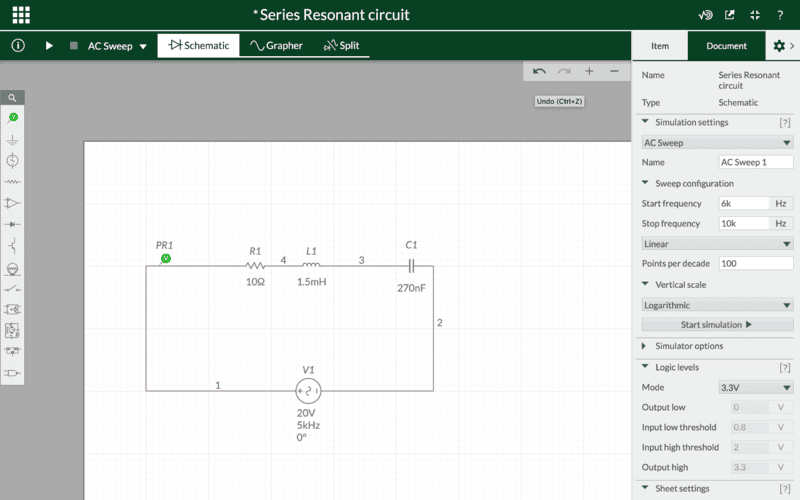
circuit is as follows
Relevant Equations
series circuit
Voltage 20V 5khz - R10 ohms Inductor 1.5mh Capacitor = 270 nF
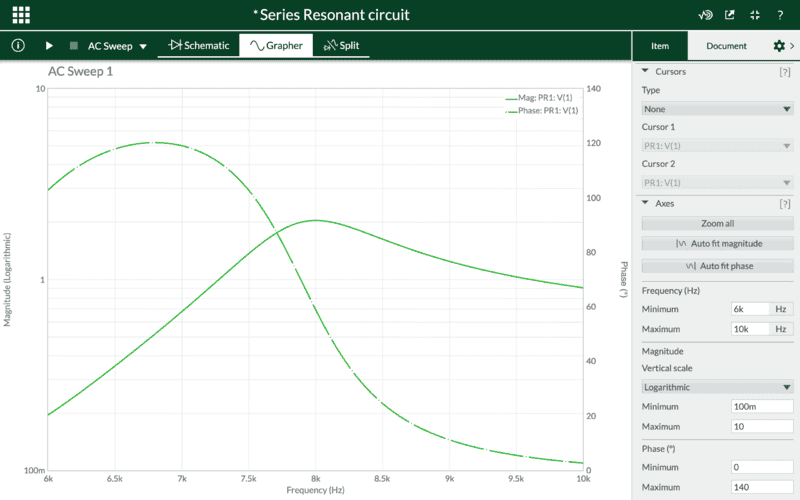
this is what i created so far, but not quite sure how to get the resonance curve, i tried to enter it in settings and do an AC sweep
Screenshot 2023-10-04 at 11.35.04.png
6k 10k resonance.png
 
Physics news on Phys.org
What voltage are you measuring? Where is the ground node?
 
20V 5khz, should i be looking at the current ?
Resonant 1.png
resonant sweep 1.png
 
I don't know what you are supposed to do. Your supposed to tell us.

But, that looks good to me. Except somethings wrong with the magnitude scale. At resonance the current should be ##I = V1/R1##. This is because at resonance the complex impedances of the reactive components will cancel each other and sum to zero. Does your voltage source have any impedance built in?

The phase looks good though, so it's something about the plot scale, I think.

edit: Oops! No sorry. There is something wrong with the magnitude. With Q=7.5 you should have more peaking at resonance. The asymptotes should intersect about 7.5x lower than the current peak at resonance.

edit#2: Never mind the peaking bit. I misread the plot. I'm more familiar with a log(f) scale which will show the linear asymptotes more clearly.
 
Last edited:
The same circuit as simulated by LTSPICE. The magnitude, in dB, is of the current in the series circuit.
1696449917732.png

1696449932010.png
 
  • Like
Likes   Reactions: DaveE
I would imagine plotting magnitude of impedance Z would be a valuable learning experience :) what does L and C do at the resonant frequency, and impedance should you see when that happens?

If you had time and wanted to explore, then I would put another pair of these in parallel to it with a different set of LRC something like 500 uH, 100 Ohm, and... 561 nF just to see what happens. I think that would be fun.
 
i think i need to download LT spice and try to run some circuits, been struggling to install it for some reason
 
LT Spice is quite good and, I would guess, the most popular on-line Spice tool. But Spice has been around for a really long time, and for basic circuits like this they are all going to give you a good answer. Whatever that green one you used in previous posts is probably fine for this. So, go for it, if you like, but don't expect that a different simulator is going to clear anything up.

Honestly, most EEs that I know learned this stuff from a physics or EE text book, not a simulator. Simulators are good at giving answers, but are usually not good for teaching concepts.
 
  • Like
Likes   Reactions: berkeman

Similar threads

  • · Replies 38 ·
2
Replies
38
Views
5K
  • · Replies 3 ·
Replies
3
Views
2K
  • · Replies 6 ·
Replies
6
Views
4K
Replies
4
Views
3K
Replies
9
Views
3K
  • · Replies 8 ·
Replies
8
Views
1K
  • · Replies 4 ·
Replies
4
Views
2K
  • · Replies 17 ·
Replies
17
Views
2K
Replies
34
Views
4K
  • · Replies 7 ·
Replies
7
Views
2K