Projectile Motion on the Moon: Finding the Optimal Launch Angle Using Equations

Click For Summary
The discussion centers on determining the optimal launch angle for a cannon on the Moon to achieve maximum distance. It is suggested that the ideal angle is π/4, but if the projectile exceeds the Moon's escape velocity, an angle of π/2 could theoretically yield maximum distance. However, exceeding escape velocity complicates the situation, as the projectile would not return, making traditional distance calculations irrelevant. Participants emphasize the importance of understanding the underlying assumptions of projectile motion equations, particularly in varying gravitational conditions. The conversation highlights the need for mathematical backing rather than assumptions in solving physics problems.
Jonathan martin
Messages
1
Reaction score
0

Homework Statement


A cannon can shoot whatever cannons shoot at different angles to the horizon, but with the same initial velocity. At what angle does the cannon shoot to a maximal distance? What would be that angle on the moon?

Homework Equations
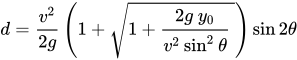

6cdb6b0652addd09d3b722bfb7e107dff0f1364a

  • d is the total horizontal distance traveled by the projectile.
  • v is the velocity at which the projectile is launched
  • g is the gravity
  • θ is the angle at which the projectile is launched
  • y0 is the initial height of the projectile

The Attempt at a Solution


The maximum angle would be pi/4 (I am assuming), however if the projectile velocity was great enough to break the moon's escape velocity then the maximum distance could be given at an angle of pi/2. Thoughts?
 
Physics news on Phys.org
Jonathan martin said:
The maximum angle would be pi/4 (I am assuming),
You cannot go around just assuming things. You need to do the math to back it up.

If you exceed the escape velocity the constant gravitational field will be a very bad approximation. Furthermore the object will not come down so it would be irrelevant to talk about the ”length” ofa shot.
 
The maximum range formula makes certain assumptions about its area of applicability (as do several other commonly employed physics formulas involving motion and energy) Do you know what the assumptions are?

Jonathan martin said:
...if the projectile velocity was great enough to break the moon's escape velocity then the maximum distance could be given at an angle of pi/2. Thoughts?
Yes that's certainly true. How does this notion tie in with the assumptions alluded to above?
 
The book claims the answer is that all the magnitudes are the same because "the gravitational force on the penguin is the same". I'm having trouble understanding this. I thought the buoyant force was equal to the weight of the fluid displaced. Weight depends on mass which depends on density. Therefore, due to the differing densities the buoyant force will be different in each case? Is this incorrect?

Similar threads

  • · Replies 7 ·
Replies
7
Views
3K
  • · Replies 11 ·
Replies
11
Views
2K
  • · Replies 4 ·
Replies
4
Views
3K
  • · Replies 15 ·
Replies
15
Views
2K
  • · Replies 3 ·
Replies
3
Views
1K
  • · Replies 15 ·
Replies
15
Views
26K
  • · Replies 3 ·
Replies
3
Views
4K
Replies
5
Views
2K
Replies
1
Views
3K
  • · Replies 3 ·
Replies
3
Views
2K