Projectile motion Q3 (A)

  • Thread starter Thread starter Aaron Curran
  • Start date Start date
  • Tags Tags
    Projectiles
Join the discussion
Registration is free. Ask a follow-up in this thread, or start your own.
6 replies · 2K views
Aaron Curran
Messages
33
Reaction score
0
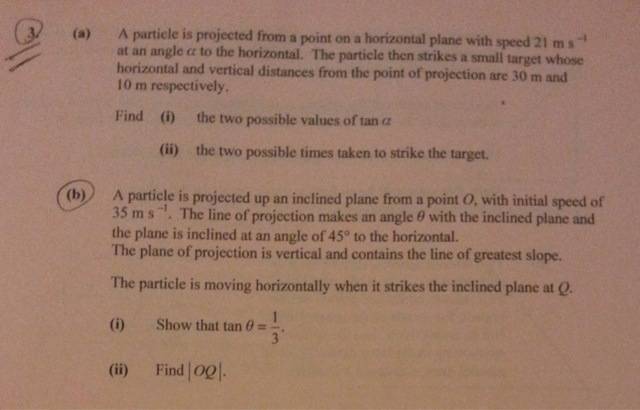
Here is the problem (Q3 (A));
ImageUploadedByPhysics Forums1423676612.394766.jpg


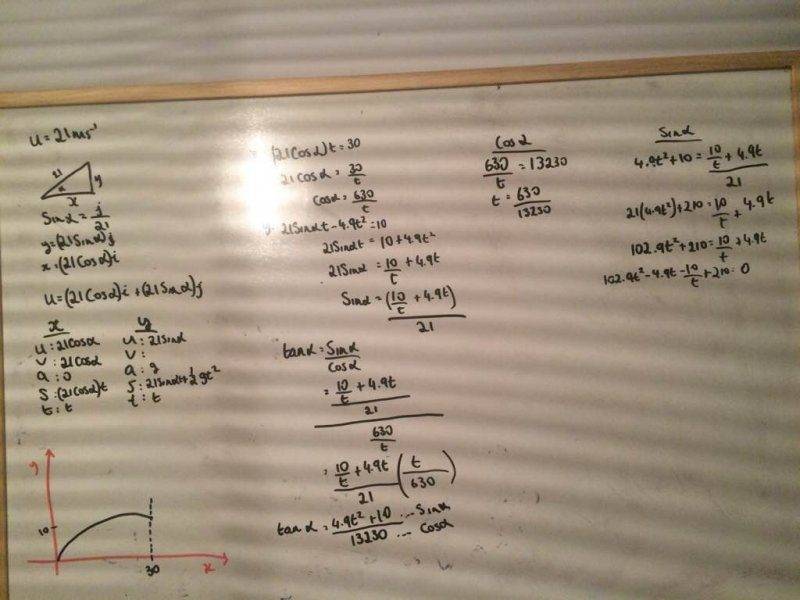
Here's what I have so far;
ImageUploadedByPhysics Forums1423676690.906861.jpg


Any help would be appreciated, thank you!
 
Physics news on Phys.org
It appears you made an algebra error when you went from ## 21 \cos \alpha = \frac {30}{ t} ## to ## \cos \alpha = \frac {630}{ t} ##.
Also, I would first find your time of impact based on your horizontal component.
With that time of impact, you can make an expression that is in terms of alpha only.
 
RUber said:
It appears you made an algebra error when you went from ## 21 \cos \alpha = \frac {30}{ t} ## to ## \cos \alpha = \frac {630}{ t} ##.
Also, I would first find your time of impact based on your horizontal component.
With that time of impact, you can make an expression that is in terms of alpha only.

Yes I realized this after I posted, I'll try that, thanks!
 
I made a substition of x = cos^2(alpha) and manipulated it into a quadratic equation to get the two solutions.
part b comes right out of part a if you have already solved for time of impact.
 
Aaron,

Something else to note: If you have the expression ##\tan \alpha = \frac{A}{B}##, then you cannot conclude that ##\sin \alpha = A## and ##\cos \alpha = B##.
 
RUber said:
I made a substition of x = cos^2(alpha) and manipulated it into a quadratic equation to get the two solutions.
part b comes right out of part a if you have already solved for time of impact.

Could you elaborate on this a bit? Not quite sure what you mean..
 
Do you have an expression that can be written as some trig functions of alpha = 0?
Use sin = sqrt(1-cos^2) to convert everything in terms of cos.