MHB Proof of Apostol's Definition 3.2 and Theorem 3.3: Help Appreciated

Click For Summary
The discussion revolves around proving the reverse triangle inequality, specifically the statement that |‖x‖ - ‖y‖| ≤ ‖x - y‖, as noted in Apostol's "Mathematical Analysis." Participants provide hints for a formal proof, suggesting the use of the triangle inequality and establishing lower bounds for both ‖x - y‖ and ‖y - x‖. The conversation emphasizes the importance of understanding the relationship between the norms and the differences of the vectors involved. The proof approach involves rewriting the norms and applying the triangle inequality effectively. Overall, the thread serves as a collaborative effort to clarify and validate the mathematical concept.
Math Amateur
Gold Member
MHB
Messages
3,920
Reaction score
48
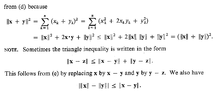
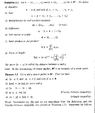
I am reading Tom M Apostol's book "Mathematical Analysis" (Second Edition) ...I am focuses on Chapter 3: Elements of Point Set Topology ... I need help regarding a remark of Apostol's made after Definition 3.2 and Theorem 3.3 ...Definition 3.2 and Theorem 3.3 read as follows:
View attachment 8477
View attachment 8478
In a note at the end of the proof of parts of Theorem 3.3 we read the following:

"... ... We also have

$$\mid \ \parallel x \parallel - \parallel y \parallel \ \mid \ \leq \ \parallel x - y \parallel$$ ... Could someone please show me how top formally and rigorously prove that ...$$\mid \ \parallel x \parallel - \parallel y \parallel \ \mid \ \leq \ \parallel x - y \parallel$$ ...

Help will be appreciated ...

Peter
 

Attachments

  • Apostol - 1 - Definition 3.2 and Theorem 3.3 ... PART 1 ....png
    Apostol - 1 - Definition 3.2 and Theorem 3.3 ... PART 1 ....png
    18.6 KB · Views: 134
  • Apostol - 2 - Definition 3.2 and Theorem 3.3 ... PART 2 .....png
    Apostol - 2 - Definition 3.2 and Theorem 3.3 ... PART 2 .....png
    5.8 KB · Views: 141
Physics news on Phys.org
Hi Peter,

Peter said:
Could someone please show me how top formally and rigorously prove that ...
$$\mid \ \parallel x \parallel - \parallel y \parallel \ \mid \ \leq \ \parallel x - y \parallel$$ ...

Here are a few hints:
  1. Write $\|x\| = \|x-y +y\|.$
  2. Use the triangle inequality.
  3. Obtain a lower bound for $\|x-y\|$.
  4. Repeat the above with $\|y\|,$ obtaining a lower bound for $\|y-x\| = \|x-y\|.$
  5. Note that the two lower bounds differ by a negative sign only.
  6. Conclude that ${\large |}\|x\| - \|y\|{\large|}\leq \|x-y\|$ since $${\large |}\|x\|-\|y\|{\large |}=\begin{cases}\|x\|-\|y\| & \|x\|\geq \|y\|\\ \|y\| - \|x\| & \|y\|\geq \|x\|. \end{cases}$$
Let me know if anything is still unclear.
 
You are right to ask this question. It is called the "reverse triangle inequality". You can try to prove it yourself by using the ordinary triangle inequality to estimate both $\|x\| = \|(x - y) + y\|$ and $\|y\| = \|(y - x) + x\|$.

EDIT: Sorry, I did not see the reply by GJA and the system did not warn me when I submitted mine.
 
GJA said:
Hi Peter,
Here are a few hints:
  1. Write $\|x\| = \|x-y +y\|.$
  2. Use the triangle inequality.
  3. Obtain a lower bound for $\|x-y\|$.
  4. Repeat the above with $\|y\|,$ obtaining a lower bound for $\|y-x\| = \|x-y\|.$
  5. Note that the two lower bounds differ by a negative sign only.
  6. Conclude that ${\large |}\|x\| - \|y\|{\large|}\leq \|x-y\|$ since $${\large |}\|x\|-\|y\|{\large |}=\begin{cases}\|x\|-\|y\| & \|x\|\geq \|y\|\\ \|y\| - \|x\| & \|y\|\geq \|x\|. \end{cases}$$
Let me know if anything is still unclear.
Thanks GJA ...

Working through your post ...

Appreciate your help...

Peter
 
Janssens said:
You are right to ask this question. It is called the "reverse triangle inequality". You can try to prove it yourself by using the ordinary triangle inequality to estimate both $\|x\| = \|(x - y) + y\|$ and $\|y\| = \|(y - x) + x\|$.

EDIT: Sorry, I did not see the reply by GJA and the system did not warn me when I submitted mine.
Thanks for the guidance and help, Janssens

Peter
 
We all know the definition of n-dimensional topological manifold uses open sets and homeomorphisms onto the image as open set in ##\mathbb R^n##. It should be possible to reformulate the definition of n-dimensional topological manifold using closed sets on the manifold's topology and on ##\mathbb R^n## ? I'm positive for this. Perhaps the definition of smooth manifold would be problematic, though.

Similar threads

  • · Replies 2 ·
Replies
2
Views
4K
Replies
2
Views
2K
  • · Replies 2 ·
Replies
2
Views
2K
  • · Replies 2 ·
Replies
2
Views
2K
  • · Replies 2 ·
Replies
2
Views
3K
Replies
3
Views
2K
  • · Replies 2 ·
Replies
2
Views
2K
  • · Replies 4 ·
Replies
4
Views
2K
  • · Replies 2 ·
Replies
2
Views
2K
  • · Replies 3 ·
Replies
3
Views
2K