Undergrad Proof of Commutator Operator Identity

Click For Summary
The discussion centers on proving a commutator operator identity relevant to the harmonic oscillator in quantum mechanics. A recommendation is made to use mathematical induction, specifically to prove two simpler statements involving the commutators of the operators. Participants emphasize the importance of posting work directly in the forum instead of images and provide links for assistance with LaTeX formatting. The conversation includes a detailed explanation of how the commutator operates on smooth functions, demonstrating its application in the context of quantum mechanics. Overall, the thread seeks collaborative input to complete the proof effectively.
Peter Yu
Messages
19
Reaction score
1
TL;DR
Proof of Commutator Operator Identity used in Harmonic Oscillator of Quantum Mechanics
Hi All,
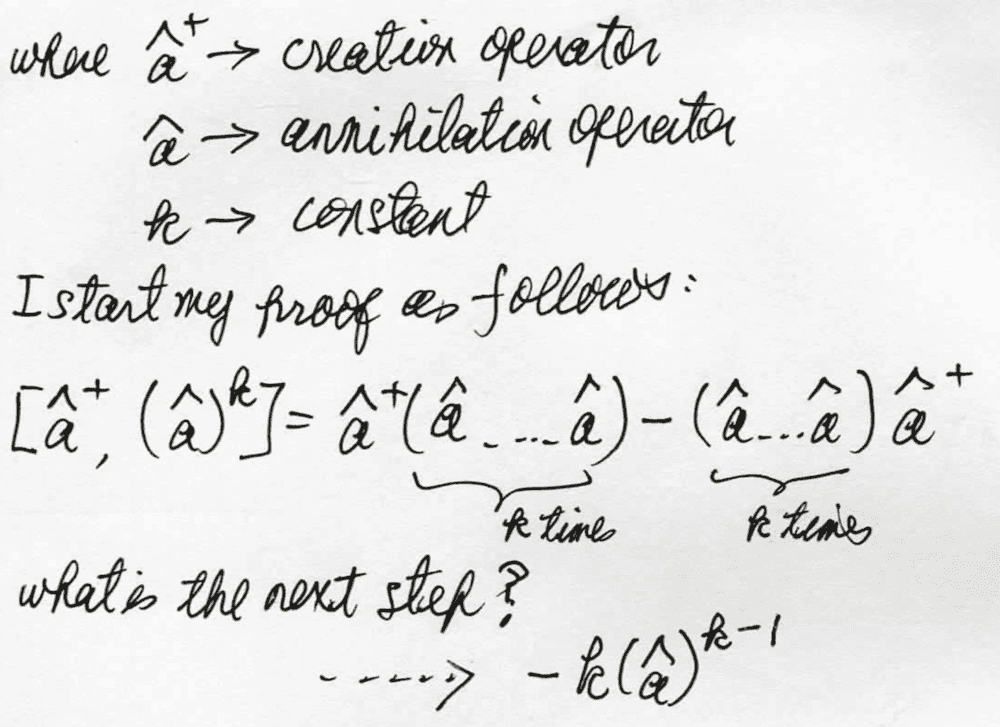
I try to prove the following commutator operator Identity used in Harmonic Oscillator of Quantum Mechanics. In the process, I do not know how to proceed forward. I need help to complete my proof.
Many Thanks.

1583139943257.png


1583139999911.png
 

Attachments

  • 1583140001145.png
    1583140001145.png
    131.4 KB · Views: 261
Physics news on Phys.org
Well, If ##k## is a natural number (which seems to be an asumtion in your proof) I would recommend you to use mathematical induction.
 
  • Like
Likes vanhees71
Thank you for your response.
Can you enlighten me on the approach.
 
Do you know what mathematical induction is?
 
Sorry I do not know. Can you give me some hints.
 
Peter Yu said:
Sorry I do not know. Can you give me some hints.
https://en.wikipedia.org/wiki/Mathematical_induction

Essentially, is to prove only two easier statements:
$$\left[\hat{a}^\dagger, \hat{a}\right]=-\hat{a}^0$$ and $$\left[\hat{a}^\dagger, \hat{a}^k\right]=-k\hat{a}^{k-1}\Longrightarrow \left[\hat{a}^\dagger, \hat{a}^{k+1}\right]=-(k+1)\hat{a}^{k}$$
 
  • Like
Likes vanhees71 and PeroK
Peter Yu said:
\big[ \hat{a}^{\dagger} , \left( \hat{a}\right)^{k}\big] = - k \left( \hat{a}\right)^{k - 1}
You can easily show that the commutator \big[ \hat{a}^{\dagger} , \hat{a} \big] = -1 has the following representation \hat{a} \to a \ \mbox{id}_{C^{\infty}} , \ \ \hat{a}^{\dagger} \to - \frac{d}{da} ,
acting on the space C^{\infty} of smooth functions of the variable a. So, for any function f(a) \in C^{\infty} and any p \in \mathbb{R}, you have \big[ \hat{a}^{\dagger} , (f(a))^{p} \ \mbox{id}_{C^{\infty}} \big] = - p \ (f(a))^{p-1} \ \frac{df}{da} \ \mbox{id}_{C^{\infty}} .
 
  • Like
Likes dextercioby

Similar threads

  • · Replies 12 ·
Replies
12
Views
697
  • · Replies 2 ·
Replies
2
Views
1K
  • · Replies 7 ·
Replies
7
Views
1K
  • · Replies 17 ·
Replies
17
Views
3K
  • · Replies 18 ·
Replies
18
Views
5K
  • · Replies 19 ·
Replies
19
Views
2K
  • · Replies 33 ·
2
Replies
33
Views
4K
  • · Replies 9 ·
Replies
9
Views
2K
  • · Replies 2 ·
Replies
2
Views
2K
  • · Replies 10 ·
Replies
10
Views
2K