Proof of T.a=0 rule in mechanics (Laws of motion)

Click For Summary
SUMMARY

The discussion centers on the T.a=0 rule in mechanics, specifically its application to constraint motion in pulley systems. The participants analyze the relationship between tensions and accelerations in a system, concluding that ΣT.a=0 leads to the equality of accelerations (a1=a2) for two masses connected by a constant-length rope. The conversation highlights the importance of considering the dimensions of tension and acceleration, as well as referencing Newton's second law (ΣF = m.a) for a more robust analysis of mechanical systems.

PREREQUISITES
  • Understanding of Newton's laws of motion
  • Familiarity with Free Body Diagrams (FBD)
  • Knowledge of pulley systems and constraint motion
  • Basic concepts of tension and acceleration in mechanics
NEXT STEPS
  • Study the implications of Newton's second law (ΣF = m.a) in complex systems
  • Explore the derivation and applications of the T.a=0 rule in various mechanical contexts
  • Learn about the dynamics of pulley systems and their constraints
  • Investigate the role of mass and tension in different mechanical setups
USEFUL FOR

Students of physics, mechanical engineers, and anyone interested in understanding the principles of motion and tension in mechanical systems.

Rinzler09
Messages
3
Reaction score
0
There is this T.a rule in laws of motion which can be applied to a system to solve problems regarding constraint motion. Here's an example
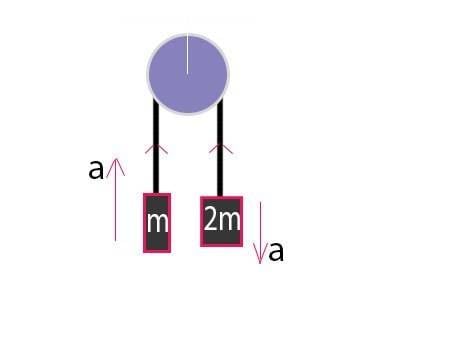
Physics Forums.jpg

This example is pretty simple so I've decided to show the application of the rule here.
Consider the FBD of m,
T is in the same direction as the acceleration. Therefore, T.a=Ta1
Considering the FBD of 2m,
T is in the opposite direction. Therefore, T.a=-Ta2

ΣT.a=0, Therefore, Ta1 - Ta2=0
Thus, a1=a2

This method is really useful for complex pulley systems such as this one.
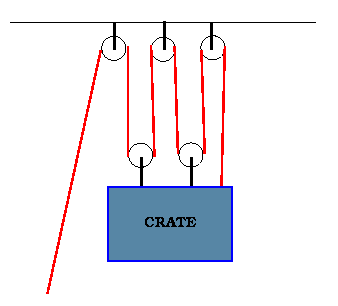
pulleys.gif


I was wondering how to prove this. Can somebody help? Just give me an idea. Don't post the proof.
 
Physics news on Phys.org
Well hello Rinzler, welcome to PF :smile: !

If you consider the constant length of the rope, it is pretty straightforward that y1 + y2 is a constant.
So v1 + v2 = 0 and a1 + a2 = 0 too.

The pulley system you draw is somewhat different, though
 
BvU said:
Well hello Rinzler, welcome to PF :smile: !

If you consider the constant length of the rope, it is pretty straightforward that y1 + y2 is a constant.
So v1 + v2 = 0 and a1 + a2 = 0 too.

The pulley system you draw is somewhat different, though
Yeah, the length of the string is constant. But I'm saying that ΣT.a for the system is zero.
 
Doesn't feel good to me: the dimension of ##\vec T \cdot \vec a## is all irregular.
##\sum \vec T \cdot \vec a = 0 ## only because ##\sum \vec a = \vec 0 ## and the T are equal.

Newton ##\sum \vec F = m\vec a## would be a lot better starting point for your analysis of e.g. the crate system.
And (with due care for the masses of the pulleys -- they can be different, equal, massless or all on one and the same axle) there will be an additional statement for the tensions.
 
A single object accelerating under the action of a single tension (like a block pulled on a horizontal surface) does not satisfy this "rule".
As for the system in OP, why not sum of accelerations or sum of tensions? They are also zero but so what? It's not a general relationship.
 

Similar threads

  • · Replies 6 ·
Replies
6
Views
5K
  • · Replies 1 ·
Replies
1
Views
1K
  • · Replies 24 ·
Replies
24
Views
2K
  • · Replies 19 ·
Replies
19
Views
10K
  • · Replies 6 ·
Replies
6
Views
2K
Replies
5
Views
2K
  • · Replies 12 ·
Replies
12
Views
2K
  • · Replies 10 ·
Replies
10
Views
5K
  • · Replies 1 ·
Replies
1
Views
2K
  • · Replies 6 ·
Replies
6
Views
3K