Propagation of uncertainty with tangent function?

Click For Summary
The discussion centers on calculating the uncertainty of the refractive index using Snell's law, where a large uncertainty value was initially obtained. It was clarified that using radians instead of degrees is crucial for accurate derivative calculations of trigonometric functions. After converting to radians, the uncertainty significantly decreased, leading to a more reasonable result. The importance of understanding the relationship between angle measurement and derivative calculations was emphasized. This highlights the necessity of using the correct units in mathematical equations to avoid misleading results.
Cheesycheese213
Messages
55
Reaction score
8
Homework Statement
Calculate the uncertainty of a value (n) calculated by the equation n=1.0003tanθ
Relevant Equations
(shown below)
For a lab, I needed to calculate the uncertainty of a refractive index that was found using Snell's law. I found an equation online for propagation of error for any general function, which was

Screen Shot 2020-03-08 at 6.51.39 PM.png

I thought that since my equation was
Screen Shot 2020-03-08 at 6.52.10 PM.png

I could just get rid of the variable y, and have
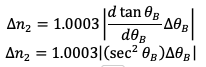
Screen Shot 2020-03-08 at 6.55.19 PM.png


After inputting my values θ = 53.61 and Δθ = 0.1, I got
Δn = 0.284193...
Which I was sort of confused by? My value for n itself is only around 1.357, and I wasn't sure why the uncertainty was so large in comparison. I was wondering if I did something wrong?

For more context, I am calculating n for many different angles, and when graphing the values either the error bars look really big, or the slope is almost insignificant from the scale.

Thanks!
 

Attachments

  • Screen Shot 2020-03-08 at 6.52.40 PM.png
    Screen Shot 2020-03-08 at 6.52.40 PM.png
    926 bytes · Views: 296
  • Screen Shot 2020-03-08 at 6.53.06 PM.png
    Screen Shot 2020-03-08 at 6.53.06 PM.png
    1,014 bytes · Views: 283
Physics news on Phys.org
Try using Radians for your angle measurement, instead of degrees. That's the only way you can take derivatives of trig functions.

Also, depending on the software package you use to graph, it could be defaulting to radians.
 
  • Like
Likes sysprog and Cheesycheese213
scottdave said:
Try using Radians for your angle measurement, instead of degrees. That's the only way you can take derivatives of trig functions.

Also, depending on the software package you use to graph, it could be defaulting to radians.
Ohhh thank you so much!
I just tried converting everything to radians, and I got a much smaller number (0.004961...). Its really interesting how it needs radians over degrees :D Thank you again!
 
  • Like
Likes sysprog, jim mcnamara and scottdave
Cheesycheese213 said:
interesting how it needs radians over degrees
It's not so much that it has to be radians. Rather, it is because the standard derivatives we learn, like d sin(x)/dx = cos (x), assume x is in radians.
 
  • Like
Likes Cheesycheese213, scottdave and sysprog
haruspex said:
It's not so much that it has to be radians. Rather, it is because the standard derivatives we learn, like d sin(x)/dx = cos (x), assume x is in radians.

Ohhhh I see! I didn't connect that! Thank you!
 
Yes, like @haruspex said, you could have a scale factor of (π radians)/180° inside the sin(x), so taking the derivative of sin(x) with x in degrees becomes (π/180)*cos(x).

This means the sine would change approx 0.01745 vertically for every Δx = 1° ( when you are near x = 0 ).
 
The book claims the answer is that all the magnitudes are the same because "the gravitational force on the penguin is the same". I'm having trouble understanding this. I thought the buoyant force was equal to the weight of the fluid displaced. Weight depends on mass which depends on density. Therefore, due to the differing densities the buoyant force will be different in each case? Is this incorrect?

Similar threads

Replies
15
Views
1K
Replies
15
Views
2K
  • · Replies 3 ·
Replies
3
Views
2K
  • · Replies 2 ·
Replies
2
Views
1K
  • · Replies 6 ·
Replies
6
Views
5K
  • · Replies 3 ·
Replies
3
Views
2K
  • · Replies 13 ·
Replies
13
Views
2K
  • · Replies 15 ·
Replies
15
Views
4K
Replies
9
Views
2K
  • · Replies 2 ·
Replies
2
Views
2K
