Physics Lab Propagation of Error Issue

Join the discussion
Ask a follow-up here, or get your own question answered by working scientists, mathematicians and engineers — people, not an autocomplete.
Real named experts · corrections over time · the nuance an AI answer skips
13 replies · 2K views
Browntown
Messages
18
Reaction score
0
Homework Statement
Physics Lab Propagation of Error Issue
Relevant Equations
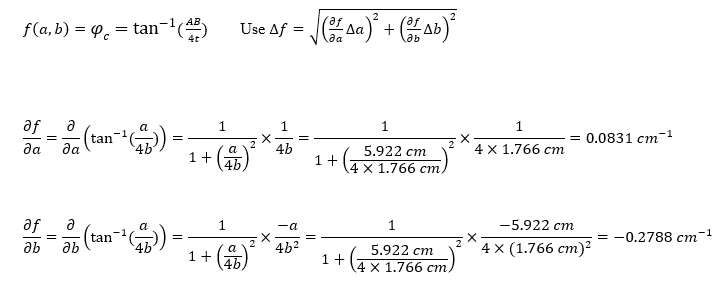
∂f/∂b=∂/∂b (tan^(-1)⁡(a/4b))= 1/(1+(a/4b)^2 )×(-a)/(4b^2 )=1/(1+((5.922 cm)/(4×1.766 cm))^2 )×(-5.922 cm)/(4×(1.766 cm)^2 )
Homework Statement: Physics Lab Propagation of Error Issue
Homework Equations: ∂f/∂b=∂/∂b (tan^(-1)⁡(a/4b))= 1/(1+(a/4b)^2 )×(-a)/(4b^2 )=1/(1+((5.922 cm)/(4×1.766 cm))^2 )×(-5.922 cm)/(4×(1.766 cm)^2 )

Hello,

I'm trying to find the uncertainty in a function from the lab manual for the critical angle of refraction and since this is my first time doing such a thing I'm a bit confused.
When I take the derivative of the inverse tan function provided and input my values, the units of cm don't seem to cancel and I can't figure out how to fix that
d9b5f221112b383309c826e733aa0727.png
 
on Phys.org
It seems to me that you want ##\Delta f = \Delta \tan^{-1}(\frac{AB}{4t})## to be unitless. What happens when you multiply ##\frac{\partial f}{\partial a}## by ##\Delta a##?
 
Δa is in units of cm so technically when they're multiplied they cancel out (cm^-1 x cm) but I thought anytime you take the inverse of a trig function you get an angle?
 
That is true. Then you differentiated that angle with respect to a variable with units of cm. What would you expect to be the units of the derivative?
 
Would the derivative of a variable with units in cm be then cm/s? instantaneous velocity?
 
Consider the definition of derivative:

$$\frac {df}{da} = \lim_{\Delta a \rightarrow 0} {\frac {f(a +\Delta a)- f(a)}{\Delta a}}$$

With ##f(a)## an angle and ##a## a distance, what would be the units of ##\frac {df}{da}##?
 
I'm sorry but I honestly have no clue..
 
Browntown said:
I'm sorry but I honestly have no clue..
OK. Let's back up one step. if ##f(a)## is unitless and ##a## has units of cm, what are the units of $$\frac {f(a +\Delta a)- f(a)}{\Delta a}$$
 
Last edited:
Would they just cancel?
 
I'm sorry, my lab report is due tomorrow and I think the stress of trying to get it done is just not letting me think properly.
 
Here's the bottom line: for the purpose of determining its units, you can treat a derivative like a fraction. So if ##f## is unitless and ##a## has units of cm, then ##\frac {df}{da}## has units of ##\frac {\text {unitless}}{\text {cm}} = \text {cm}^{-1}##
 
So that means that even though its the inverse tangent function, because it's the derivative of it, it can have units of cm^-1?
 
Browntown said:
So that means that even though its the inverse tangent function, because it's the derivative of it, it can have units of cm^-1?
Yes.
 
Awesome! Thank you so much!