Troubleshooting Proportional Counter Problem

  • Context: Graduate 
  • Thread starter Thread starter Xaritou
  • Start date Start date
  • Tags Tags
    Counter Proportional
Click For Summary
SUMMARY

The forum discussion centers on troubleshooting issues with a proportional gas detector system used for krypton gas detection, specifically involving a Co57 source. Users identified potential problems related to the preamplifier, amplifier, and gas circulation, noting that the spectrum has degraded over the past two months. Key observations include consistent FWHM of peaks and a possible loss of gain, with suggestions to investigate RF interference and power supply stability. Recommended reading includes "Radiation Detection and Measurement" by Glenn F. Knoll for further understanding of detector theory.

PREREQUISITES
  • Understanding of proportional gas detectors
  • Familiarity with signal amplification in electronic systems
  • Knowledge of radiation sources, specifically Co57
  • Basic principles of gas flow and its impact on detector performance
NEXT STEPS
  • Study "Radiation Detection and Measurement" by Glenn F. Knoll for comprehensive insights on detector theory
  • Research the effects of gas degradation in closed-can proportional counters
  • Learn about RF interference and its impact on signal integrity in detection systems
  • Investigate power supply stability and its influence on detector performance
USEFUL FOR

Researchers, physicists, and engineers working with radiation detection systems, particularly those involved in the maintenance and troubleshooting of proportional gas detectors.
Xaritou
Messages
6
Reaction score
0
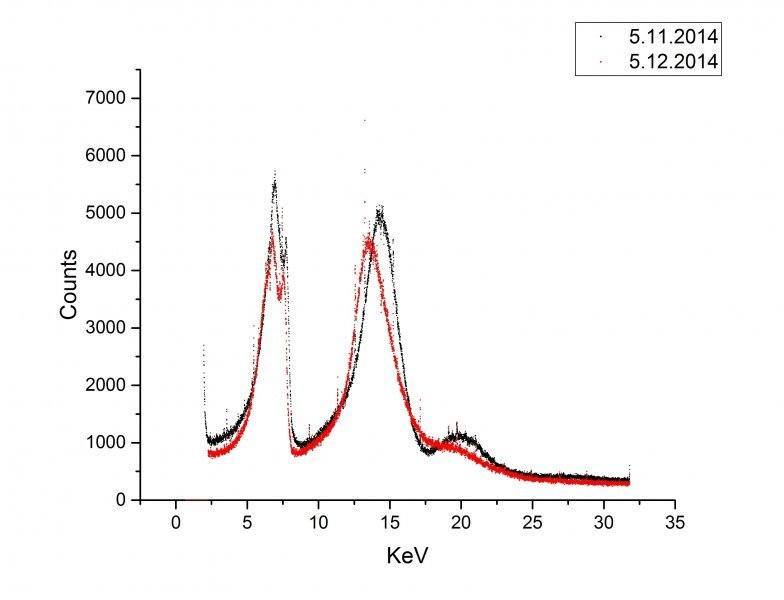
Hi guys. I have a problem with my spectrum and I would like your help. I have a system with a proportional Gas detector (krypton gas), preamplifier and amplifier, Co57 source, and the last two months the spectrum has gotten worst as you can see in the attachment. Does anyone know what might be the problem? Detector? Preamplifier? Unfortunately I don't have spare parts so I can't eliminate something.
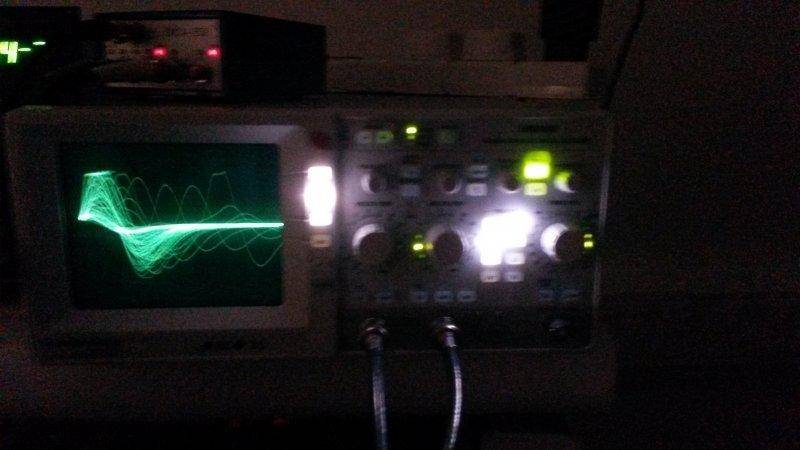
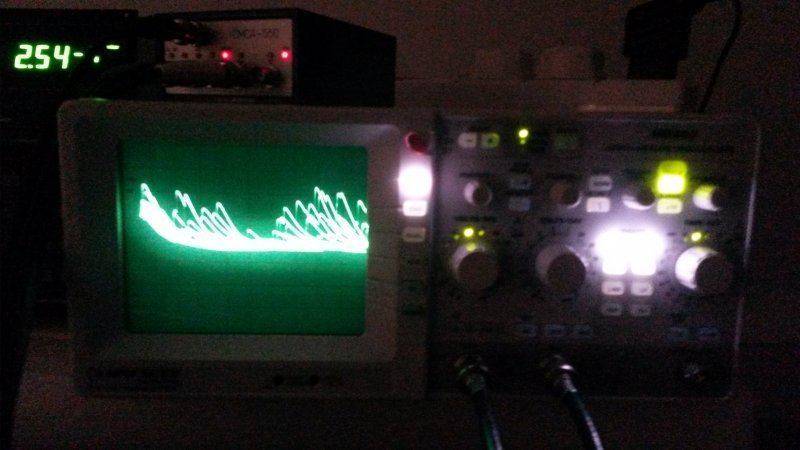
The last two pictures are the output signal from the preamplifier, and the amplifier
Co57 Spectrum.jpg
20150127_155518.jpg
20150127_155411.jpg
 
Physics news on Phys.org
I'd look for the manufacturer's website and see if someone has posted this issue there.
 
This obviously depends on how much you've used it, but how's the gas circulation in the counter?

To me, it looks like the FWHM of the peaks is pretty much the same, ditto the relative heights of the peaks. Were the spectra taken for the same time (accounting for a little 57Co decay)? It just looks like you've just lost a little gain? Is this spectrum actually unusable to you?

jedishrfu - that implies it has been bought off the shelf! :D
 
e.bar.goum said:
This obviously depends on how much you've used it, but how's the gas circulation in the counter?

To me, it looks like the FWHM of the peaks is pretty much the same, ditto the relative heights of the peaks. Were the spectra taken for the same time (accounting for a little 57Co decay)? It just looks like you've just lost a little gain? Is this spectrum actually unusable to you?

jedishrfu - that implies it has been bought off the shelf! :D

Yes the spectra was taken for the same time, the difference from the decay should be very small. The detector is a "closed can" style, so there is no gas circulation. The spectrum is not unusable but its not perfect. I must use the counts from the 14keV peak, for Mossbauer experiments, and the "non 14keV" i take into account are extra noise so it creates a little problem.

The thing that annoys me, is that the peak at 6 keV remained perfect. an the other two are problematic.
 
It seems to me that the difference due to decay in one month should be about 8%. (The halflife of 57Co is only 272 days, after all). But that's probably not the only problem. I'm assuming you've kept the geometry constant as well.

I asked about gas flow because you do expect that closed-can type proportional counters will degrade over time due to deposition.

It's hard to tell without being there, obviously, and it's hard to tell without being able to swap out components. I'd be taking away the source, and looking at what the scope is triggering on - are you picking up any RF? If you move around the amplifier/preamp/cables, does the noise change?

ETA: Another thought: How's the power supply? Has your leakage current gone substantially up?
 
Last edited:
e.bar.goum said:
It seems to me that the difference due to decay in one month should be about 8%. (The halflife of 57Co is only 272 days, after all). But that's probably not the only problem. I'm assuming you've kept the geometry constant as well.

I asked about gas flow because you do expect that closed-can type proportional counters will degrade over time due to deposition.

It's hard to tell without being there, obviously, and it's hard to tell without being able to swap out components. I'd be taking away the source, and looking at what the scope is triggering on - are you picking up any RF? If you move around the amplifier/preamp/cables, does the noise change?

ETA: Another thought: How's the power supply? Has your leakage current gone substantially up?

I changed the cables completely, the power supply is ok. I even tried it with 1500-1800 V (it was 1700 originally). Without source, its just little random noise. Geometry is constant. I also removed the cryostat, shielding and collimator. At first. I though it was x ray fluorescence from something.
It looks to me that it actually split the main peaks in two, with the second one in little less energy. Maybe the ions can't move and be collected fast enough so they create an electric field that "reduce" the next avalanche and the measured energy from the next photon.
But I don't know the symptoms from gas degradation. If someone can suggest a book or something to read about gas detectors and problems, I would be grateful.
 
Xaritou said:
I changed the cables completely, the power supply is ok. I even tried it with 1500-1800 V (it was 1700 originally). Without source, its just little random noise. Geometry is constant. I also removed the cryostat, shielding and collimator. At first. I though it was x ray fluorescence from something.
It looks to me that it actually split the main peaks in two, with the second one in little less energy. Maybe the ions can't move and be collected fast enough so they create an electric field that "reduce" the next avalanche and the measured energy from the next photon.
But I don't know the symptoms from gas degradation. If someone can suggest a book or something to read about gas detectors and problems, I would be grateful.

It sounds like you've done the obvious things. I highly recommend Radiation Detection and Measurement by Glenn F. Knoll as a first resource for any detector theory. There's a chapter on proportional counters. He has a comprehensive set of references at the end of every chapter too, so you can use it as a springboard for further reading.
 

Similar threads

  • · Replies 4 ·
Replies
4
Views
4K
  • · Replies 12 ·
Replies
12
Views
2K
Replies
1
Views
2K
  • · Replies 3 ·
Replies
3
Views
3K
  • · Replies 11 ·
Replies
11
Views
2K
  • · Replies 2 ·
Replies
2
Views
2K
  • · Replies 27 ·
Replies
27
Views
6K
Replies
7
Views
7K
  • · Replies 1 ·
Replies
1
Views
1K
Replies
79
Views
9K