Prove centre of mass of an arc is rotationally invariant

Click For Summary

Discussion Overview

The discussion revolves around proving the rotational invariance of the centroid (or center of mass) of an arc, focusing on the mathematical definitions and transformations involved. Participants explore various approaches, including polar coordinates and matrix representations, to establish this property.

Discussion Character

  • Exploratory
  • Technical explanation
  • Mathematical reasoning

Main Points Raised

  • One participant defines the coordinates of the centroid using integrals over arc length and asks for a proof of invariance under rotation.
  • Another suggests using polar coordinates as a substitution to facilitate the rotation.
  • A participant expresses concern about the complexity of integrating a specific example and considers using matrices instead.
  • There is a suggestion to expand the linear combination in terms of x as a function of r and theta, indicating that the integral should not depend on theta if invariance is to be shown.
  • A participant reformulates the centroid definitions in polar coordinates and questions whether the average values of r and theta would be sufficient for the proof.
  • Further elaboration on the transformation of coordinates under rotation is presented, including the substitution of angles and the implications for the centroid's coordinates in the new system.
  • There is an ongoing inquiry into demonstrating that certain relationships hold after the coordinate transformation, specifically regarding the equality of the radial components and the angular components post-rotation.

Areas of Agreement / Disagreement

Participants have not reached a consensus on the best approach to prove the invariance. Multiple competing views and methods are presented, and the discussion remains unresolved.

Contextual Notes

The discussion involves complex mathematical transformations and assumptions about the properties of integrals in different coordinate systems, which may not be fully explored or resolved.
Happiness
Messages
686
Reaction score
30
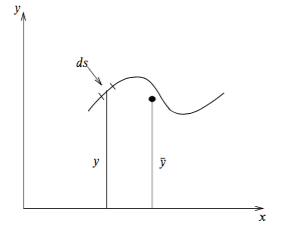
Suppose the coordinates ##(\bar{x}, \bar{y})## of the centroid (or the centre of mass) of an arc is defined as follows

Screen Shot 2016-07-13 at 3.53.40 pm.png


##\bar{x}=\frac{1}{L}\int x\,ds## and ##\bar{y}=\frac{1}{L}\int y\,ds##, where ##L## is the arc length.

Could you prove that the centroid is invariant under a rotation of the coordinate axes?
 
Physics news on Phys.org
Hey Happiness.

Have you tried doing a substitution that allows you to rotate everything?

Hint - Try using polar co-ordinates.
 
chiro said:
Hey Happiness.

Have you tried doing a substitution that allows you to rotate everything?

Hint - Try using polar co-ordinates.

Hey chiro

Yes I've considered doing that for a specific example, ##y=x^3-4x^2+x+12##, but it is very tedious and the integration we get is most likely not do-able. And even if we can perform the integration, we would only prove it for a specific case.

I'm thinking using matrices may help, but I'm not sure how.
 
Last edited:
If you want to use matrices then just expand the linear combination in terms of x as a function of r and theta.

What you will find is that it's exactly the same as the integral.

When you did the substitution - did you go to (r,theta) space and if so what did you get when doing so?

Note that for 2D polar you have x = rcos(theta), y = rsin(theta) and the Jacobian is r.

What you will have to show is that your integral as a function of theta is the same so this means your integral won't be a function of theta at all (i.e. it disappears).

If you show this in general you have proved the invariance property.
 
Is this correct?

Under polar coordinates, the definitions of ##\bar{x}## and ##\bar{y}## become

##\bar{r}\cos\bar{\theta}=\frac{1}{L}\int_{\theta_1}^{\theta_2}r(\theta)\cos\theta\sqrt{r^2(\theta)+(\frac{dr(\theta)}{d\theta})^2}d\theta##

##\bar{r}\sin\bar{\theta}=\frac{1}{L}\int_{\theta_1}^{\theta_2}r(\theta)\sin\theta\sqrt{r^2(\theta)+(\frac{dr(\theta)}{d\theta})^2}d\theta##

where ##\bar{r}## is the magnitude of the position vector ##\vec{r}## of the centroid and ##\bar{\theta}## is the angle the position vector ##\vec{r}## makes with the positive x-axis. (##\bar{r}## and ##\bar{\theta}## may not necessarily be the average values of ##r## and ##\theta##. Would they necessarily and sufficiently be so?) ##r^2(\theta)## means ##r^2## is a function of ##\theta##.

Consider a rotation of the coordinate axes by an angle ##\alpha## clockwise. Then the point ##(r, \theta)\to(r, \theta+\alpha)## and the value ##r(\theta)\to r(\theta+\alpha)##. [##r(\theta+\alpha)## means for every ##\theta## in ##r(\theta)## we substitute ##\theta+\alpha##.] We have

##\bar{x}'=\frac{1}{L}\int_{\theta_1+\alpha}^{\theta_2+\alpha}r(\theta+\alpha)\cos(\theta+\alpha)\sqrt{r^2(\theta+\alpha)+(\frac{dr(\theta+\alpha)}{d\theta})^2}d\theta##

where the ##\bar{x}'## is the x-coordinate of the centroid in the new rotated coordinate system.

Using the substitution ##\beta=\theta+\alpha##, ##\beta_1=\theta_1+\alpha##, ##\beta_2=\theta_2+\alpha## and ##\frac{d\theta}{d\beta}=1##, we have

##\bar{r}'\cos\bar{\theta}'=\bar{x}'=\frac{1}{L}\int_{\beta_1}^{\beta_2}r(\beta)\cos(\beta)\sqrt{r^2(\beta)+(\frac{dr(\beta)}{d\beta})^2}d\beta##

where the primed quantities are the corresponding quantities in the new rotated coordinate system.

Recall that ##\bar{r}\cos\bar{\theta}=\frac{1}{L}\int_{\theta_1}^{\theta_2}r(\theta)\cos\theta\sqrt{r^2(\theta)+(\frac{dr(\theta)}{d\theta})^2}d\theta## is a function of ##\theta_1, \theta_2## and ##L##. Let's call it ##f=f(\theta_1, \theta_2, L)##. Then

##\bar{r}'\cos\bar{\theta}'=\bar{x}'=f(\beta_1, \beta_2, L)=f(\theta_1+\alpha, \theta_2+\alpha, L)##.

But it remains to show why ##\bar{r}'=\bar{r}## and ##\cos\bar{\theta}'=\cos(\bar{\theta}+\alpha)##. That is, why

##f(\theta_1+\alpha, \theta_2+\alpha, L)=\bar{r}\cos(\bar{\theta}+\alpha)##.
 
Last edited:

Similar threads

  • · Replies 9 ·
Replies
9
Views
2K
  • · Replies 1 ·
Replies
1
Views
2K
  • · Replies 5 ·
Replies
5
Views
4K
  • · Replies 3 ·
Replies
3
Views
2K
  • · Replies 17 ·
Replies
17
Views
3K
  • · Replies 3 ·
Replies
3
Views
3K
  • · Replies 11 ·
Replies
11
Views
2K
  • · Replies 3 ·
Replies
3
Views
2K
  • · Replies 4 ·
Replies
4
Views
3K
  • · Replies 5 ·
Replies
5
Views
3K