Amer
- 259
- 0
it is a question in my book said
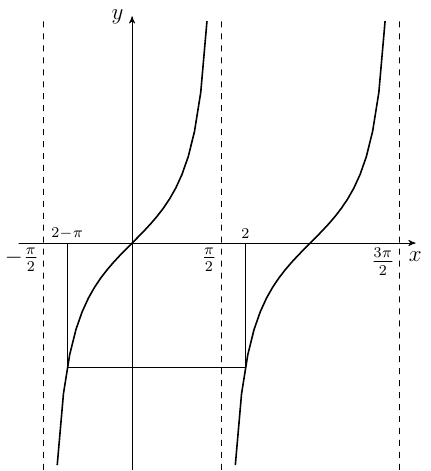
Prove that the function [tex]f(x) = 2 + x - \tan ^{-1} x[/tex] has the property [tex]\mid f'(x)\mid < 1[/tex]
Prove that f dose not have a fixed point
but i found that this function has a fixed point
[tex]y = 2 + y - \tan ^{-1} y[/tex]
[tex]y = \tan 2[/tex]
is it right that the question is wrong
Prove that the function [tex]f(x) = 2 + x - \tan ^{-1} x[/tex] has the property [tex]\mid f'(x)\mid < 1[/tex]
Prove that f dose not have a fixed point
but i found that this function has a fixed point
[tex]y = 2 + y - \tan ^{-1} y[/tex]
[tex]y = \tan 2[/tex]
is it right that the question is wrong
Last edited by a moderator: