Proving a^0=1: Step-by-Step Guide

  • Context: High School 
  • Thread starter Thread starter Rijad Hadzic
  • Start date Start date
  • Tags Tags
    Proof
Click For Summary
SUMMARY

The discussion centers on proving that \( a^0 = 1 \) for any non-zero \( a \). Participants outline definitions of exponents, emphasizing that \( a^n \) is defined as the product of \( a \) multiplied by itself \( n \) times. They conclude that \( a^0 \) must be defined as 1 to maintain consistency with the exponentiation laws, particularly \( a^n \cdot a^m = a^{n+m} \). The consensus is that while this can be motivated by definitions, it does not constitute a formal proof, as it relies on accepted mathematical conventions.

PREREQUISITES
  • Understanding of exponentiation and its properties
  • Familiarity with basic algebraic operations
  • Knowledge of mathematical definitions and the concept of limits
  • Basic understanding of sequences and their convergence
NEXT STEPS
  • Study the properties of exponentiation in detail, focusing on integer and rational exponents
  • Explore the concept of limits in sequences, particularly in relation to exponential functions
  • Investigate the definition and implications of \( 0! = 1 \) in combinatorial contexts
  • Learn about the continuity of functions and how it relates to defining powers for real numbers
USEFUL FOR

Mathematicians, educators, and students seeking a deeper understanding of exponentiation, particularly in contexts involving zero and negative exponents. This discussion is beneficial for anyone interested in the foundational definitions in algebra and their implications in higher mathematics.

Rijad Hadzic
Messages
321
Reaction score
20
I'm trying to prove that a^0 is = 1

So if I define a^1 to be = (a)(1)

and a^n to be = (1)(a)(a)...(a) with the product being taken n times
and a^m to be = (1)(a)(a)...(a) with the product being taken m times

a^n * a^m would then = (1)[(a)(a)...(a) with the product being taken n times * and a^m to be = (1)(a)(a)...(a) with the product being taken m times]

which clearly gives a^n * a^m = a^(n+m)

if m = 0, a^n * a^0 = a^(n+0) = a^(n), so a^0 = 1

for some reason this does make sense to me but I have a feeling the result is not satisfying enough.
 
Mathematics news on Phys.org
Rijad Hadzic said:
Iwhich clearly gives a^n * a^m = a^(n+m)
But only for n and m both non-zero positive integers.
 
##a^0 =1 \ (a \ne 0)## by definition.

This definition is chosen so that you have:

##a^na^m = a^{n + m}##
 
  • Like
Likes   Reactions: Demystifier
jbriggs444 said:
But only for n and m both non-zero positive integers.
damn it forgot to state this. But my proof still doesn't satisfy me for some reason
 
PeroK said:
##a^0 =1 \ (a \ne 0)## by definition.

This definition is chosen so that you have:

##a^na^m = a^{n + m}##

Are you saying the proof is not valid if I start from a^n*a^m ??
 
Rijad Hadzic said:
Are you saying the proof is not valid if I start from a^n*a^m ??

I'm saying that, essentially, you cannot prove it. Anymore than you can prove that ##0! = 1##.

Sure, if you assume that

##a^na^m = a^{n + m}##

Then ##a^0 = 1## follows from that. But, that's more a motivation for a definition than a proof.
 
  • Like
Likes   Reactions: jim mcnamara and jbriggs444
PeroK said:
I'm saying that, essentially, you cannot prove it. Anymore than you can prove that ##0! = 1##.

Sure, if you assume that

##a^na^m = a^{n + m}##

Then ##a^0 = 1## follows from that. But, that's more a motivation for a definition than a proof.

Wouldn't

"So if I define a^1 to be = (a)(1)

and a^n to be = (1)(a)(a)...(a) with the product being taken n times
and a^m to be = (1)(a)(a)...(a) with the product being taken m times
"
allow it to constituted as a proof though, since I'm defining it in that way?
 
Rijad Hadzic said:
Wouldn't

"So if I define a^1 to be = (a)(1)

and a^n to be = (1)(a)(a)...(a) with the product being taken n times
and a^m to be = (1)(a)(a)...(a) with the product being taken m times
"
allow it to constituted as a proof though, since I'm defining it in that way?
A proof of what? That is an adequate definition of a^n for n an integer greater than zero. It says nothing about a^0.

It is also redundant. If you define a^n, you've defined a^m. The "n" and the "m" are dummy variables.

Edit: I do not think I was understanding what you were trying to express.

You want to define a^n as the result of evaluating "1(a)...(a)" where there are n a's. In the case of n=0, this means zero a's and it is just "1".

Under this definition, a^0 = 1 by definition (even when a=0) and there is nothing to prove.
 
Last edited:
  • Like
Likes   Reactions: Delta2
I think the appropriate way would be to assume that ##f(x)=a^x## is continuous and then show that the sequence

##a^{1/2},a^{1/4},a^{1/8},\dots##

or

##\sqrt{a},\sqrt[4]{a},\sqrt[8]{a},\dots##

has limit 1 when ##a\neq 0##.

It's just a matter of choosing some properties you want the exponential function to have, and then showing that the only value of ##a^0## that is logically compatible with those properties is 1.
 
Last edited:
  • Like
Likes   Reactions: scottdave and Demystifier
  • #10
hilbert2 said:
I think the appropriate way would be to assume that ##f(x)=a^x## is continuous and then show that the sequence

##a^{1/2},a^{1/4},a^{1/8},\dots##

or

##\sqrt{a},\sqrt[4]{a},\sqrt[8]{a},\dots##

has limit 1 when ##a\neq 0##.

It's just a matter of choosing some properties you want the exponential function to have, and then showing that the only value of ##a^0## that is logically compatible with those properties is 1.

That's fine, but perhaps a physicist's view. The function ##a^x## for real ##x## is a more advanced construction. You might hope to resolve what ##a^0## should be while you are still dealing with integer powers.
 
  • #11
PeroK said:
That's fine, but perhaps a physicist's view. The function ##a^x## for real ##x## is a more advanced construction. You might hope to resolve what ##a^0## should be while you are still dealing with integer powers.

Yes, in my version of the proof the property ##a^{1/n} = \sqrt[n]{a}## is assumed as an "axiom", while a simpler choice could also be possible. I guess we're playing the game of "inventing the exponential for the first time" here, instead of relying on commonly accepted sets of rules.
 
  • #12
hilbert2 said:
Yes, in my version of the proof the property ##a^{1/n} = \sqrt[n]{a}## is assumed as an "axiom", while a simpler choice could also be possible. I guess we're playing the game of "inventing the exponential for the first time" here, instead of relying on commonly accepted sets of rules.

That "game" is called pure mathematics!
 
  • #13
PeroK said:
Sure, if you assume that

##a^na^m = a^{n + m}##
This just looks to me like the associative law of multiplication: ##(aa...a)_{n\text{ times}}(aa...a)_{m\text{ times}} = (aa...a)_{n+m\text{ times}}##
 
  • #14
FactChecker said:
This just looks to me like the associative law of multiplication: ##(aa...a)_{n\text{ times}}(aa...a)_{m\text{ times}} = (aa...a)_{n+m\text{ times}}##
That doesn't get you to ##a^0=1##.

The issue is, for example, that you could verify this for positive integers:

##a^3 a^2 = a^5##

But, if you try to verify this for any integers you have:

##a^2 a^{-2} = 1##

But, you can't verify that ##a^0 =1## as "a multiplied by itself 0 times" is not immediately defined. You have to define ##a^0 =1## in order for your law of indices to extend to integers.

And that's what is done.
 
  • Informative
Likes   Reactions: scottdave
  • #15
##a^{-1}=\frac{1}{a}##. Therefore ##a^1\cdot a^{-1}=a^{1-1}=a^0=\frac{a}{a}=1##.
 
  • Like
Likes   Reactions: scottdave, Wes Turner, Delta2 and 1 other person
  • #16
mathman said:
##a^{-1}=\frac{1}{a}##
Only if you define it thus.
 
  • #17
mathman said:
##a^{-1}=\frac{1}{a}##. Therefore ##a^1\cdot a^{-1}=a^{1-1}=a^0=\frac{a}{a}=1##.
If you, a priori, assume that a basic law holds when extend the numbers involved, then:

##a^n b^n = (ab)^n##

Extends to:

##(-1)^{1/2}(-1)^{1/2} =1^{1/2} = 1##

Which is then a "proof" that ##-1 = 1##.
 
  • #18
In general, one can think of the expression ##A^B ## as the set of all mappings ##f:B\to A ##. For arbitrary cardinalities it holds that ##\left\lvert A^B\right\rvert = \left\lvert A\right\rvert ^\left\lvert B \right\rvert##. Thus ##a^0 = \{a\} ^\emptyset = 1_\mathbb N ##, as for any set ## A##, there is exactly one mapping ##f:\emptyset\to A ##

One can also use this to semi-prove things like ##0! = 1 ##. Factorial represents the number of permutations, thus there is exactly one "empty permutation". It is safer to define ##0! = 1 ##.

All of this depends on where you are operating. In a group, for instance, we just define ##g^0## to be equal to the identity as the expression ##g^0 ## doesn't really make sense, otherwise. In a semigroup ##s^0 ## might be an ill-defined array of symbols.

In the real numbers, one could think ##\log _a1 = 0 ## iff ##a^0 =1 ##. Which was first, the egg or the chicken? It's a lot of boring debate, to be honest. Let's just say that if the structure permits it, we define ##a^0 = 1 ## where the meanings of the symbols depend on context.
 
Last edited:
  • Like
Likes   Reactions: ZeGato, dextercioby and Delta2
  • #19
Maybe this is too basic, but hopefully it helps. Consider the sequence 2,4,8,16,32,\ldots. The n-th term of this sequence is 2^n. In going from the n-th term to the (n+1)-st term, we multiply by 2. If we want this pattern to hold for all integers n, then we are forced to have 2^0=1, 2^{-1}=1/2, etc. so that our sequence is \ldots 1/4,1/2,1,2,4,8,\ldots.

Another way of phrasing this is just that we want 2^{n+1}=2^1\cdot 2^n since 2^{a+b}=2^{a}2^b is a law that we would like to keep.

Probably you can't prove that a^n is the right thing for nonpositive exponents since usually exponentials are defined first for only when the exponent is a positive integer, and then you extend the definition to integer exponents in the above way, and then to rationals, and then to reals.
 
  • #20
jbriggs444 said:
Only if you define it thus.
How else would you define it?
 
  • #21
mathman said:
How else would you define it?
In a conversation where one is discussing the definition of ##a^0##, introducing a definition of ##a^{-1}## seems premature.
 
  • #22
So at what point can I just define something without proving its true and have a result that's true regardless if the definition is true or not

I guess what a better way to say is when can I make an assumption?
 
Last edited:
  • #23
Rijad Hadzic said:
So at what point can I just define something without proving its true and have a result that's true regardless if the definition is true or not

I guess what a better way to say is when can I make an assumption?

The fundamental issue is that when you use some mathematical symbols, you must define what you mean by that arrangement of symbols. Until you know what you mean by those symbols, you cannot start to do mathematics using them. In this case, for example, you might write:

##2^0##

But, what does that mean? There's no immediate way to "multiply 2 by itself 0 times". Unlike ##2^1, 2^2, 2^3 \dots ##, which have a simple, clear definition.

My recommended approach is to define ##2^0 = 1## before you go any further. Then you know what those symbols mean.

Now, of course, you need to be careful that a definition is consistent with other definitions, and you need to understand the implications of a certain definition.

In this case, the only other candidate might be to define ##2^0 = 0##. But, when you look at the way powers work, you see that defining ##2^0 =1## is logical and consistent.
 
Last edited:
  • Like
Likes   Reactions: Rijad Hadzic, Delta2, Stephen Tashi and 1 other person
  • #24
PeroK said:
My recommended approach is to define ##2^0 = 1## before you go any further (why?). Then you know what those symbols mean.

Now, of course, you need to be careful that a definition is consistent with other definitions, and you need to understand the implications of a certain definition.

In this case, the only other candidate might be to define ##2^0 = 0##. But, when you look at the way powers work (you define how powers work afterward?), you see that defining ##2^0 =1## is logical and consistent.
But that means that you basically define what ##2^{-1}## means and then you adjust your "guess" to ##2^0 = 1##.
jbriggs444 said:
In a conversation where one is discussing the definition of ##a^0##, introducing a definition of ##a^{-1}## seems premature.
Not only is defining ##a^{-1}## not premature, it is essential. Otherwise, you are only guessing arbitrarily as @PeroK explained, and you modify your guess as you (finally) define ##a^{-1}##. ##a^0 = 1## makes sense only if ##a^{-n} =\frac{1}{a^n}##. then a simple limit approach proves the definition of ##a^0##. Therefore, I tend to support @mathman 's approach:
mathman said:
##a^{-1}=\frac{1}{a}##. Therefore ##a^1\cdot a^{-1}=a^{1-1}=a^0=\frac{a}{a}=1##.
---------------------------------------
PeroK said:
If you, a priori, assume that a basic law holds when extend the numbers involved, then:

##a^n b^n = (ab)^n##

Extends to:

##(-1)^{1/2}(-1)^{1/2} =1^{1/2} = 1##

Which is then a "proof" that ##-1 = 1##.
Doesn't that only proves that ##-1 \times -1 = 1##?

##a^n## and ##a^{-n}## have both distinct definitions, so stating both «sources» ##a## are the same because they give the same result is as fair as saying that since ##\sin\frac{\pi}{2} = 1## and ##\cos 0=1##, then ##\frac{\pi}{2} = 0## must be true.
 
  • #25
jack action said:
##a^n## and ##a^{-n}## have both distinct definitions, so stating both «sources» ##a## are the same because they give the same result is as fair as saying that since ##\sin\frac{\pi}{2} = 1## and ##\cos 0=1##, then ##\frac{\pi}{2} = 0## must be true.

That makes no sense to me. Although looking at your avatar might explain things!
 
Last edited:
  • #26
jack action said:
Not only is defining ##a^{-1}## not premature, it is essential.
Ummm, no. It is not essential. Given a definition for raising a number to an arbitrary positive, non-zero, integer power, one can extend that definition to ##a^0## in one obvious way that preserves the truth of ##a^{n+1} = a \times a^n##

There is, of course, an extra bit of freedom in defining 0^0 to be consistent with that equality.

If one is working in the ring of integers, ##a^{-1}## may not be defined.
 
  • Like
Likes   Reactions: dextercioby and PeroK
  • #27
jbriggs444 said:
Given a definition for raising a number to an arbitrary positive, non-zero, integer power, one can extend that definition to ##a^0## in one obvious way that preserves the truth of ##a^{n+1} = a \times a^n##
Well, that looks more like a proof to me and it is a much more useful answer than your previous ones. And it is certainly better than @PeroK 's answer who basically said «let's create an arbitrary definition and see if it's "logical and consistent"» (which makes no sense to me as a mathematical proof).

I'm glad I made you elaborate your thoughts on the subject, because I like polite exchanges that enrich my life.
 
  • Like
Likes   Reactions: jim hardy
  • #28
You could start with ##a^{n+1}=a\times a^n## then ##a^n=\frac{a^{n+1}}{a}## and work backwards to get ##a^0=\frac{a^1}{a}=1##. Further continuation to get negative exponents.
 
  • #29
jack action said:
Well, that looks more like a proof to me
It is not a proof. You don't prove definitions.
 
  • #30
jbriggs444 said:
It is not a proof. You don't prove definitions.
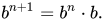
I know Wikipedia is not considered the best reference, but here what they have to say about exponentiation:
Positive exponents
Formally, powers with positive integer exponents may be defined by the initial condition
7d240dbaf6181ae1801474f3d28dcd5504aacae6

and the recurrence relation
22becb6fbb370b056af0dc723f2af7e4db6a034a

[...]
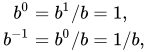
Negative exponents
The following identity holds for an arbitrary integer n and nonzero b:
bc5945fefb607bd5dffd31f93161985362c8e547

[...]

The identity above may be derived through a definition aimed at extending the range of exponents to negative integers.
For non-zero b and positive n, the recurrence relation above can be rewritten as
50badcf877aaca6046b1f3a8bc15123e6a11943a

By defining this relation as valid for all integer n and nonzero b, it follows that
79324b0f81e42f7b891a815da86599083450324a
So the process is to define for positive exponents (##b^1 = b##). Then an identity is derived to extend to negative exponent (##b^n = \frac{b^{n+1}}{b}, n\ge 1##). Note that we use this relation to specifically extend the definition to negative exponents (I like to think this comes before an attempt to understand what ##b^0## could be, but you prove successfully that it is not necessary).

Finally, once this definition is accepted, ##b^0=1## must be true because ##\frac{b^{0+1}}{b}=1##. It is not defined as is, it is a consequence of the accepted general definition of what exponentiation is ("It follows that ##b^0=1##"). Isn't that a proof? Because I really doubt someone started with «Let's assume ##b^0 = 1## and find an exponentiation definition that includes that definition».
 

Similar threads

  • · Replies 4 ·
Replies
4
Views
1K
  • · Replies 55 ·
2
Replies
55
Views
6K
  • · Replies 8 ·
Replies
8
Views
3K
  • · Replies 3 ·
Replies
3
Views
2K
  • · Replies 6 ·
Replies
6
Views
3K
  • · Replies 1 ·
Replies
1
Views
1K
  • · Replies 5 ·
Replies
5
Views
2K
  • · Replies 5 ·
Replies
5
Views
3K
  • · Replies 3 ·
Replies
3
Views
906
  • · Replies 5 ·
Replies
5
Views
2K