Proving a parallelogram is a rhombus, given an Isosceles triangle

Click For Summary

Homework Help Overview

The discussion revolves around proving that a given parallelogram is a rhombus, using properties of an isosceles triangle. Participants are grappling with the implications of specific statements and reasons provided by the instructor, particularly regarding the transitive property of equality and congruence.

Discussion Character

  • Mixed

Approaches and Questions Raised

  • Participants express confusion about the necessity of the transitive property in the proof, questioning its application in the context of the statements provided. There is a focus on the congruence of sides in the isosceles triangle and how that relates to the properties of the parallelogram.

Discussion Status

The discussion is ongoing, with participants exploring various interpretations of the problem and the implications of the statements made by the instructor. Some have offered insights into the use of the transitive property, while others are questioning the assumptions made about the sides of the isosceles triangle.

Contextual Notes

There is uncertainty regarding which sides of the isosceles triangle are congruent, as well as the clarity of the problem statement itself. Participants note that the original problem may lack specificity, leading to varied interpretations of the necessary conditions for proving the quadrilateral is a rhombus.

Joodez
Messages
12
Reaction score
0
I believe I could work this problem fine had the instructor not placed statements #3,4, and 6, as well as the reasons # 5 and 7. I can't seem to understand where he's using the transitive property in #5. If these steps weren't here I would assume, I'm only using substitution to prove that "RS" = "RU" and therefore satisfies, along with the parallelogram statement, that this quadrilateral or parallelogram is indeed a rhombus. Coming from the statement of a parallelogram and knowing the congruency of two of the adjacent sides, I just don't understand why there's any need for a transitive property. Does anyone have any ideas or a direction they can lead me in?
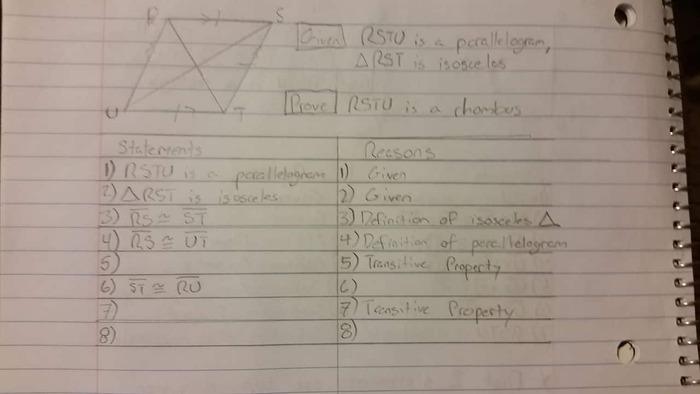
20160214_161326.jpg
 
Physics news on Phys.org
Joodez said:
I believe I could work this problem fine had the instructor not placed statements #3,4, and 6, as well as the reasons # 5 and 7. I can't seem to understand where he's using the transitive property in #5. If these steps weren't here I would assume, I'm only using substitution to prove that "RS" = "RU" and therefore satisfies, along with the parallelogram statement, that this quadrilateral or parallelogram is indeed a rhombus. Coming from the statement of a parallelogram and knowing the congruency of two of the adjacent sides, I just don't understand why there's any need for a transitive property. Does anyone have any ideas or a direction they can lead me in?

20160214_161326.jpg
Your image doesn't show in the thread.

In your own words, how do you state the transitive property?
 
The transitive property of equality states that: a=b, b=c, therefore; a=c

3vfoKCn.jpg


direct link: http://i.imgur.com/3vfoKCn.jpg

I uploaded the image to a different provider. Let me know if there are still any issues. I would write down the statements and reasons, but without the rhombus picture, it may be hard to visualize what's going on.
 
Joodez said:
The transitive property of equality states that: a=b, b=c, therefore; a=c

3vfoKCn.jpg


direct link: http://i.imgur.com/3vfoKCn.jpg

I uploaded the image to a different provider. Let me know if there are still any issues. I would write down the statements and reasons, but without the rhombus picture, it may be hard to visualize what's going on.
I could see it OK in my reply panel, but not directly in your post.

The transitive property should hold equally well for congruence, so what's wrong with using it as follows:

ST ≅ RU , RU ≅ UT , ∴ ST ≅ UT
 
Given x=y and y=z, what can you deduce? Does that not depend on the transitivity of equality!
By the way, I'm not aware that triangle RST being isosceles implies a specific two sides are equal, so I don't know how we get statement 3. Could it not be RS=RT?
 
SammyS said:
I could see it OK in my reply panel, but not directly in your post.

The transitive property should hold equally well for congruence, so what's wrong with using it as follows:

ST ≅ RU , RU ≅ UT , ∴ ST ≅ UT
I'm having a problem with the fact that we find this congruence:

ST ≅ RU

Although the instructor forced that congruence into the statement located directly below. The only reason I have those boxes prefilled is because they were done so by the instructor. Maybe this doesn't break what your saying, and I don't think it does. What you state is perfectly logical from my understanding, however, the instructor seems to have found some transitive property just before the "ST ≅ RU" statement. If you understand why this is done, could you please explain it to me. Is he simply utilizing a reflexive property to state what is already stated through the transitive property above?
 
haruspex said:
Given x=y and y=z, what can you deduce? Does that not depend on the transitivity of equality!
By the way, I'm not aware that triangle RST being isosceles implies a specific two sides are equal, so I don't know how we get statement 3. Could it not be RS=RT?
Yipes, thanks for pointing this out. Only two sides of an isosceles triangle "must" be equivalent. Alright, I'm going to have to rework this from there on a bit and see what I come out with. Sorry for posting incorrect calculations in the problem above, in fact, let me post the original problem from the worksheet so as not to derail anyone.

1MzZelo.png
 
Joodez said:
Yipes, thanks for pointing this out. Only two sides of an isosceles triangle "must" be equivalent. Alright, I'm going to have to rework this from there on a bit and see what I come out with. Sorry for posting incorrect calculations in the problem above, in fact, let me post the original problem from the worksheet so as not to derail anyone.

1MzZelo.png
Seems to me that you have to assume the case RS=ST or it is not necessarily true that the figure is a rhombus. So go with your original attempt and just fill in the remaining blanks. It's just a poorly specified question, or maybe there's some convention I don't know whereby "ABC is isosceles" implies that AB and BC are equal.
 
Alright, so now that I realize that this:
RS ≅ RT
is just as possible with the given information as this:
RS ≅ ST
and this:
ST ≅ RT
so...
how can it be proven at all that this object is a rhombus? Because it is a parallelogram, side RS ≅ UT and ST ≅ RU. This is given, based upon the formula for a parallelogram instead of that of the Isosceles.

From here, I don't realize how a transitive property statement is eligible to be made. If "ST ≅ RT", then how can we be certain that side ST will ever be congruent to side RS?
 
  • #10
haruspex said:
Seems to me that you have to assume the case RS=ST or it is not necessarily true that the figure is a rhombus. So go with your original attempt and just fill in the remaining blanks. It's just a poorly specified question, or maybe there's some convention I don't know whereby "ABC is isosceles" implies that AB and BC are equal.
This is exactly the issue I see with the way this problem is formatted. I too am unaware as to the reasoning behind "triangle" RST defining RS ≅ ST. This just doesn't add up to me.

If I am to assume the original "incorrect" train of thought, what statement could the teacher be making in #5 to provide the transitive property reason? I think he's inferring this:

ST ≅ UT, because RS ≅ ST and RS ≅ UT

I see the transitive property being used for that statement, I guess, but after the fact that I can't solidify which sides are which for that isosceles, I don't really follow the current train of thought. To me, it seems like the entirety of this statement is broken unless, the format "triangle" RST means S is the vertex at which RS and ST are declared ≅.
 
  • #11
Joodez said:
Alright, so now that I realize that this:
RS ≅ RT
is just as possible with the given information as this:
RS ≅ ST
and this:
ST ≅ RT
so...
how can it be proven at all that this object is a rhombus? Because it is a parallelogram, side RS ≅ UT and ST ≅ RU. This is given, based upon the formula for a parallelogram instead of that of the Isosceles.

From here, I don't realize how a transitive property statement is eligible to be made. If "ST ≅ RT", then how can we be certain that side ST will ever be congruent to side RS?
upload_2016-2-14_18-48-15.png


The instructor's reason given for #3 is that ΔRST is isosceles. Yes, it should have been stated in the given which two sides are congruent. However, wasn't that indicated in the figure?
 
  • #12
SammyS said:
View attachment 95844

The instructor's reason given for #3 is that ΔRST is isosceles. Yes, it should have been stated in the given which two sides are congruent. However, wasn't that indicated in the figure?
It is not indicated in the printed version in post #7.
 
  • #13
There's at least a hint of it here from the original figure.
upload_2016-2-14_19-30-59.png
 
  • #14
SammyS said:
There's at least a hint of it here from the original figure.
View attachment 95853
Sure, but I presumed that was from Joodez' interpretation of the information.
 
  • #15
haruspex said:
Sure, but I presumed that was from Joodez' interpretation of the information.
Aye, that was my original (now taken back) interpretation of what I was actually considering to be an "equilateral" triangle.

Below is what I found to be the finished proof, assuming that the isosceles triangle given means that RS = ST.

KNAUv8k.jpg
 
  • #16
My browser needed updating & was giving me fits, so I missed some of these posts. I see now.
 
  • #17
SammyS said:
My browser needed updating & was giving me fits, so I missed some of these posts. I see now.
No worries, it happens to the best of us. Thank you to you, SammyS, and haruspex. You helped me out a lot here, by pointing out the things you did.
 

Similar threads

Replies
6
Views
2K
  • · Replies 4 ·
Replies
4
Views
3K
  • · Replies 1 ·
Replies
1
Views
1K
  • · Replies 1 ·
Replies
1
Views
4K
  • · Replies 12 ·
Replies
12
Views
3K
  • · Replies 18 ·
Replies
18
Views
5K
  • · Replies 2 ·
Replies
2
Views
3K
  • · Replies 2 ·
Replies
2
Views
3K
Replies
6
Views
8K
  • · Replies 10 ·
Replies
10
Views
5K