Proving differentiability for a function from the definition

1 reply · 1K views · last reply
member 731016
Homework Statement
Please see below
Relevant Equations
Please see below
For this problem,
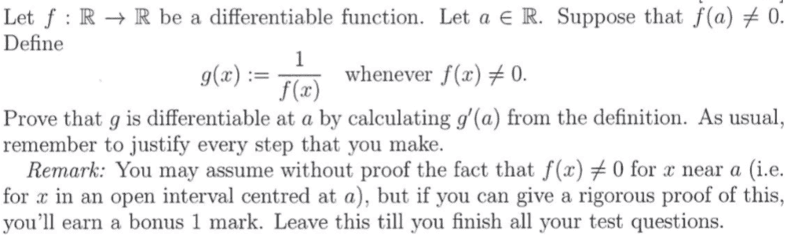
Printed exam question: let f be a differentiable function from R to R with f(a) not equal to 0, define g(x) = 1/f(x) where f(x) is not 0, and prove g is differentiable at a by computing g'(a) from the definition, with an optional bonus remark.

The solution is,
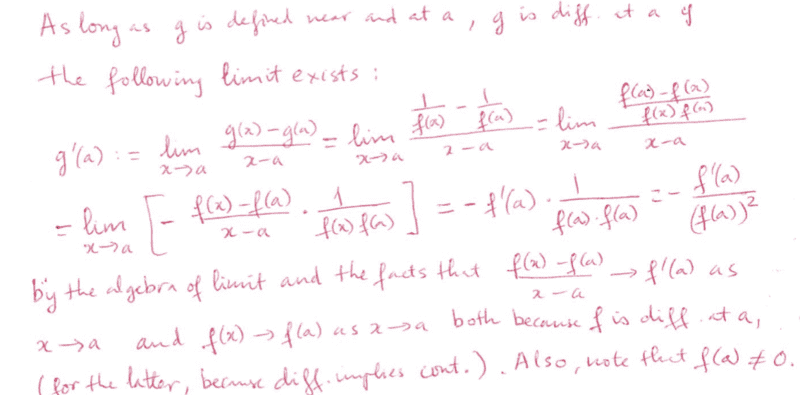
Handwritten derivation of the derivative of g = 1/f at a, showing g'(a) as a limit of difference quotients, simplified to -f'(a)/(f(a))^2, with a note that f(a) is nonzero.

However, does someone please know why we allowed to assume that the derivative exists for f i.e ##f'(a) = \lim_{x \to a} \frac{f(x) - f(a)}{x - a}##?

Thanks!
 
ChiralSuperfields said:
Homework Statement: Please see below
Relevant Equations: Please see below

For this problem,
View attachment 345049
The solution is,
View attachment 345050
However, does someone please know why we allowed to assume that the derivative exists for f i.e ##f'(a) = \lim_{x \to a} \frac{f(x) - f(a)}{x - a}##?

Thanks!
Because of the first sentence: Let ##f## be a differentiable function.
 
  • Like
  • Love
Likes   Reactions: SammyS, nuuskur and member 731016