Discussion Overview
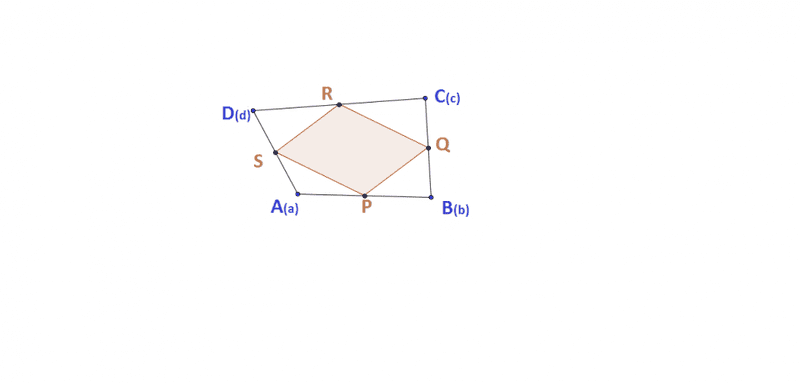
The discussion revolves around the proof that the midpoints of the sides of a quadrilateral form a parallelogram, focusing on the use of position vectors and the choice of origin in vector representation.
Discussion Character
- Technical explanation
- Mathematical reasoning
- Debate/contested
Main Points Raised
- Some participants discuss the placement of the origin when defining position vectors for points A, B, C, and D.
- It is suggested that the origin can be placed at any convenient point, such as point A, which simplifies calculations.
- There is a proposal to use the formula for the position vector of the midpoint, with some participants indicating that using the origin at A makes the calculations simpler.
- Participants question the relationship between the position vectors of points Q and P in the context of defining a parallelogram.
- One participant states that a parallelogram has opposite sides that are parallel and equal in length, contributing to the understanding of the geometric properties involved.
- There is a clarification that the expression for the vector PQ is derived from the position vectors of Q and P, leading to a discussion about the definitions involved in proving the properties of a parallelogram.
Areas of Agreement / Disagreement
Participants generally agree on the flexibility of choosing the origin for position vectors, but there is no consensus on the specific implications of this choice for proving the properties of the parallelogram.
Contextual Notes
Some participants express uncertainty about the standard formulas and definitions related to position vectors and parallelograms, indicating a need for clarity on these concepts.