Putting a slab of some material just after the slits in Young's model

Click For Summary
SUMMARY

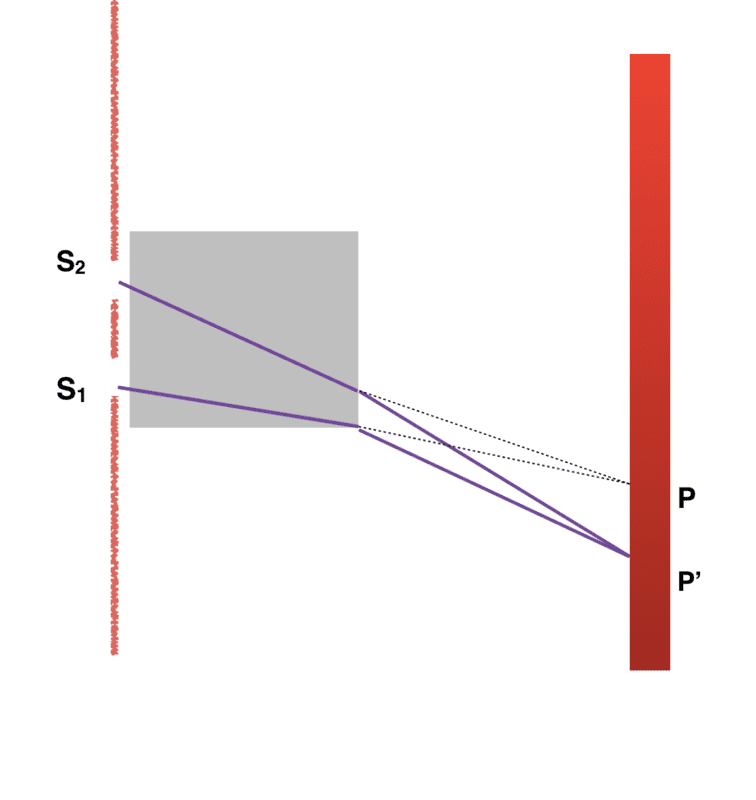
The discussion focuses on the impact of placing a slab with refractive index \(\mu\) and width \(D\) in front of the slits in Young's Double Slit experiment. The introduction of the slab causes the light rays to bend, resulting in a shift of the interference pattern from point \(P\) to point \(P'\). The participants explore the derivation of path difference equations, emphasizing the necessity of using optical path length instead of geometric path length due to the varying speed of light in different media. The final equations for constructive interference are established as \(d \frac{n_1}{n_2} \sin\theta_1 = m\lambda\), where \(m\) is an integer and \(\lambda\) is the wavelength in air.

PREREQUISITES
  • Understanding of Young's Double Slit experiment
  • Knowledge of Snell's Law and refractive indices
  • Familiarity with wave properties, including wavelength and phase difference
  • Basic trigonometry for calculating path differences
NEXT STEPS
  • Study the derivation of optical path length in different media
  • Learn about the effects of varying refractive indices on wave behavior
  • Explore the mathematical formulation of interference patterns in optics
  • Investigate the implications of slab thickness on interference patterns
USEFUL FOR

Physics students, optical engineers, and educators interested in wave optics and interference phenomena.

Adesh
Messages
735
Reaction score
191
Homework Statement
Find the equations of path difference and the equations for maxima and minima.
Relevant Equations
#path~difference ~= d\sin\theta#.
If I put a slab of some material whose refractive index is \mu and width is D, in front of slits in Young's Double Slit model, then
SEND 11.29.07 PM.png

In the figure you can see that I have placed the slab just after the slits. So, when rays going to come out of the slab they will bend away from normal (here I'm assuming that the material of the slab is optically denser than the air) and due to this bend they will intersect at P' and if the slab were to be absent they would have met at P. So, a pattern at P has shifted to P' but what is the itexematics of it? How to derive equations for path difference in this situation? Do we draw a perpendicular from S_1 to S_2P like usual, but S_2P is not a single line it gets bent just after the slab. How should I begin?
 
Physics news on Phys.org
Adesh said:
Homework Statement:: Find the equations of path difference and the equations for maxima and minima.
Homework Equations:: #path~difference ~= d\sin\theta#.

If I put a slab of some material whose refractive index is \mu and width is D, in front of slits in Young's Double Slit model, then

View attachment 255168
In the figure you can see that I have placed the slab just after the slits. So, when rays going to come out of the slab they will bend away from normal (here I'm assuming that the material of the slab is optically denser than the air) and due to this bend they will intersect at P' and if the slab were to be absent they would have met at P. So, a pattern at P has shifted to P' but what is the itexematics of it? How to derive equations for path difference in this situation? Do we draw a perpendicular from S_1 to S_2P like usual, but S_2P is not a single line it gets bent just after the slab. How should I begin?
You have to determine the optical path difference between the rays separately in the slab and in air, and then add up the differences.
The optical path-length is the physical length multiplied by the refractive index.
You can consider the interfering waves parallel, as the screen is far away, and the distance between the slits is very small. No need to calculate with two angles of incidence. The parallel waves become a single wave.
 
  • Like
Likes   Reactions: Adesh
ehild said:
You have to determine the optical path difference between the rays separately in the slab and in air, and then add up the differences.
The optical path-length is the physical length multiplied by the refractive index.
You can consider the interfering waves parallel, as the screen is far away, and the distance between the slits is very small. No need to calculate with two angles of incidence. The parallel waves become a single wave.
In your short answer you have given me so much information, thank you for that.

Should I do that perpendicular thing one time in the slab and then in the air? I really want to know why we have to use optical path length in this case, why does geometric path length (the simple case from where we derive ##path ~difference ~= d\sin\theta##) doesn’t work here?
 
The interference of two parallel traveling waves depend on the phase difference between them. The speed of light in a medium depends on the refractive index, so the wavelength is different in different media.
If the wavelength becomes shorter, the same distance traveled causes greater phase change.
What is the Mathematical form of a wave traveling in the direction x?
 
  • Like
Likes   Reactions: Adesh and Orodruin
ehild said:
If the wavelength becomes shorter, the same distance traveled causes greater phase change.
Does this conclusion came from $$ phase ~difference ~= \frac{2\pi}{\lambda} x$$
Where ##x## is the path difference? I’m not able to think intuitively about it. I understand that when ##\lambda ## decreases the value of the expression increases (because when denominator decrease the value of the expression gets bigger) but how to think of it intuitively.
ehild said:
What is the Mathematical form of a wave traveling in the direction x?
##y(x,t) = A \cos (\omega t - kx)##.
 
Adesh said:
Does this conclusion came from $$ phase ~difference ~= \frac{2\pi}{\lambda} x$$
Where ##x## is the path difference?
Yes. And how does the wavelength in a medium depend on the refractive index?
Adesh said:
I’m not able to think intuitively about it. I understand that when ##\lambda ## decreases the value of the expression increases (because when denominator decrease the value of the expression gets bigger) but how to think of it intuitively.

##y(x,t) = A \cos (\omega t - kx)##.
The "k" in the formula is the "wavenumber" 2pi/lambda.
You know that a wave is periodic both in time and place. If the time period is T, the wave travels ##\lambda=vT## distance in one period. V= c/n where c is the speed of light in vacuum and n is the refractive index. The refractive index in materials is usually greater then in vacuum where it is 1, so the wavelength is shorter in a medium than in vacuum.
 
ehild said:
Yes. And how does the wavelength in a medium depend on the refractive index?

The "k" in the formula is the "wavenumber" 2pi/lambda.
You know that a wave is periodic both in time and place. If the time period is T, the wave travels ##\lambda=vT## distance in one period. V= c/n where c is the speed of light in vacuum and n is the refractive index. The refractive index in materials is usually greater then in vacuum where it is 1, so the wavelength is shorter in a medium than in vacuum.
So, that means the wave will travel a shorter distance in time ##T## because speed is reduced. Therefore, the distance traveled in time ##T## is (when a medium of refractive index n is placed) $$ \lambda_n = v_n T$$.
Am I right? What to do next?
 
Adesh said:
So, that means the wave will travel a shorter distance in time ##T## because speed is reduced. Therefore, the distance traveled in time ##T## is (when a medium of refractive index n is placed) $$ \lambda_n = v_n T$$.
Am I right? What to do next?
How is the wavelength in the medium related to the vacuum wavelength? Did you mean, that it is the vacuum wavelength divided by the refractive index?
You wrote that the phase difference is ## \frac{2\pi}{\lambda} x##
what is equal to ##\frac{2\pi}{\lambda_0/n} x=\frac{2\pi}{\lambda_0 }nx## as if the distance traveled was multiplied by n.
Assume an angle of incidence, determine the geometric path difference in the slab, if there is any, multiply it by the refractive index. Add the path difference arising in the vacuum, outside the slab.
 
Last edited:
  • Like
Likes   Reactions: Adesh
4OwcW.gif


In this diagram I have drawn the rays parallel because it would make geometry easier to see.

PHYSICSFORUMS.png
I have drawn perpendiculars ##S_1A## and ##S'_1A'## on the rays ##S_2A## and ##S'_2A'##. By simple geometry angle ##S_2 S_1A = \theta_1## and ##S'_2 S'_1 A' =\theta_2## . Now, by trigonometry ## S_2 A = d \sin\theta_1## and ##S'_2 A' = d\sin\theta_2##. Therefore, $$ total~path~difference~= d\sin\theta_1 + d\sin\theta_2$$. Am I correct so far?
 
  • #10
Adesh said:
In this diagram I have drawn the rays parallel because it would make geometry easier to see.

View attachment 255171
There is also a path difference between the rays at the exit from the slab.
1578226125289.png
 
  • Like
Likes   Reactions: Adesh
  • #11
ehild said:
There is also a path difference between the rays at the exit from the slab.
View attachment 255174
Does that mean the two rays were of equal length inside the slab? So, total path difference is ##d\sin\theta_2## ?
 
  • #12
Adesh said:
Does that mean the two rays were of equal length inside the slab? So, total path difference is ##d\sin\theta_2## ?
Yes.
 
  • Like
Likes   Reactions: Adesh
  • #13
ehild said:
Yes.
By Snell’s Law $$ n_1 \sin\theta_1 = n_2\sin\theta_2 \\
\sin\theta_2 = \frac{n_1}{n_2} \sin\theta_1$$
Therefore, the path difference is ## d ~\frac{n_1}{n_2} ~\sin\theta_1##. So, for constructive interference we have $$ d~\frac{n_1}{n_2} ~ \sin\theta_1 = m\lambda$$ where ##m## is any integer and ##\lambda## is wavelength of the wave in medium with refractive index ##n_1## (that is air in our case).

So, why does the thickness of the slab matters? This equation is totally independent of width of the slab. Please explain.
 
  • #14
Adesh said:
So, why does the thickness of the slab matters? This equation is totally independent of width of the slab. Please explain.
You got the condition for constructive interference in terms of the angles - theta1 or theta2. But you observe the light spots on a screen. At what distance x is the first spot from the central one? Assume the slab has thickness T and the screen is at distance L from the slits.
What happens if you observe the spots on the rare side of the slab (which is matted)?
 
  • Like
Likes   Reactions: Adesh
  • #15
ehild said:
You got the condition for constructive interference in terms of the angles - theta1 or theta2. But you observe the light spots on a screen. At what distance x is the first spot from the central one? Assume the slab has thickness T and the screen is at distance L from the slits.
What happens if you observe the spots on the rare side of the slab (which is matted)?
Okay. So, when we solve for shifting we need to consider the thickness, I got it.
Thank you so much. I learned very much today from you.
 

Similar threads

  • · Replies 7 ·
Replies
7
Views
6K
  • · Replies 1 ·
Replies
1
Views
3K
Replies
5
Views
4K
Replies
8
Views
25K
  • · Replies 5 ·
Replies
5
Views
2K
Replies
2
Views
4K
  • · Replies 1 ·
Replies
1
Views
3K
  • · Replies 24 ·
Replies
24
Views
24K