Quadratic Conformal Mapping with Parameters | QP

  • Context: Graduate 
  • Thread starter Thread starter benpaulthurston
  • Start date Start date
  • Tags Tags
    conformal mapping
Click For Summary

Discussion Overview

The discussion revolves around the topic of quadratic conformal mapping with parameters, exploring mathematical formulations and potential applications in General Relativity. Participants share formulas, programming approaches, and seek clarification on the representation of these mappings.

Discussion Character

  • Exploratory
  • Technical explanation
  • Mathematical reasoning

Main Points Raised

  • One participant presents a formula for quadratic conformal mapping and expresses uncertainty about its relation to General Relativity, mentioning a Python program for image processing.
  • Another participant clarifies that the variable Q in the formula can represent any of the X, Y, Z coordinates, suggesting that the formula's uniformity across axes may simplify the mapping process, though they remain uncertain about its overall utility.
  • A participant shares a detailed mathematical expression for a variable p, indicating the parameters involved and the range for variables s and t.
  • One participant introduces a matrix representation of the mapping but expresses dissatisfaction with it, seeking feedback on whether the matrix A has established applications elsewhere.
  • A later reply corrects a previous error regarding the representation of vectors in the matrix and contemplates the use of tensor products to potentially enhance the matrix representation.

Areas of Agreement / Disagreement

Participants do not appear to reach a consensus on the best representation or application of the quadratic conformal mapping, with multiple approaches and uncertainties expressed throughout the discussion.

Contextual Notes

Some limitations include the potential complexity of maintaining coordinate systems in General Relativity and the unresolved nature of the matrix representation and its applications.

benpaulthurston
Messages
5
Reaction score
0
I found this formula for doing a quadratic conformal map with parameters:
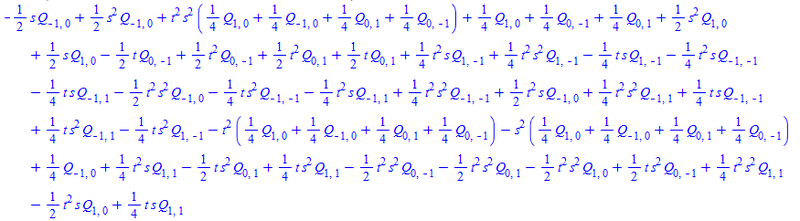
qts.PNG

I think there's probably a nice Einstein notation representation of this above but I haven't figured it out yet.. But anyway the mapping is like below:
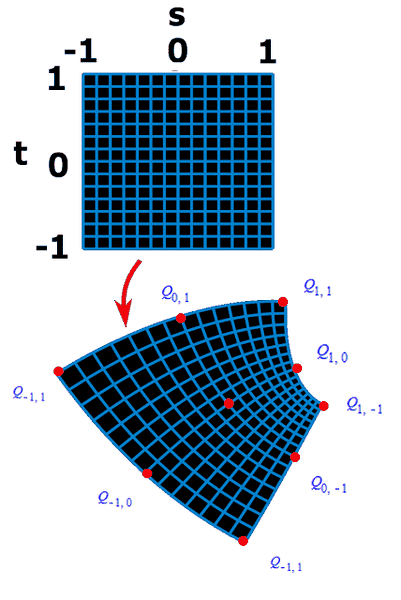
qts2.png


I don't know enough about General Relativity to know how this would fit in exactly, but so far I've written a program in Python to do this with images:

conformala.png


Any comments are appreciated, thanks!
 
Physics news on Phys.org
I guess I should have explained that Q in the above can be any of the X,Y,Z values it's the same formula for each, I've looked at some of the General Relativity formulas and it looked to me like it's a lot of effort to keep all the coordinate axis straight, this formula is the same for each coordinate axis separately so they can sort of be dealt with individually, but I'm not sure if that would help much or not...
 
If you want to have something you can copy and paste into a math program you can use this:
p = 1.0*((1/4)*b-(1/2)*s*b+(1/2)*s*s*b+(1/2)*t*t*d+(1/2)*t*d+(1/4)*e+(1/4)*g+
t*t*s*s*((1/4)*g+(1/4)*b+(1/4)*d+(1/4)*e)-(1/2)*t*t*s*g+(1/2)*s*s*g+
(1/2)*s*g-s*s*((1/4)*g+(1/4)*b+(1/4)*d+(1/4)*e)-t*t*((1/4)*g+(1/4)*b+
(1/4)*d+(1/4)*e)-(1/2)*t*t*s*s*e+(1/2)*t*s*s*e+(1/4)*t*s*f+(1/4)*t*s*s*f+
(1/4)*t*t*s*f+(1/4)*t*t*s*s*f-(1/4)*t*t*s*c-(1/4)*t*s*s*c+
(1/4)*t*t*s*s*c+(1/4)*t*s*c-(1/2)*t*t*s*s*g-(1/2)*t*e+(1/2)*t*t*e-
(1/2)*t*t*s*s*b+(1/2)*t*t*s*b+(1/4)*d-(1/2)*t*s*s*d-(1/2)*t*t*s*s*d+
(1/4)*t*t*s*s*a-(1/4)*t*s*a-(1/4)*t*t*s*a+(1/4)*t*s*s*a-(1/4)*t*s*s*h+
(1/4)*t*t*s*s*h+(1/4)*t*t*s*h-(1/4)*t*s*h)

The a,b,c,d,e,f,g,h are mapped like this:
conformal2.png


and s and t still range over -1..1
 

Attachments

  • upload_2016-1-2_10-38-21.png
    upload_2016-1-2_10-38-21.png
    4.7 KB · Views: 489
I found this matrix way of writing it, but I'm not entirely happy with it unless maybe someone happens to know if this matrix A is used somewhere else:
m.PNG

a.PNG

qst.png
 
Sorry in the above I put 2 t*s^2 in the column vector, I'm now wondering if maybe I make that column vector and the row vector two 3x3 matrices and use the tensor product if that makes A something nicer...
 

Similar threads

Replies
7
Views
3K
  • · Replies 5 ·
Replies
5
Views
3K
  • · Replies 5 ·
Replies
5
Views
3K
  • · Replies 6 ·
Replies
6
Views
2K
  • · Replies 5 ·
Replies
5
Views
2K
  • · Replies 31 ·
2
Replies
31
Views
3K
  • · Replies 2 ·
Replies
2
Views
2K
  • · Replies 2 ·
Replies
2
Views
16K
  • · Replies 2 ·
Replies
2
Views
2K
  • · Replies 1 ·
Replies
1
Views
4K