Quantum Entanglement: Changes at E1 & E3 Affecting Particle A

Click For Summary
SUMMARY

This discussion centers on the implications of quantum entanglement and special relativity (SR) regarding the changes in the spin of entangled particles A and B. It is established that when particle B's spin is measured at events E1 and E3, the changes do not affect particle A's spin due to the breakdown of entanglement after the first measurement. Furthermore, the concept of "now" in SR is clarified as having no physical meaning, thus negating the idea that E1's or E3's "now" corresponds to E2. The conversation emphasizes the limitations of certain interpretations of quantum mechanics (QM) regarding instantaneous changes in entangled particles.

PREREQUISITES
  • Understanding of Quantum Mechanics (QM) principles
  • Familiarity with Special Relativity (SR)
  • Knowledge of quantum entanglement and its implications
  • Basic grasp of particle spin and measurement in quantum systems
NEXT STEPS
  • Explore the concept of quantum entanglement in detail
  • Research the implications of Special Relativity on quantum measurements
  • Study different interpretations of Quantum Mechanics, particularly those addressing entanglement
  • Investigate the phenomenon of measurement in quantum systems and its effects on entangled particles
USEFUL FOR

Physicists, quantum mechanics researchers, students studying advanced physics, and anyone interested in the foundational concepts of quantum entanglement and its relationship with special relativity.

Stephanus
Messages
1,316
Reaction score
104
Dear PF Forum,
I have a question regarding Quantum Entanglement.
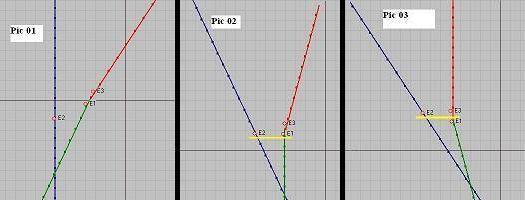
QE.JPG

I don't know much about QE, but there's something that I want to know.
Two particles are entangled.
Blue line is the world line of Particle A

See Pic 02
Particle B travels according to Green line.
And at E1 Particle B's spin is changed (is that how we say it in QM?) so the "change" is reflected in Particle A, right.
A: Is it true that E1's "now" is at E2, according to SR?

Now Particle B accelerates a little so its word line is the Red Line. See Pic 02
And at E3 Particle B's spin is changed, now the change (Pic 03) is reflected at E2
B: Is it true that E3's "now" is at E2 ,according to SR?

C: Can, at E2, particle A is changed according to two different events?

Thank you very much
 
Physics news on Phys.org
The "event" would properly be the event that the spin was measured.
 
  • Like
Likes   Reactions: Stephanus
Stephanus said:
And at E1 Particle B's spin is changed (is that how we say it in QM?) so the "change" is reflected in Particle A, right.

The usual way would be to say that a measurement is made of particle B's spin, which, at least according to some interpretations of QM, forces particle A's spin to change "instantaneously". But no measurement is being made of particle A's spin, so the question of "when" particle A's spin changes is physically meaningless--indeed, the claim that "particle A's spin changes" is itself physically meaningless.

Stephanus said:
Is it true that E1's "now" is at E2, according to SR?

No. SR says that the concept of "now" has no physical meaning.

Stephanus said:
at E3 Particle B's spin is changed, now the change (Pic 03) is reflected at E2

No; particle B's spin is measured a second time, but just as above, since no measurement is being made of particle A's spin, the question of "when" particle A's spin changes is physically meaningless, as is, indeed, the claim that particle A's spin "changes" at all.

There is also another factor you are overlooking: even on the interpretations of QM where the first measurement of particle B's spin "changes" particle A's spin "instantaneously", via entanglement, that process also breaks the entanglement. So on this interpretation, when the second measurement of particle B's spin is made, it no longer does anything to particle A's spin because the two are no longer entangled.

Stephanus said:
Is it true that E3's "now" is at E2 ,according to SR?

No. See above.

Stephanus said:
Can, at E2, particle A is changed according to two different events?

No. See above.

What this scenario is really illustrating is the limitations of the interpretation of QM that says that a measurement of one entangled particle "instantaneously" changes a property of the other entangled particle. The best way to deal with this is to drop that interpretation.
 
  • Like
Likes   Reactions: Stephanus

Similar threads

  • · Replies 40 ·
2
Replies
40
Views
5K
  • · Replies 4 ·
Replies
4
Views
1K
  • · Replies 24 ·
Replies
24
Views
2K
  • · Replies 41 ·
2
Replies
41
Views
5K
  • · Replies 17 ·
Replies
17
Views
4K
  • · Replies 9 ·
Replies
9
Views
2K
  • · Replies 8 ·
Replies
8
Views
1K
  • · Replies 33 ·
2
Replies
33
Views
3K
  • · Replies 4 ·
Replies
4
Views
2K
Replies
79
Views
9K