Quantum Hall Effect resistivity

Click For Summary

Discussion Overview

The discussion centers on the behavior of resistivity in the context of the quantum Hall effect, particularly in relation to the density of states (DOS) and the implications of scattering. Participants explore the relationship between resistivity and the availability of scattering states, as well as the role of edge states and conductivity components.

Discussion Character

  • Exploratory
  • Technical explanation
  • Debate/contested

Main Points Raised

  • One participant questions why resistivity remains constant when there are no available states to scatter into, suggesting a connection to the density of states.
  • Another participant proposes that in scenarios with more free states, scattering increases, leading to higher resistivity.
  • A participant explains that back scattering is absent due to chiral edge states, with the direction determined by the magnetic field.
  • There is mention of a phase transition occurring when the energy gap closes, transitioning the system from an insulator to a metal, affecting both conductivity and resistivity.
  • Clarifications are made regarding the quantization of Hall conductance, noting that it applies only to the σxy component, while the σxx component is zero in the presence of a gap.

Areas of Agreement / Disagreement

Participants express differing views on the relationship between resistivity and scattering states, with some proposing that increased scattering leads to higher resistivity, while others emphasize the absence of back scattering in chiral edge states. The discussion remains unresolved regarding the implications of these factors on resistivity behavior.

Contextual Notes

Participants highlight the complexity of the relationship between resistivity and the density of states, as well as the role of impurities and the nature of edge states. There is an acknowledgment of the need for further clarification on the differences between the σxx and σxy components.

rwooduk
Messages
757
Reaction score
59
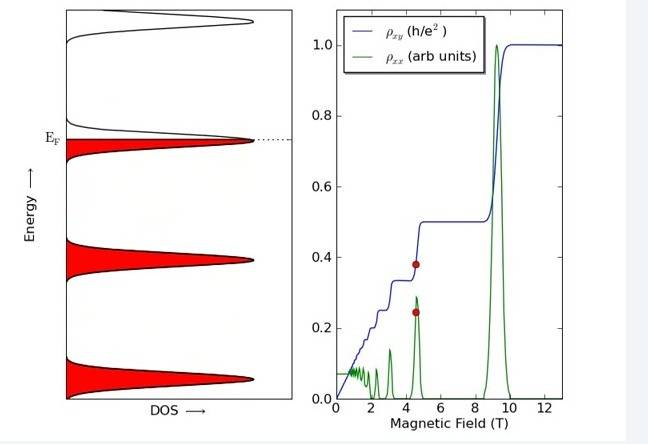
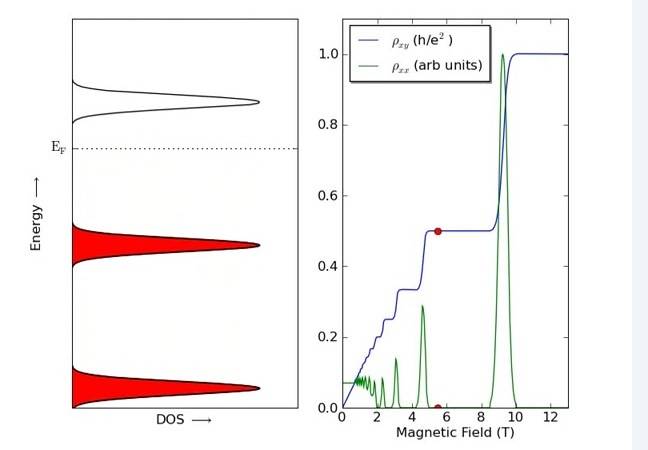
I'm having trouble understanding why the resistivity behaves as it does in comparison to the density of states for the quantum hall effect. Take the following two diagrams:
(A)
Hf9ByOi.jpg

(B)
BIZp3X5.jpg


I understand that there can be no scattering in (A) because all states are full (i.e. no elastic) and the gap is too big to scatter inelastically. But why should the resistivity remain constant?

Also on (B) why does the resistivity increase when there are free states to scatter into? Is it saying scattering hinders conduction?

Having real trouble relating the DOS to resistivity. Any suggestions more than welcome.
 
Physics news on Phys.org
Ok, I'll update this. Since there are more free states in (b) the scattering increases and so does the resistivity.

For (A) when there are no states available it drops to zero.

^^ This is for the XY component. I'm still a little unsure of the difference (aside from direction) of the XX and XY plots. So any advice would be appreciated.
 
There is no back scattering because the edge states are chiral, the direction is determined by the B field. The diagonal components of the conductivity matrix (when you have the chemical potential between bands) are zero because there is no current along the direction of the electric field except when the gap closes. When this happens the system becomes a metal, both the conductivity and resistivity are then nonzero. The resistivity is the inverse of conductivity, there can be no resistivity for this reason, the inverse of conductivity is not diagonal it is off diagonal. When the gap closes there is a phase transition between an insulator with hall conductivity ne^2/h and (n+1)e^2/h. When there are impurities there is still no backscattering of the edge states, they will just go around the impurity. There can't be backscattering, the states are chiral.

The quantization of the hall conductance is not for the sigma xx it is only for sigma xy. If there is a gap, the system is an insulator, there can't be a current in the bulk (xx direction).
 
  • Like
Likes   Reactions: rwooduk
radium said:
There is no back scattering because the edge states are chiral, the direction is determined by the B field. The diagonal components of the conductivity matrix (when you have the chemical potential between bands) are zero because there is no current along the direction of the electric field except when the gap closes. When this happens the system becomes a metal, both the conductivity and resistivity are then nonzero. The resistivity is the inverse of conductivity, there can be no resistivity for this reason, the inverse of conductivity is not diagonal it is off diagonal. When the gap closes there is a phase transition between an insulator with hall conductivity ne^2/h and (n+1)e^2/h. When there are impurities there is still no backscattering of the edge states, they will just go around the impurity. There can't be backscattering, the states are chiral.

The quantization of the hall conductance is not for the sigma xx it is only for sigma xy. If there is a gap, the system is an insulator, there can't be a current in the bulk (xx direction).

Thats very helpful! Thank you!
 

Similar threads

  • · Replies 0 ·
Replies
0
Views
1K
  • · Replies 1 ·
Replies
1
Views
2K
  • · Replies 5 ·
Replies
5
Views
2K
  • · Replies 1 ·
Replies
1
Views
4K
  • · Replies 4 ·
Replies
4
Views
4K
  • · Replies 3 ·
Replies
3
Views
3K
  • · Replies 6 ·
Replies
6
Views
4K
  • · Replies 2 ·
Replies
2
Views
11K
  • · Replies 2 ·
Replies
2
Views
3K
  • · Replies 4 ·
Replies
4
Views
3K