Question About Current Transformers

Click For Summary
Using 100/5 current transformers (CTs) with an overload relay rated for low amperage can effectively protect a higher amperage circuit, provided the proper burden resistor is used. The trip rating of 4 amps refers to the secondary side of the CTs, and they can handle brief overload conditions without burning up, as long as the burden is correctly applied. However, if the secondary winding is disconnected while current flows in the primary, it can generate dangerously high voltages. The burden resistor must be selected based on the desired voltage across its terminals, with calculations for power rating based on current. Overall, as long as the CTs are not subjected to excessive primary currents or incorrect burden resistors, they should operate safely under normal and overload conditions.
Josh111
Messages
37
Reaction score
0
I am hoping to use a overload relay I have rated at a low amperage to protect a higher amperage circuit. I plan to use 100/5 current transformers and connect them to the line/load terminals of the overload relay.
The trip rating will be at 4 amps through the ct circuit but will have a time delay.

I am wondering if the current transformers will burn up when connected together through the relay or if they are made for this.

Will they burn up under normal operating conditions?

Will they burn up under overload/short circuit conditions only?
Attached is a diagram.
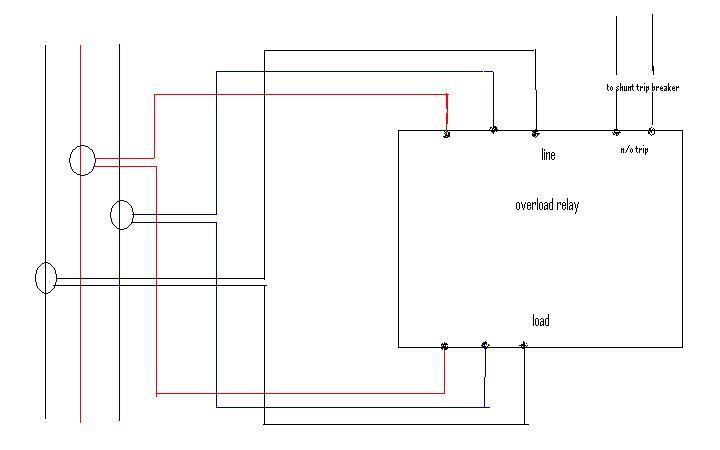
draw.JPG
 
Engineering news on Phys.org
When you say the trip will be at 4 amps, do you mean through the CT primary, or through the secondary? In any case, as long as you're not using the 100:5 CTs on a circuit with a primary current of much higher than 100 amps, you should be fine as long as you're using the proper burden resistor. They should be able to handle an overload condition for a short period of time without overheating; we test our equipment at a 2x overload condition for a minute or two and have never had a CT burn up unless the burden resistor was incorrect.
 
Last edited by a moderator:
negitron said:
When you say the trip will be at 4 amps, do you mean through the CT primary, or through the secondary? In any case, as long as you're not using the 100:5 CTs on a circuit with a primary current of much higher than 100 amps, you should be fine as long as you're using the proper burden resistor. They should be able to handle an overload condition for a short period of time without overheating; we test our equipment at a 2x overload condition for a minute or two and have never had a CT burn up unless the burden resistor was incorrect.

I mean 4 amps through the secondary. If it says 100/5 is that 5 amps when current is at 100 amps and the proper burden resistor is applied or when shorted.

What will happen when short circuit flows through circuit? 6000 line/neutral amps short circuit capacity generator. Will the CT's burn up?
 
Depends on how long the fault current exists. Although, in reality, you're more likely to burn up the burden resistors, in my experience CTs are well able to tolerate brief (<1 s) fault currents in excess of 100x rating. I don't think we've ever managed to actually burn one up, although metering circuitry has occasionally been destroyed due to overvoltage caused by open or missing burden resistors.
 
Last edited:
If it says 100/5 is that 5 amps when current is at 100 amps and the proper burden resistor is applied or when shorted.

If burden resistance is necessary how do you know what the burden is supposed to be and how do you determine the power rating of resistances if you don't know the voltages on the secondary?
 
Last edited:
The current through the burden resistor will be 5 amps for a 100-amp primary current, which means the larger the value of the burden, the higher the voltage across it (within limits; eventually the CT core will saturate). So, you choose your burden depending on the voltage you need to see across its terminals, using our old friend V = IR. Once you have that, you calculate the power rating with I2R.
 
negitron said:
The current through the burden resistor will be 5 amps for a 100-amp primary current, which means the larger the value of the burden, the higher the voltage across it (within limits; eventually the CT core will saturate). So, you choose your burden depending on the voltage you need to see across its terminals, using our old friend V = IR. Once you have that, you calculate the power rating with I2R.

So are you saying then that the greater the impedance of the load the greater the voltage drop? It seems the voltage drop is always the applied voltage.
Are you saying that the current will always be 5 amp regardless of resistance?

The overload relay measures current it would seem then that there should be no resistance through the load, (if that will not cause it to burn up) because resistance will limit current.
 
Last edited:
Josh111 said:
Are you saying that the current will always be 5 amp regardless of resistance?

Yes, up to the point where a high enough voltage drop causes the CT core to begin saturating. This is, in fact, true for any transformer. If the primary current is held constant, then the secondary current will be maintained at the level dictated by the turns ratio regardless of load resistance. On the other hand if, as is the usual case with power transformers, you hold the primary voltage more or less constant, then the secondary voltage will remain more or less constant over the current range the transformer was designed for.
 
Last edited:

Similar threads

Replies
3
Views
1K
  • · Replies 31 ·
2
Replies
31
Views
5K
  • · Replies 8 ·
Replies
8
Views
3K
  • · Replies 8 ·
Replies
8
Views
3K
  • · Replies 21 ·
Replies
21
Views
2K
Replies
12
Views
3K
  • · Replies 25 ·
Replies
25
Views
5K
Replies
21
Views
8K
  • · Replies 23 ·
Replies
23
Views
3K
  • · Replies 1 ·
Replies
1
Views
2K