Question about potential well schrodinger

Click For Summary

Discussion Overview

The discussion revolves around solving for constants in the context of the Schrödinger equation for a potential well. Participants explore numerical methods and algorithms to find energy eigenvalues and wave functions, addressing the challenges of iterative solutions and root-finding techniques.

Discussion Character

  • Technical explanation
  • Mathematical reasoning
  • Exploratory

Main Points Raised

  • One participant seeks assistance in understanding how to solve for constants in the wave function related to a potential well, mentioning the need for an iterative method.
  • Another participant suggests that the problem would be better suited for the Differential Equations forum.
  • A participant proposes transforming the equation into a specific form and using numerical root-finding algorithms, such as Newton's method, to find energy values.
  • Another participant emphasizes the importance of finding all solutions (energy eigenvalues) and suggests using graphical methods to identify solution boundaries, recommending the bisection method for its reliability.
  • A participant acknowledges the utility of root-finding algorithms and mentions using MATLAB for visualization and numerical solutions, noting the existence of built-in functions for this purpose.

Areas of Agreement / Disagreement

Participants express various approaches to solving the problem, with no consensus on a single method. Different numerical techniques are discussed, indicating a range of opinions on the best approach.

Contextual Notes

Participants highlight the need for clarity on the definitions of constants and the specific form of the equations involved, as well as the importance of identifying all possible solutions in the context of energy eigenvalues.

Who May Find This Useful

Individuals interested in numerical methods for solving differential equations, particularly in quantum mechanics and potential well problems, may find this discussion beneficial.

ChaseRLewis
Messages
43
Reaction score
0
So been self-studying till this point and it has been pretty easy / generic with the PDE's. At this point though the math gets a bit more out of my depth and was curious if someone might lend a hand in helping me understand what is going on.

My question is pretty much is there a good algorithm to solve for the constants given the situation below. To solve this problem it requires an iterative method to find the constants for the wave function that meets the requirements based on the potential.

given n = 1 you get
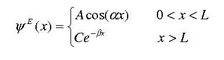
3360718083_5ff4ba5b07.jpg


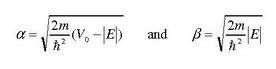
giving you the following solution for the constants alpha and beta

3360727877_01278918f2.jpg


each constant having the value of

3361532710_9c767d3dfb.jpg


so to solve for the energy (and thus the wave equation) for an arbitrary potential value

you must solve for the constants that satisfies the potential value. (This is called an Eigenvector right?)
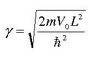
3361554890_f2e7469862.jpg

the L2 is because they transformed the alpha and beta values to unitless dimensions (these are pics from a website I'm using to supplement my understanding : P easier than typing all this).
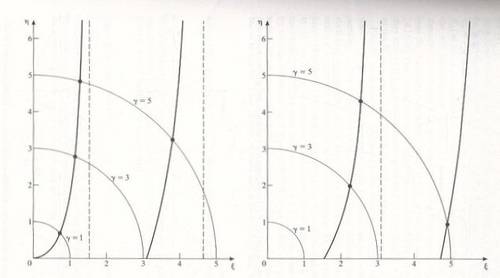
3361964472_0fbc0e421f.jpg
TL:DR; Longwinded, question to basically ask is there a good marching algorithm to solve this type of problem for the given constants? Google isn't giving me much, at this point unfortunately.
 
Physics news on Phys.org
A good question to ask on the Diff Eq forum.
 
Put the equation in the form ##\alpha \tan (\alpha L) - \beta = 0##, substitute for ##\alpha## and ##\beta##, insert numerical values for all quantities except E, and use any numerical root-finding algorithm (e.g. Newton's method) to find the roots (the values of E that make the left side equal to zero).
 
It has been a long time that I've done this calculation numerically. The problem is not to find a solution but to find all solutions (energy eigenvalues). The good thing in this case is, you can easily read off from the equation, where the solutions must ly. It's easier to see by plotting the functions on the left-hand and right-hand side of the equation and look at the various branches of the tan function and the intersections of the two graphs of these functions.

Now, you know precisely boundaries between which necessarily one and only one energy eigenvalue must be located, and then the savest way is some method of nested intervals. I've been using the bisection method, which is perhaps not the fastest but a very safe way to find all the eigenvalues.
 
jtbell said:
Put the equation in the form ##\alpha \tan (\alpha L) - \beta = 0##, substitute for ##\alpha## and ##\beta##, insert numerical values for all quantities except E, and use any numerical root-finding algorithm (e.g. Newton's method) to find the roots (the values of E that make the left side equal to zero).

Ah root finding algorithm, I've been writing my own MATLAB code to help me visualize and do each of the equations and was trying to think of how to solve this numerically (i could easily do it in excel or a calculator just couldn't think of how to write a good algorithm that did it myself). In fact, quick doc search says MATLAB has a built-in function for finding roots. Thanks! Just couldn't find the right words.
 

Similar threads

Replies
2
Views
1K
  • · Replies 3 ·
Replies
3
Views
2K
Replies
20
Views
3K
  • · Replies 2 ·
Replies
2
Views
2K
  • · Replies 12 ·
Replies
12
Views
1K
  • · Replies 10 ·
Replies
10
Views
2K
  • · Replies 3 ·
Replies
3
Views
2K
  • · Replies 1 ·
Replies
1
Views
2K
  • · Replies 7 ·
Replies
7
Views
3K
  • · Replies 14 ·
Replies
14
Views
3K