Question about the role of mass in inclined planes

Join the discussion
Ask a follow-up here, or get your own question answered by working scientists, mathematicians and engineers — people, not an autocomplete.
Real named experts · corrections over time · the nuance an AI answer skips
5 replies · 3K views
tovisonnenberg
Messages
19
Reaction score
1
Hi! I have a question about inclined planes. In the diagram I attached, you can see that, with or without friction, mass does not affect the acceleration of the block. However, in my experience, the more people I put on my sled, the faster it goes. Why is this?
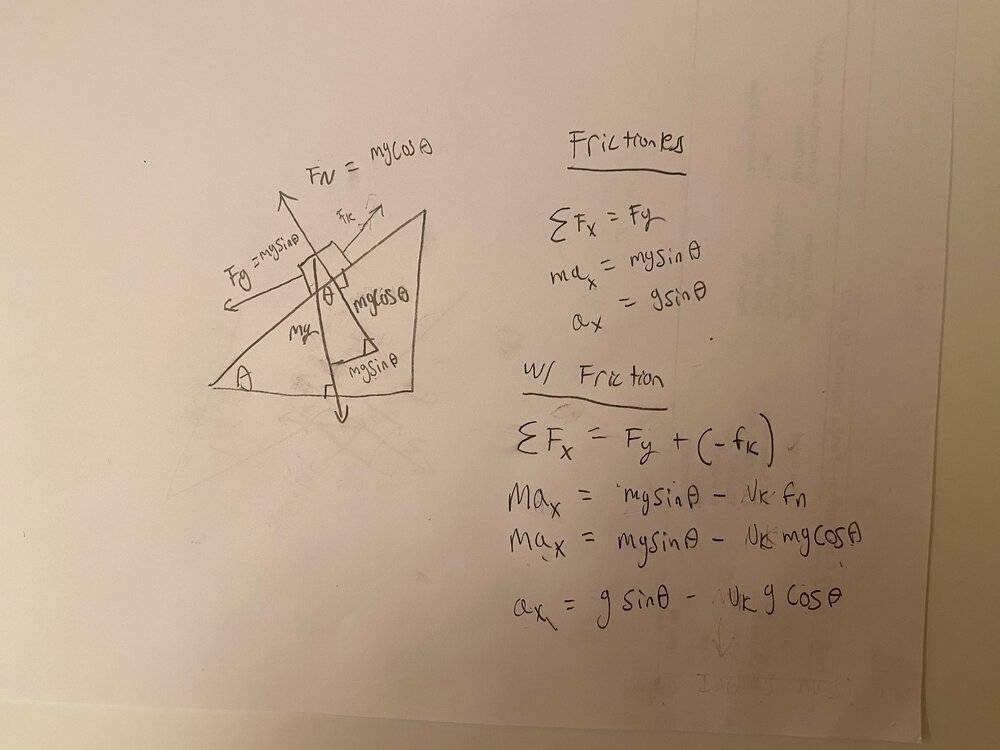
IMG_0005.jpeg
 
on Phys.org
russ_watters said:
Sled, as in snow? Snow doesn't work like a hard, dry surface for friction. It compacts and maybe even melts a little against the sled.
Ah, so a combination of greater compaction and a little melting decreases the coefficient of friction?
 
tovisonnenberg said:
Ah, so a combination of greater compaction and a little melting decreases the coefficient of friction?
Considerably. Every try ice-skating on a hardwood floor? Same principle
 
Reply
  • Like
Likes   Reactions: vanhees71, russ_watters and tovisonnenberg
So a related question is why wind resistance and rolling resistance are different from friction on an inclined plane. Clearly extra weight makes masses fall faster in air, and makes bike riders accelerate faster down hills...
 
tovisonnenberg said:
Hi! I have a question about inclined planes. In the diagram I attached, you can see that, with or without friction, mass does not affect the acceleration of the block. However, in my experience, the more people I put on my sled, the faster it goes. Why is this?
In general, air resistance depends on the surface area in the direction of travel. If one person is sitting behind another on the sled, then you have twice the mass and twice the gravitational force against almost the same air resistance.

For example, in the bob-sled competitions there is a maximum weight allowance.

https://adventure.howstuffworks.com/outdoor-activities/snow-sports/bobsled2.htm

"Heavier sleds go faster, so teams that do not reach the maximum occupied weight may add ballasts to make their bob heavier. Officials weigh the sleds at the end of the run to make sure they meet the weight requirement."

I guess it makes sense that all sleds are weighed up to the maximum - otherwise the heaviest team would probably win. I had no idea that teams could add ballast - but that does explain why generally there are only a few hundredths of a second between teams. The difference between first and last in a bob-sled competition is essentially experimental error!