Question about the Stern-Gerlach Experiment

  • Context: Graduate 
  • Thread starter Thread starter captainhampto
  • Start date Start date
  • Tags Tags
    Experiment Stern-gerlach
Join the discussion
Ask a follow-up here, or get your own question answered by working scientists, mathematicians and engineers — people, not an autocomplete.
Real named experts · corrections over time · the nuance an AI answer skips
3 replies · 4K views
captainhampto
Messages
12
Reaction score
0
I have a general question about the Stern-Gerlach experiment. When a spin 1/2-particle passes through the magnets, is that effectively equivalent to applying a Hadamard transform to the state of the particle going through the apparatus?

Also, let's say I wanted to create a quantum circuit to reflect the Stern-Gerlach experiment. Would that basically be equivalent to:

H|q0> -> (measurement occurs) -> |q0> = |up> or |q0> = |down>
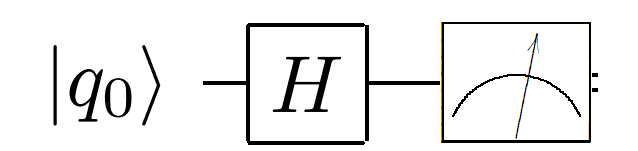
Untitled-1.png
 
Physics news on Phys.org
captainhampto said:
When a spin 1/2-particle passes through the magnets, is that effectively equivalent to applying a Hadamard transform to the state of the particle going through the apparatus?
Well, no. Could you elaborate on why you would think this?

Also, let's say I wanted to create a quantum circuit to reflect the Stern-Gerlach experiment. Would that basically be equivalent to:

H|q0> -> (measurement occurs) -> |q0> = |up> or |q0> = |down>
Untitled-1.png

Sort of. It depends on the direction of the magnetic field in the Stern-Gerlach apparatus. If the magnetic field points along the z-direction, then the Stern-Gerlach apparatus is measuring the spin along the z-axis, which is represented already by the "dial" symbol, so you should lose the Hadamard gate. If the magnetic field points along the x-axis, then you should be getting out particles with spin pointing along the +x or -x directions, so your circuit is still not quite right -- you need another Hadamard gate after the measurement.
 
Thanks again for the response cortiver, very much appreciated. So just for clarification, depending on the axis the Stern-Gerlach apparatus is measuring in, results in a differently constructed circuit?

So for the z-direction it is simply the measurement operation, the +x and -x require a Hadamard gate before and after the measurement? Also are there any specific papers/books that delve more into converting existing quantum mechanically based experiments into quantum computing analogies such as this one here (i.e. double slit experiment, interferometer, etc.)

Thanks again, I greatly appreciate the assistance.
 
captainhampto said:
Thanks again for the response cortiver, very much appreciated. So just for clarification, depending on the axis the Stern-Gerlach apparatus is measuring in, results in a differently constructed circuit?
Yes, measuring along different axes represents a different process, so obviously it needs a different circuit diagram to represent it. The "dial" symbol represents measurement along the z-axis -- you can get measurement along a different axis by combining with other gates, but you could also just define a new symbol to represent measurement along that axis.

So for the z-direction it is simply the measurement operation, the +x and -x require a Hadamard gate before and after the measurement? Also are there any specific papers/books that delve more into converting existing quantum mechanically based experiments into quantum computing analogies such as this one here (i.e. double slit experiment, interferometer, etc.)

Quantum computing deals with finite-dimensional quantum systems (e.g. spins). You can't represent continuous-space processes like two-slit interference in a quantum circuit diagram.