Question about travelling wave equation

  • Thread starter Thread starter Yoseph Santoso
  • Start date Start date
  • Tags Tags
    Wave Wave equation
Click For Summary
SUMMARY

The discussion centers on the traveling wave equation with a period T = 2s, leading to the derived wave equation y = -0.5 sin(πt - 0.5πx). Participants clarify that while the negative sign cannot be discarded, it represents a phase shift of π, resulting in an equivalent equation y = 0.5 sin(πt - 0.5πx + π). The amplitude, defined as a positive distance, remains unaffected by the sign change, emphasizing the importance of understanding amplitude as a magnitude rather than a negative value.

PREREQUISITES
  • Understanding of wave mechanics and wave equations
  • Familiarity with trigonometric functions and their properties
  • Knowledge of amplitude and phase shifts in waveforms
  • Basic grasp of mathematical notation and terminology in physics
NEXT STEPS
  • Study the concept of phase shifts in wave equations
  • Learn about the properties of sine and cosine functions in wave mechanics
  • Explore the implications of amplitude in physical systems
  • Investigate the relationship between wave frequency, wavelength, and speed
USEFUL FOR

Students of physics, educators teaching wave mechanics, and anyone interested in understanding the mathematical representation of waves and their properties.

Yoseph Santoso
Messages
19
Reaction score
0
There is a multiple choices question about traveling wave in my book.
Based on the graphic, if T = 2s, the wave equation is ...
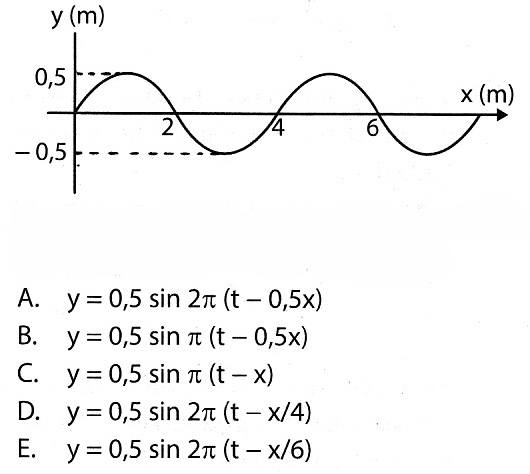
fis.jpg


My answer :
ω = 2π/T = 2π/2 = π
k = 2π/λ = 2π/4 = 0,5π → in my country, we use comma (,) for point (.)
y = ±A sin (ωt - kx)
y = -0,5 sin (πt - 0,5πx)
y = -0,5 sin π(t - 0,5x)

but the answer on my book is B. Could we throw the negative anyway?
 
Last edited:
Physics news on Phys.org
Yoseph Santoso said:
There is a multiple choices question about traveling wave in my book.
Based on the graphic, if T = 2s, the wave equation is ...

View attachment 258146

My answer :
ω = 2π/T = 2π/2 = π
k = 2π/λ = 2π/4 = 0,5π → in my country, we use comma (,) for point (.)
y = ±A sin (ωt - kx)
y = -0,5 sin (πt - 0,5πx)
y = -0,5 sin π(t - 0,5x)

but the answer on my book is B. Could we throw the negative anyway?
You can't just throw away the negative, but you can see it's the same equation as B with an additional phase of ##\pi##.
 
  • Like
Likes   Reactions: Yoseph Santoso
How do you get the minus sign?
 
PeroK said:
You can't just throw away the negative, but you can see it's the same equation as B with an additional phase of ##\pi##.
Amplitude itself is just distance
It can't be negative.
 
Adityameowmeow said:
Amplitude itself is just distance
It can't be negative.
Nobody was making the amplitude negative. If the equation is ##y=-A\sin(\omega t)##, where A>0, then the amplitude is A. Changing it to ##y=A\sin(\omega t)## would be wrong, but if you wish you can change it to ##y=A\sin(\omega t+\pi)##.
 
Adityameowmeow said:
Amplitude itself is just distance
A better term in English is "magnitude". Just like a vector has "magnitude" and "direction". :smile:
 

Similar threads

Replies
27
Views
3K
  • · Replies 8 ·
Replies
8
Views
2K
  • · Replies 6 ·
Replies
6
Views
2K
  • · Replies 5 ·
Replies
5
Views
10K
  • · Replies 6 ·
Replies
6
Views
3K
  • · Replies 4 ·
Replies
4
Views
2K
  • · Replies 5 ·
Replies
5
Views
2K
  • · Replies 3 ·
Replies
3
Views
2K
  • · Replies 10 ·
Replies
10
Views
5K
  • · Replies 1 ·
Replies
1
Views
1K