Question about travelling wave equation

  • Thread starter Thread starter Yoseph Santoso
  • Start date Start date
  • Tags Tags
    Wave Wave equation
Click For Summary

Homework Help Overview

The discussion revolves around a multiple-choice question regarding the traveling wave equation, specifically focusing on the implications of a negative amplitude in the equation derived from given parameters such as the period of the wave.

Discussion Character

  • Conceptual clarification, Assumption checking

Approaches and Questions Raised

  • Participants discuss the calculation of angular frequency and wave number, questioning the treatment of the negative sign in the wave equation. There is an exploration of whether the negative can be disregarded and how it relates to the phase of the wave.

Discussion Status

Some guidance has been offered regarding the interpretation of the negative sign in the wave equation, with a suggestion that it can be related to a phase shift. The conversation reflects a mix of interpretations regarding the amplitude and its representation in the equation.

Contextual Notes

Participants note that in their context, the representation of numbers uses a comma for decimal points, which may affect clarity in calculations. There is also a focus on the definition of amplitude and its implications in the context of the wave equation.

Yoseph Santoso
Messages
19
Reaction score
0
There is a multiple choices question about traveling wave in my book.
Based on the graphic, if T = 2s, the wave equation is ...
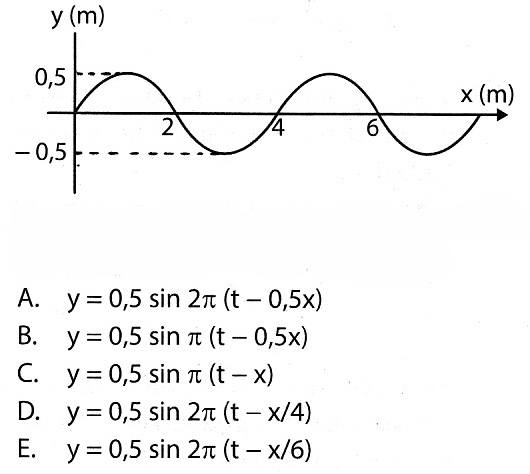
fis.jpg


My answer :
ω = 2π/T = 2π/2 = π
k = 2π/λ = 2π/4 = 0,5π → in my country, we use comma (,) for point (.)
y = ±A sin (ωt - kx)
y = -0,5 sin (πt - 0,5πx)
y = -0,5 sin π(t - 0,5x)

but the answer on my book is B. Could we throw the negative anyway?
 
Last edited:
Physics news on Phys.org
Yoseph Santoso said:
There is a multiple choices question about traveling wave in my book.
Based on the graphic, if T = 2s, the wave equation is ...

View attachment 258146

My answer :
ω = 2π/T = 2π/2 = π
k = 2π/λ = 2π/4 = 0,5π → in my country, we use comma (,) for point (.)
y = ±A sin (ωt - kx)
y = -0,5 sin (πt - 0,5πx)
y = -0,5 sin π(t - 0,5x)

but the answer on my book is B. Could we throw the negative anyway?
You can't just throw away the negative, but you can see it's the same equation as B with an additional phase of ##\pi##.
 
  • Like
Likes   Reactions: Yoseph Santoso
How do you get the minus sign?
 
PeroK said:
You can't just throw away the negative, but you can see it's the same equation as B with an additional phase of ##\pi##.
Amplitude itself is just distance
It can't be negative.
 
Adityameowmeow said:
Amplitude itself is just distance
It can't be negative.
Nobody was making the amplitude negative. If the equation is ##y=-A\sin(\omega t)##, where A>0, then the amplitude is A. Changing it to ##y=A\sin(\omega t)## would be wrong, but if you wish you can change it to ##y=A\sin(\omega t+\pi)##.
 
Adityameowmeow said:
Amplitude itself is just distance
A better term in English is "magnitude". Just like a vector has "magnitude" and "direction". :smile:
 

Similar threads

Replies
27
Views
4K
  • · Replies 8 ·
Replies
8
Views
2K
  • · Replies 6 ·
Replies
6
Views
2K
  • · Replies 5 ·
Replies
5
Views
10K
  • · Replies 6 ·
Replies
6
Views
3K
  • · Replies 4 ·
Replies
4
Views
2K
  • · Replies 5 ·
Replies
5
Views
2K
  • · Replies 3 ·
Replies
3
Views
2K
  • · Replies 10 ·
Replies
10
Views
5K
  • · Replies 1 ·
Replies
1
Views
1K