Question About Unit Circle (CircularFunction) of a Trig Func

Click For Summary

Discussion Overview

The discussion revolves around understanding the coordinates corresponding to the angle ##\sin (\frac{7π}{4})## on the unit circle, specifically how this angle relates to the coordinates ##(\frac{\sqrt {2}}{2}, -\frac{\sqrt{2}}{2})##. The scope includes conceptual understanding of trigonometric functions and their representation on the unit circle.

Discussion Character

  • Conceptual clarification
  • Debate/contested
  • Mathematical reasoning

Main Points Raised

  • One participant questions how to determine the coordinates for the angle ##\frac{7π}{4}##, noting that it corresponds to 315°.
  • Another participant suggests drawing the unit circle and marking the angle ##\frac{7π}{4}## to aid understanding.
  • A subsequent reply asks if drawing the unit circle is necessary.
  • One participant confirms that drawing the unit circle is indeed helpful.
  • Another participant provides a mathematical approach by suggesting to subtract ##2\pi## from the angle to find its equivalent angle in the first rotation, leading to ##-\frac{\pi}{4}##.
  • Another contribution describes the geometric interpretation of the angle on the unit circle, explaining how to visualize the relationship between the angle, the hypotenuse, and the sides of the right triangle formed.
  • A later reply offers a more straightforward approach, suggesting that memorizing the unit circle and using mnemonic devices can simplify the process of recalling the coordinates.

Areas of Agreement / Disagreement

Participants express differing views on the best approach to understanding the unit circle and the coordinates associated with specific angles. There is no consensus on a single method or explanation.

Contextual Notes

Some participants rely on visual aids while others suggest memorization techniques, indicating a variety of learning preferences and approaches to the topic.

basty
Messages
94
Reaction score
0
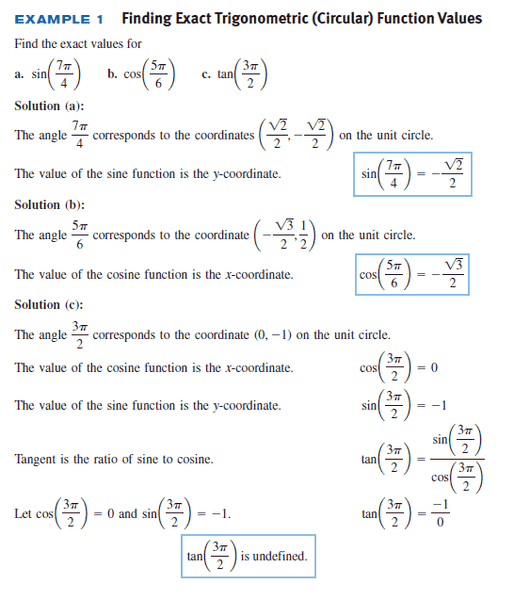
Please take a look below example (the attached image below).

How do I know that the angle ##\sin (\frac{7π}{4})## is corresponds to the coordinates ##(\frac{\sqrt {2}}{2}, -\frac{\sqrt{2}}{2})##?

I know that ##\frac{7π}{4}## is 315°.
circ_func.png
 
Mathematics news on Phys.org
Did you draw a unit circle and mark e.g. the ##7\pi \over 4## angle ?
 
BvU said:
Did you draw a unit circle and mark e.g. the ##7\pi \over 4## angle ?

Should I?
 
Yes
 
subtract ## 2\pi## that is ##\frac{7}{4}\pi -2\pi=\frac{7-8}{4}\pi=-\frac{\pi}{4}##...
 
If you draw a line from (0, 0) with length 1 and making angle [itex]\theta[/itex] with the x-angle and drop a perpendicular to the x-axis, then the distance to the foot of that perpendicular, along the x-axis is the "near side" of a right triangle with angle [itex]\theta[/itex] and hypotenuse 1. Similarly, the length of the perpendicular, parallel to the y-axis, is the "opposite side".
 
Well, I think any high school teacher I knew when I was teaching would have a simple answer:

Memorize the unit circle (which isn't so hard to do if notice the angular symmetries and remember the mnemonic device All Students Take Calculus in order to remember the signs).
 

Similar threads

  • · Replies 1 ·
Replies
1
Views
3K
  • · Replies 11 ·
Replies
11
Views
3K
  • · Replies 17 ·
Replies
17
Views
6K
Replies
8
Views
2K
  • · Replies 9 ·
Replies
9
Views
2K
  • · Replies 4 ·
Replies
4
Views
2K
  • · Replies 5 ·
Replies
5
Views
2K
  • · Replies 10 ·
Replies
10
Views
2K
  • · Replies 5 ·
Replies
5
Views
2K
  • · Replies 29 ·
Replies
29
Views
5K