Why do we care about trig identities?

Click For Summary

Discussion Overview

The discussion centers around the significance of trigonometric identities in mathematics and their applications in various fields such as engineering and physics. Participants explore the reasons for studying these identities, their practical uses, and the challenges of memorization and understanding.

Discussion Character

  • Exploratory
  • Conceptual clarification
  • Debate/contested
  • Homework-related

Main Points Raised

  • One participant questions the necessity of learning trigonometric identities, particularly the identity ##\cos u \cdot \sin v = \frac{1}{2} [\sin(u + v) - \sin(u - v)]##, expressing confusion about its practical application.
  • Another participant emphasizes the importance of the identity ##\sin^2 u + \cos^2 u = 1##, noting its relevance in various applications, including integration methods and physics.
  • Some participants suggest that learning identities is akin to memorizing basic arithmetic to facilitate solving complex problems without re-deriving them each time.
  • There are differing views on how many identities one should memorize, with some advocating for memorization of a few key identities while others suggest looking them up as needed.
  • A participant shares a personal experience in quantum mechanics, illustrating how trigonometric identities are crucial for understanding probabilities related to spin states.
  • One participant proposes that understanding the algebraic manipulation of identities can aid in memorization, rather than relying solely on visualization.
  • Another participant mentions the utility of certain identities in everyday applications, prompting questions about how others utilize these identities in their daily lives.

Areas of Agreement / Disagreement

Participants express a mix of agreement and disagreement regarding the necessity and methods of learning trigonometric identities. While some acknowledge their importance in various fields, others debate the extent to which they should be memorized versus referenced as needed. The discussion remains unresolved on the best approach to learning these identities.

Contextual Notes

Some participants highlight the limitations of memorization strategies and the need for understanding underlying concepts. There is also mention of the dependence on specific contexts, such as academic courses or personal interests, which may influence how identities are approached.

Who May Find This Useful

This discussion may be useful for students studying mathematics or physics, educators looking for insights on teaching trigonometric identities, and anyone interested in the practical applications of trigonometry in STEM fields.

musicgold
Messages
303
Reaction score
19
Homework Statement: This is not a homework question.
I am trying to understand why we spend so much time studying trig identities.
Homework Equations: As far as I understand, the two basic trig functions (sin and cos ) show the relationship between the sides of a right angle triangle in a unit circle. We care about them because we can apply this knowledge in many engineering and physics situations.

What I don't get is why we care so much about identities like

img2.gif
.

Why should I spend time learning and remembering something like ## cos u . sin v = \frac {1}{ 2} [sin(u + v) − sin(u − v)] ##

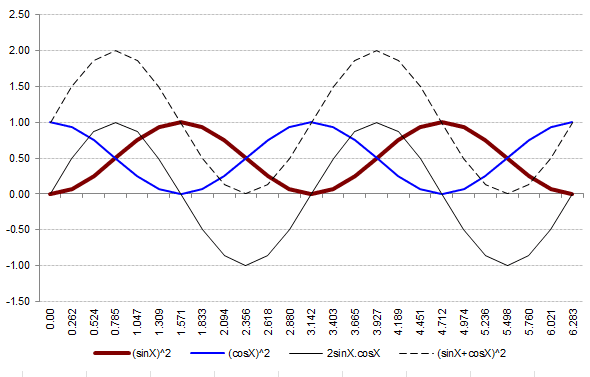
Here is how I tried to understand ## (sin u + cos v )^2 = sin^2 u +cos^2 v + 2 sin u . cos v ## . All I see is sinusoidal functions with different periods and some of them are always positive.

How do I use this knowledge?
1571407784884.png
 
Mathematics news on Phys.org
Good answer here: https://math.la.asu.edu/~surgent/mat271/mintrig.pdf

Short answer is to learn some of the identities well, not all. The above is a guideline.
 
  • Like
Likes   Reactions: musicgold
Secant and cosecant might be a bit unusual or even be called redundant as they are just reciprocals of sine and cosine, but especially the identity ##\sin^2 u+ \cos^2 u =1## is very important. It is the equation of a circle, and as such present in many applications: change between Cartesian and polar coordinates, integration methods, physics in general. Especially in integration calculus we often switch between trig functions and polynomials, depending on which it is easier to find an antiderivative for.

But also in mechanics, there are angles all around and want to be calculated from lengths. Think of the formula for pulling a cart: work = force times distance times cosine between them.
 
  • Like
  • Informative
Likes   Reactions: Klystron and musicgold
Then you have other formulas like ##a \cdot b=|a||b|sin \theta ## which gives rise to orthogonality, geometry, so this is a very narrow view of what matters.
 
  • Like
Likes   Reactions: musicgold
I always felt we learn these identities like we learn our addition and multiplication tables so we don't dwell on rederiving them over and over again as we solve more complex problems.

You will find the many math prodigies have these and many more facts at their fingertips allowing them to peel away the layers of a complex problem and get to the heart of it quickly and efficiently with minimal reduction mistakes.

I am reminded of the story told here recently of trying to get a math paper published that 1+1=2 by subbing in various math identities trig or otherwise to create a complex enough and interesting enough expression that looks devilishly hard to prove but in the end when the identities are stripped away by the reader, they realize its simply 1+1=2.
 
  • Like
Likes   Reactions: musicgold and WWGD
jedishrfu said:
I always felt learn these identities like we learn our addition and multiplication tables so we don't dwell on rederiving them over and over again as we solve more complex problems.
I get what you are saying. My problem is when you understand something it is easier to memorize it. How do you make sense of the product of two ratios:
## cos u . sin v = \frac {1}{ 2} [sin(u + v) − sin(u − v)] ##
 
musicgold said:
I get what you are saying. My problem is when you understand something it is easier to memorize it. How do you make sense of the product of two ratios:
## cos u . sin v = \frac {1}{ 2} [sin(u + v) − sin(u − v)] ##

I would just look that up. The only four I know for sure without looking them up are:

##\sin^2 x + \cos^2 x = 1## (*Note)

##\sec^2 x = 1 + \tan^2 x##

##\cos^2 x - \sin^2 x = \cos (2x)##

##2\sin x \cos x = \sin(2x)##

Everything else I would look up.

(*Note) This and the formula for quadratic roots are probably the two most useful things to remember. I use them every day!
 
  • Like
Likes   Reactions: musicgold
PeroK said:
I would just look that up. The only four I know for sure without looking them up are:

##\sin^2 x + \cos^2 x = 1## (*Note)

##\sec^2 x = 1 + \tan^2 x##

##\cos^2 x - \sin^2 x = \cos (2x)##

##2\sin x \cos x = \sin(2x)##

Everything else I would look up.

(*Note) This and the formula for quadratic roots are probably the two most useful things to remember. I use them every day!
If I may, ( ignore otherwise), how do you use these every day? Do you teach? You seem advanced in your knowledge so I can't think of how you would use them daily.
 
  • Like
Likes   Reactions: musicgold
WWGD said:
If I may, ( ignore otherwise), how do you use these every day? Do you teach? You seem advanced in your knowledge so I can't think of how you would use them daily.

I just study Physics for my own interest.

Just today I was looking at QM Spin and if you take an electron z-up spin state and measure its spin about at axis at an angle ##\theta## to the z-axis, then the probabilities of getting spin up and down measurements are ##\cos^2(\theta/2)## and ##\sin^2(\theta/2)## respectively. The trig identity is important as that ensures that these two probabilities (which are the only options) sum to ##1##.

Moreover, the spin state has a phase factor of ##exp(\frac{i\phi}{2})##, which is a complex number of modulus ##1##. If we expand the complex exponential as:

##exp(\frac{i\phi}{2}) = \cos(\frac{\phi}{2}) + i \sin (\frac{\phi}{2})##

Then, again, it is the same trig identity that ensures this has indeed a modulus of ##1##.

##\cos^2 + \sin^2 = 1## is truly ubiquitous.
 
  • Like
Likes   Reactions: Klystron, musicgold and WWGD
  • #10
PeroK said:
I just study Physics for my own interest.

Just today I was looking at QM Spin and if you take an electron z-up spin state and measure its spin about at axis at an angle ##\theta## to the z-axis, then the probabilities of getting spin up and down measurements are ##\cos^2(\theta/2)## and ##\sin^2(\theta/2)## respectively. The trig identity is important as that ensures that these two probabilities (which are the only options) sum to ##1##.

Moreover, the spin state has a phase factor of ##exp(\frac{i\phi}{2})##, which is a complex number of modulus ##1##. If we expand the complex exponential as:

##exp(\frac{i\phi}{2}) = \cos(\frac{\phi}{2}) + i \sin (\frac{\phi}{2})##

Then, again, it is the same trig identity that ensures this has indeed a modulus of ##1##.

##\cos^2 + \sin^2 = 1## is truly ubiquitous.
Thanks. Now I/we have a good answer for the repeated question : "Why should I learn trig , I will never use it again?":).
 
  • Like
Likes   Reactions: musicgold
  • #11
musicgold said:
I get what you are saying. My problem is when you understand something it is easier to memorize it. How do you make sense of the product of two ratios:
## cos u . sin v = \frac {1}{ 2} [sin(u + v) − sin(u − v)] ##

For that identity, I'd think of the algebra - how the symbols are going to combine after you apply the addition formulas for ##\sin{(u+v)}## and ##\sin{(u-v)}##. It's a mistake to attempt to visualize all mathematical facts as facts about pictures and graphs. Strings of symbols form patterns and change into other patterns.

Are you in a class where you are expected to memorize a long list of trigonometric identities? If so, I think you will have to memorize some of them by rote. I recall seeing a message on the internet that claimed using ##e^{i\theta} = \cos{\theta} + i \sin{\theta}## can be used to derive most trig identities, but I've never looked into that.

If you are worried about remembering every trig identity that you encounter as preparation for future courses - only a few of them are used frequently and obscure identities are things people expect to look up.

If you are worried about remembering lots of trig identities as preparation for entering math solving contests, I don't know anything about that.
 
  • Like
Likes   Reactions: musicgold
  • #12
Like Jedi suggested here, automating/memorizing a few formulas will help free your mind to do more advanced work. I assume you do not review every aspect of your life daily before studying or going to work; you automate and build on it. I am not discouraging you to find a way of understanding the formulas but until you do, you may just bite the bullet, repeat them for the exam. Notice, e.g, actors who remember their lines. Yes, in an ideal world schooling would be different but at this point it is not. Edit: Maybe playing around with them will help you memorize them.
 
  • Like
Likes   Reactions: musicgold
  • #13
I use them frequently in my work in, e.g., antenna coordinate transformations and signal processing. Example: I recently analyzed the large-signal behavior of an electro-optic modulator. When overdriven, and using complex (I&Q) signals, one gets sums and products of sines, cosines and Bessel functions. I tend to remember the most common trig relations, but look up relations involving derivatives and inverse trig functions.
 
  • Like
Likes   Reactions: Klystron, musicgold and WWGD
  • #14
PeroK said:
##exp(\frac{i\phi}{2}) = \cos(\frac{\phi}{2}) + i \sin (\frac{\phi}{2})##
Then, again, it is the same trig identity that ensures this has indeed a modulus of ##1##.
##\cos^2 + \sin^2 = 1## is truly ubiquitous.

Some would say the fact that ##e^x e^{-x} = 1## is what ensures the trig identity!
 
  • Like
Likes   Reactions: musicgold
  • #15
Stephen Tashi said:
I recall seeing a message on the internet that claimed using ##e^{i\theta} = \cos{\theta} + i \sin{\theta}## can be used to derive most trig identities, but I've never looked into that.

$$e^{i(u+v)} + e^{i(u-v)} = e^{iu}e^{iv} - e^{iu}e^{-iv} = e^{iu}(e^{iv} + e^{-iv}) = (\cos u + i\sin u)(\cos v + i\sin v + cos (-v) +i \sin(-v)) = (\cos u + i\sin u)(2\cos v) = 2 \cos u \cos v + 2i \sin u \cos v $$
And
$$e^{i(u+v)} + e^{i(u-v)} = \cos(u+v) +i \sin(u+v) + \cos(u-v) + i\sin(u-v)$$
Comparing real and imaginary parts yields:
$$\cos(u+v) + cos(u-v) = 2\cos u \cos v; \ \ \sin(u+v) + sin(u-v) = 2 \sin u \cos v$$
 
  • Like
Likes   Reactions: Stephen Tashi, Klystron and jedishrfu
  • #16
Euler's formula is great for rederiving these identities. However, the more difficult approach is to use the a diagram of two right triangles with an appropriate layout as shown in the video below:


We had to learn this proof because we didn't learn of Euler's formula until we covered complex number algebra.

Euler's formula approach is so much cooler and one has to wonder how Euler came upon it.
 
  • #17
Sine and Cosine are the "basic" wave functions and it becomes apparent that in physics (from classical to quantum physics and from non relativistic to relativistic) and engineering, waves play an important role, so just try to learn about sine and cosine as much as you can!
 
  • #18
I think that trig and calculus are the two most important math sectors that i have learned. Trig for its many practical applications and calculus because it helped open my mind to an entirely different way of thinking.

These identities help you find values when you are given certain parameters but need others. They are just different "Angles" of going at a problem.

The complex trig functions are often very important for higher level math derivations. Some integration techniques for example are simplified by using these identities, and are key to major mathematical formulas being found.

http://www.mathcentre.ac.uk/resources/uploaded/mc-ty-intusingtrig-2009-1.pdf
Also of thought is that these functions (maybe useless to most of us) are useful for people that perform these higher level calculations. Much like remembering that 5+5 is 10. I didn't count that i just remembered it and so it saved me time.
 

Similar threads

  • · Replies 11 ·
Replies
11
Views
2K
  • · Replies 2 ·
Replies
2
Views
2K
  • · Replies 2 ·
Replies
2
Views
2K
Replies
9
Views
3K
Replies
2
Views
1K
Replies
54
Views
4K
  • · Replies 2 ·
Replies
2
Views
2K
  • · Replies 14 ·
Replies
14
Views
2K
Replies
4
Views
2K
  • · Replies 1 ·
Replies
1
Views
2K