Question on Calculating Coulomb force in VECTOR FORM

3 replies · 4K views · last reply
mhrob24
Messages
53
Reaction score
9
Homework Statement
Point charges q1 = 14 µC and q2 = −60 µC are fixed at r1 = (5.0î − 4.0ĵ) m and r2 = (9.0î + 7.5ĵ) m.

What is the force (in N) of q2 on q1?
(Express your answer in vector form.)
Relevant Equations
F = ke(Qq/r^2)
The only thing tripping me up here is that the answer needs to be in vector form. If the question was asking for the scalar form, then I would just find the distance between the charges (plot the charges according to their vector coordinates, then use pythagorean theorem to find the distance between the two. However, I believe (could be wrong here) that in order to get the vector form, I must calculate the force like I normally would for the scalar version, but then I would have to multiply the force by the unit vector representing the distance between the 2 charges. Here is my work done for this problem:
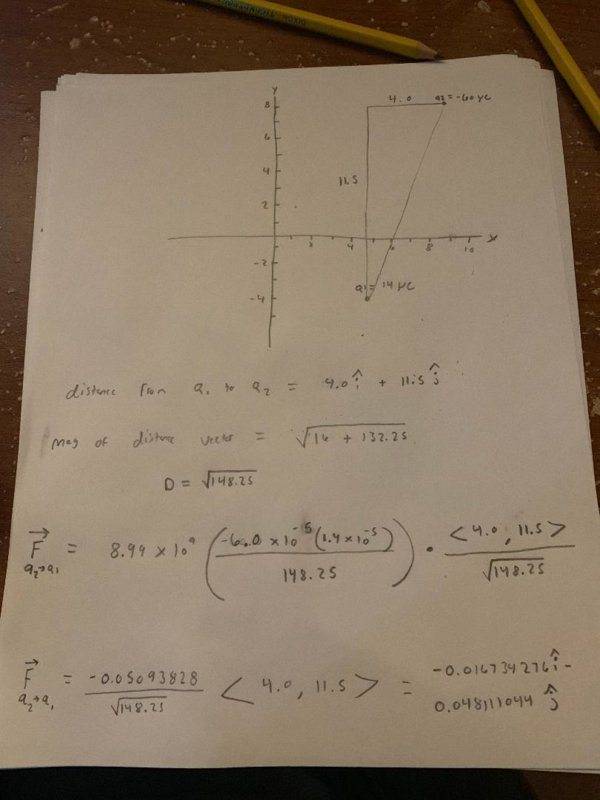
Handwritten work on paper: a coordinate sketch with a vertical 11.5 m side and a diagonal to q2 = -60 µC, then the vector distance 4.0 i + 11.5 j, magnitude sqrt(148.25), and the Coulomb force expression with unit vector.
However, when I enter that vector at the bottom of my page into webassign (online HW platform), it is incorrect. I know the Force calculation is 100% correct so It has to be something with my unit vector, but I don't see the problem. The x-distance between the two charges is 4m and the y distance between the two charges is 11.5m right? So the vector representing the direct distance between the two charges is < 4.0, 11.5>. Then the unit vector is just this vector divided by its magnitude (sqrt(148.25)). I don't see where I'm going wrong...
 
I haven't checked any of the arithmetic. But, without doing any calculation, you should be able to deduce the signs of the x and y components of the force.
 
  • Like
Likes   Reactions: mhrob24
Lmao. You're right. My signs of the components of the force vector were backwards. Q2 will attract Q1 so Q1 will accelerate in both the POSITIVE x and y directions. I had both components of the force vector as negative. I switched the signs and got the correct answer on Webassign. I spent like an hour trying to figure out what was going on :oldgrumpy: Thank you!
 
  • Like
Likes   Reactions: TSny
Yes. When you express the force vector in terms of a magnitude and a unit vector in the direction of the force, the magnitude part should be a positive number. When finding the magnitude of the force, just use the magnitudes (absolute values) of the charges in Coulomb's law.

Handwritten Coulomb force vector equation: F with subscript q2,q1 equals 8.99 x 10^9 times a bracket containing (-1.0 x 10^-6)(1.4 x 10^-5) over 148.25, times the vector <4.0, 11.5> over the square root of 148.25. The word 'no' in orange, with an orange circle around the negative sign in the first charge term.