mhrob24
- 53
- 9
- Homework Statement
- Point charges q1 = 14 µC and q2 = −60 µC are fixed at r1 = (5.0î − 4.0ĵ) m and r2 = (9.0î + 7.5ĵ) m.
What is the force (in N) of q2 on q1?
(Express your answer in vector form.)
- Relevant Equations
- F = ke(Qq/r^2)
The only thing tripping me up here is that the answer needs to be in vector form. If the question was asking for the scalar form, then I would just find the distance between the charges (plot the charges according to their vector coordinates, then use pythagorean theorem to find the distance between the two. However, I believe (could be wrong here) that in order to get the vector form, I must calculate the force like I normally would for the scalar version, but then I would have to multiply the force by the unit vector representing the distance between the 2 charges. Here is my work done for this problem:
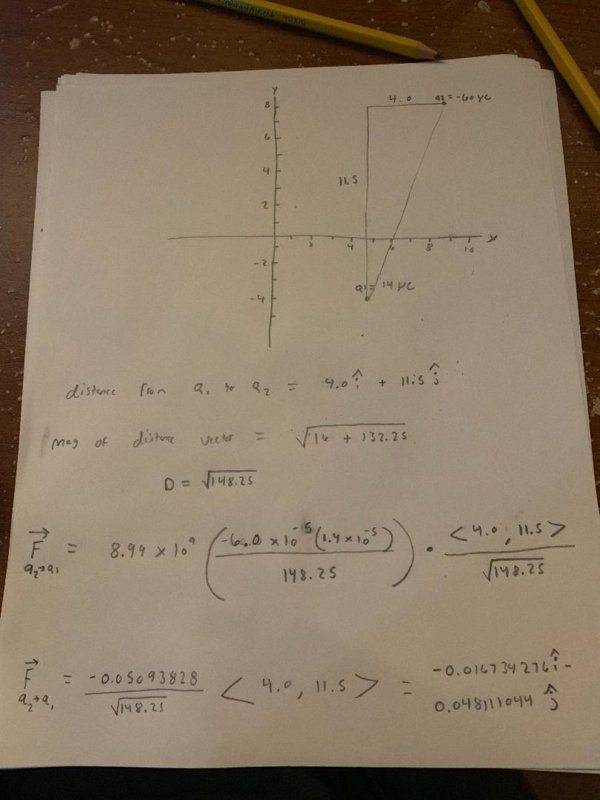 However, when I enter that vector at the bottom of my page into webassign (online HW platform), it is incorrect. I know the Force calculation is 100% correct so It has to be something with my unit vector, but I don't see the problem. The x-distance between the two charges is 4m and the y distance between the two charges is 11.5m right? So the vector representing the direct distance between the two charges is < 4.0, 11.5>. Then the unit vector is just this vector divided by its magnitude (sqrt(148.25)). I don't see where I'm going wrong...
 Thank you!