Question on conservation of angular momentum

Click For Summary

Homework Help Overview

The discussion revolves around a mechanics problem involving a disk rotating with angular velocity and a ball moving in an Archimedean spiral. Participants are exploring the conservation of angular momentum and the reference frames involved in the problem.

Discussion Character

  • Conceptual clarification, Assumption checking

Approaches and Questions Raised

  • Participants are questioning which reference frame should be used for the conservation of angular momentum: the non-inertial disk reference frame or the inertial laboratory frame. There are discussions about the implications of net torque in both frames and the role of virtual forces.

Discussion Status

Some participants have offered insights regarding the conditions under which angular momentum is conserved and have provided reasoning about the relationship between the ball's motion and the reference frames. Multiple interpretations of the problem are being explored, particularly concerning the effects of non-inertial frames.

Contextual Notes

There is an ongoing examination of the definitions and assumptions related to the problem, including the nature of forces acting on the ball and the implications of the disk's rotation on angular momentum conservation.

Jeremy1986
Messages
17
Reaction score
3
Dear guys,
Recently, i am confused with a problem in my textbook of mechanics. The question is,
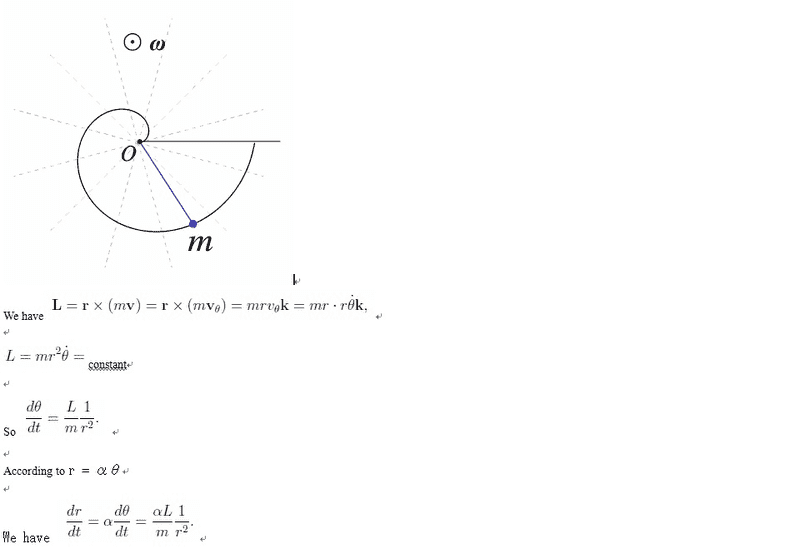
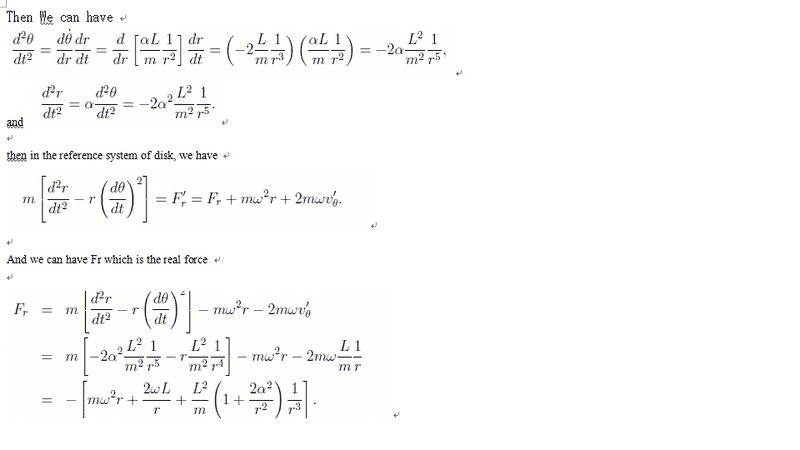
suppose there is a disk, placed horizontally, rotate about its center with angular velocity ω. A ball move with respect to the center of the disk in a trace of Archimedean spiral r=αθ. The angular momentum of the ball is conserved with respect to the center O. What is the real force Fθ and Fr acting on that ball ?

this is the question and the solution given in the textbook, since they are written in chinese, i translate it into english
upload_2015-12-9_16-6-29.png
upload_2015-12-9_16-7-2.png


Here is my question. From the solution we can see that the θ is the angular in the disk reference system. And they use the statement that the angular momentum is constant. i don't know which reference system should this statement be applied, whether the disk-reference system which is non-inertial or the laboratory frame of reference which is inertial?

For me, i think it should be the laboratory frame of reference. and because the disk-reference system is non-inertial, so the angular momentum with respect to the disk-reference system is no longer conserved so it should not be constant anymore

sorry for the long question, i hope i explained both the question and my opinion well. thanks for your help!
 
Last edited:
Physics news on Phys.org
i got some idear after posting this thread :biggrin:

the statement "A ball move with respect to the center of the disk in a trace of Archimedean spiral r=αθ,"
here 'with respect to' mean r andθ is in the disk reference of frame.

the conservation of angular momentum can only happens in the disk reference of frame. because in the lab reference frame the net torque can never be zero. but in the disk reference of frame, the net torque can be zero with the help of virtual forces.
 
Jeremy1986 said:
i got some idear after posting this thread :biggrin:

the statement "A ball move with respect to the center of the disk in a trace of Archimedean spiral r=αθ,"
here 'with respect to' mean r andθ is in the disk reference of frame.

the conservation of angular momentum can only happens in the disk reference of frame. because in the lab reference frame the net torque can never be zero. but in the disk reference of frame, the net torque can be zero with the help of virtual forces.

You could see this more easily by considering the ball moving out with constant radial velocity ##v_r## relative to the disk. It's position relative to the disk is ##r = v_rt, \ \theta = 0##

In the external frame, it's position is ##r = v_rt, \ \theta = \omega t##, hence ##r = \alpha \theta## with ##\alpha = v_r/ \omega##

Or, turning this round: ##v_r = \alpha \omega##

And, its angular momentum in the external frame is ##L = mrv_{\theta} = mr^2 \omega = m \alpha^2 \omega^3 t^2##
 
PeroK said:
You could see this more easily by considering the ball moving out with constant radial velocity ##v_r## relative to the disk. It's position relative to the disk is ##r = v_rt, \ \theta = 0##

In the external frame, it's position is ##r = v_rt, \ \theta = \omega t##, hence ##r = \alpha \theta## with ##\alpha = v_r/ \omega##

Or, turning this round: ##v_r = \alpha \omega##

And, its angular momentum in the external frame is ##L = mrv_{\theta} = mr^2 \omega = m \alpha^2 \omega^3 t^2##
Thanks PeroK! I was out for the past couple of days, and sorry for the late reply. your reply enlightens me, and i think you are right.
as the statement in the question "The angular momentum of the ball is conserved with respect to the center O", we can get that f'θ in the disk-reference frame equals to 0. And this means, as you said,"the ball moving out with constant radial velocity vr relative to the disk". Thanks again for your kind help!
 
Last edited:

Similar threads

  • · Replies 3 ·
Replies
3
Views
2K
  • · Replies 4 ·
Replies
4
Views
2K
  • · Replies 6 ·
Replies
6
Views
1K
Replies
1
Views
2K
  • · Replies 16 ·
Replies
16
Views
3K
  • · Replies 30 ·
2
Replies
30
Views
4K
  • · Replies 1 ·
Replies
1
Views
2K
  • · Replies 10 ·
Replies
10
Views
2K
  • · Replies 10 ·
Replies
10
Views
2K
  • · Replies 17 ·
Replies
17
Views
1K