Question on plate size in plate tectonics

  • Thread starter Thread starter Althistorybuff
  • Start date Start date
  • Tags Tags
    Plate
Click For Summary
SUMMARY

The discussion centers on the size and number of tectonic plates on Earth, with participants exploring why there are approximately 20 to 30 large plates rather than a greater number of smaller ones. Key insights include the role of continental drift and subduction processes, which have led to the subsumption of smaller plates over geological time. The conversation also touches on the implications of mantle viscosity and convection patterns, suggesting that a planet with lower mantle viscosity could support a higher number of smaller tectonic plates.

PREREQUISITES
  • Understanding of plate tectonics and continental drift
  • Familiarity with geological processes such as subduction and rifting
  • Basic knowledge of mantle convection and its effects on planetary geology
  • Awareness of viscosity and its implications in geological contexts
NEXT STEPS
  • Research the effects of mantle viscosity on tectonic plate formation
  • Explore the concept of mantle convection cells and their sizes
  • Investigate the geological implications of subduction zones on plate size
  • Examine case studies of other planetary bodies with different tectonic characteristics
USEFUL FOR

Writers, geologists, and planetary scientists interested in the dynamics of tectonic plates and their implications for planetary formation and evolution.

Althistorybuff
Messages
20
Reaction score
0
Question from an amateur:

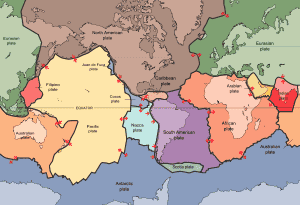
The Earth's plates seem pretty large compared to the planet. This example has about 20 to 30 with about 6 seemingly making up the majority of the Earth's surface.

Is there a reason why they are so large?

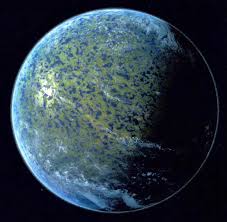
I'm writing a novel in which a planet, instead of having 20 to 30 plates, may have 100 small ones. That way, I don't have a handful of large oceans or large continents but a huge number of smaller Greenland to Hawaii sized island chains with dozens of large Mediterranean-sized seas.
images?q=tbn:ANd9GcQqETN4_TyetVxDj3iIQxdXiBTT6Xa-54PnS659nQmdqwlKCVXpag.jpg


Is there some aspect of planetary tectonics that would explain why there would be more numerous but smaller plates?
300px-Plates_tect2_en.svg.png


Thanks.
 
Earth sciences news on Phys.org
Consider: https://earth-planets-space.springeropen.com/articles/10.1186/s40623-016-0400-x

I would look at it in this somewhat non-scientific analogy: If you take a system of objects, like the solar system:
Few really large objects - Sun sized and larger
More medium sized objects - hot Jupiter size
Lots of much smaller objects. Earth and moon sizes
Huge number of tiny objects: thousands of asteroids.

During planetary formation, the tiny objects rained down onto the larger ones; they were subsumed.

With plates on Earth powered by continental drift, tiny ones have been subsumed by subduction in the past, leaving larger ones still intact. New smaller plates form in active rift valleys from old larger ones.

The article mentions something like this, but more from an obervational point of view.
 
  • Like
Likes   Reactions: RogueOne, davenn and Nik_2213
jim mcnamara said:

nice article, Jim, thanks :)

jim mcnamara said:
With plates on Earth powered by continental drift, tiny ones have been subsumed by subduction in the past, leaving larger ones still intact. New smaller plates form in active rift valleys from old larger ones.

have to agree with that. There's no real reason why there should be a set number of a specific size.
In a chaotic system that is forever changing over the millions of years, the size, shape and number is also going to be constantly changingDave
 
Thanks all.
 
jim mcnamara said:
@davenn - posts deleted.

Thanks Jim, I have deleted my one :)
 
Althistorybuff said:
Is there a reason why they are so large?

That seems to be an open question. As the continents are formed by convections inside the mantle, they should be much smaller because the size of a convection cell is limited by the deep of the fluid - in this case 3000 km. In addition the resulting shape and distribution of the continents should be more symmetric (e.g. like a honeycomb structure). For some reason the mantle doesn't behave like a homogeneous fluid. A possible reason could be an increasing viscosity in deeper layers of the mantle. In that case I would expect smaller continents on a world with a lower viscosite of the mantle compared to Earth. A side effect could be increased volcanism.
 

Similar threads

  • · Replies 7 ·
Replies
7
Views
6K
  • · Replies 0 ·
Replies
0
Views
2K
  • · Replies 4 ·
Replies
4
Views
4K
  • · Replies 9 ·
Replies
9
Views
9K
  • · Replies 33 ·
2
Replies
33
Views
19K
  • · Replies 1 ·
Replies
1
Views
2K
Replies
15
Views
10K
  • · Replies 8 ·
Replies
8
Views
4K
  • · Replies 4 ·
Replies
4
Views
3K
  • · Replies 7 ·
Replies
7
Views
8K