Question on Resolving Power of Diffraction Grating

Join the discussion
Registration is free. Ask a follow-up in this thread, or start your own.
3 replies · 3K views
warhammer
Messages
164
Reaction score
33
Homework Statement
A diffraction grating kept at normal incidence gives a line of wavelength 540nm in a certain order superposed with another wavelength of 450nm of the next higher order. If the angle of diffraction is 10 degree, compute the no. of lines per centimeter in the grating. Will the line be resolved in the first order, if the light is assumed to fall in an area of cm width grating?
Relevant Equations
Resolving Power=mN=λ/∆λ
I have doubts about my work for the second part of the question, where I am asked if resolution will be possible or not.

For the first part, I calculated No. of lines N=6.43*10^2 lines/cm

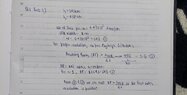
For the second part, I have attached below a snapshot of my neatly written work. I request a PF member to have a look & guide me.

(And Greetings for the New Year! 🙏🏻🌸)
 

Attachments

  • 20211228_213254.jpg
    20211228_213254.jpg
    40.7 KB · Views: 185
Physics news on Phys.org
On this one, there is little doubt that those two lines will be resolved at first order=450 nm and 540 nm are very far apart. In any case, it should be apparent that the two are at 6th order and 5th order respectively when they overlap.
For ## D=1 ## cm, ## N=D \delta=643 ##, so that ## Nm=643=\frac{\lambda}{\Delta \lambda} ##, making the resolution ## \Delta \lambda \approx 1 ## nm , ( just slightly less than 1 nm), at first order, (## m=1 ##). Two lines that are 90 nm apart will be very far apart, and of course they are resolved. :)
Note: The spectrometer has enough resolution that it would most likely distinguish two lines of ## \lambda= 450 ## nm and ## 451 ## nm at first order. To ask whether it can separate ## \lambda=450 ## nm and ## \lambda=540 ## nm at first order is perhaps kind of a dumb question. :)
 
Last edited:
Reply
  • Informative
Likes   Reactions: warhammer
Charles Link said:
On this one, there is little doubt that those two lines will be resolved at first order=450 nm and 540 nm are very far apart. In any case, it should be apparent that the two are at 6th order and 5th order respectively when they overlap.
For ## D=1 ## cm, ## N=D \delta=643 ##, so that ## Nm=643=\frac{\lambda}{\Delta \lambda} ##, making the resolution ## \Delta \lambda \approx 1 ## nm , ( just slightly less than 1 nm), at first order, (## m=1 ##). Two lines that are 90 nm apart will be very far apart, and of course they are resolved. :)
Note: The spectrometer has enough resolution that it would most likely distinguish two lines of ## \lambda= 450 ## nm and ## 451 ## nm at first order. To ask whether it can separate ## \lambda=450 ## nm and ## \lambda=540 ## nm at first order is perhaps kind of a dumb question. :)
Ah, thank you so much for your kind guidance sir. I was able to gauge this but I needed to back the same mathematically and was somewhat doubtful of my work for some reason (if my math based reasoning was ok or not) but with your guidance, I can be quite sure of it :D
 
Reply
  • Like
Likes   Reactions: Charles Link
@warhammer For additional details on the diffraction grating spectrometer, including how the resolution formula is derived,
see https://www.physicsforums.com/insights/fundamentals-of-the-diffraction-grating-spectrometer/

Edit: I should add that most often with a spectrometer, the resolution is determined by the slit width, rather than by the diffraction limit. With slit widths of ## b ##, we have the usual ## m \lambda=d \sin{\theta} ##, so that ## \Delta \theta \approx \frac{m \Delta \lambda}{d}=\frac{b}{f} ##, (within a factor of 2). The result is ## \Delta \lambda \approx \frac{bd}{mf} ##.

When the slit width ## b ## is made small enough that this latest ## \Delta \lambda=\frac{bd}{mf} ## is less than ## \Delta \lambda_{diffraction \, limit}=\frac{\lambda}{Nm} ##, then the resolution is determined by the diffraction limit.

(and I see I discussed this in calculation (5) of the above article where slit width ## b=\Delta x ##).
 
Last edited:
Reply
  • Informative
Likes   Reactions: warhammer