Questions from Quantum Measurements

Click For Summary
SUMMARY

The forum discussion centers on the interpretation of measurement outcomes in quantum mechanics, specifically regarding eigenvalues and the Pauli Y matrix. Participants address the confusion surrounding the measurement outcome being 0 and clarify that an eigenvalue can indeed be 0, particularly in the context of linear transformations. The discussion highlights the importance of clearly defining terms like the Pauli Y matrix and emphasizes the need for complete problem formulations to facilitate understanding. Key concepts such as the Born Rule and the application of quantum gates like Hadamard and cNOT are also mentioned.

PREREQUISITES
  • Understanding of quantum mechanics principles, particularly eigenvalues and eigenvectors.
  • Familiarity with quantum gates, specifically Hadamard and cNOT gates.
  • Knowledge of the Born Rule for calculating probabilities in quantum states.
  • Basic understanding of Pauli matrices, particularly the Pauli Y matrix (σ_y).
NEXT STEPS
  • Study the properties and applications of the Pauli Y matrix in quantum mechanics.
  • Learn about the Born Rule and its implications in quantum state measurement.
  • Explore the use of quantum gates in quantum computing, focusing on Hadamard and cNOT gates.
  • Investigate the significance of eigenvalues in linear transformations and their role in quantum mechanics.
USEFUL FOR

Students of quantum mechanics, quantum computing enthusiasts, and educators seeking to clarify concepts related to measurement outcomes and eigenvalues in quantum systems.

ARoyC
Messages
56
Reaction score
11
Homework Statement
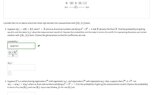
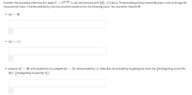
Please check the attached screenshots for the questions.
Relevant Equations
Spectral Decomposition of Y, Probability of a Measurement Outcome and Posterior State Formula
[Mentor Note: Two similar thread starts merged]

The questions are from MIT OCW. First of all, I cannot understand what is the meaning of the measurement outcome being 0. How can an eigenvalue be 0? I tried doing the problems guessing that by 0 they mean the posterior state will be |0>. The only correct answer I got was for the first part of the second problem. I first wrote the state of the first qubit after passing through the first Hadamard gate. Then I wrote the tensor product state of the two qubits. After that, I applied the cNOT gate on the second qubit and then again the Hadamard gate on the first qubit. Then I used Born Rule to find the probability of the first qubit being in |0>. But I cannot get the answer for the other two parts using this method. Same problem for the first question.

It would be great if someone can help me out. Thank you in advance.
 

Attachments
  • Screenshot 2023-07-08 122050.jpg
    Screenshot 2023-07-08 122050.jpg
    17.8 KB · Views: 146
  • Screenshot 2023-07-08 122200.jpg
    Screenshot 2023-07-08 122200.jpg
    33.1 KB · Views: 147
Last edited by a moderator:
Physics news on Phys.org
Hi, everyone.

Please check the following two questions.

1.
Screenshot 2023-07-08 122050.jpg

2.
Screenshot 2023-07-08 122200.jpg

The questions are from MIT OCW. First of all, I cannot understand what is the meaning of the measurement outcome being 0. How can an eigenvalue be 0? I tried doing the problems guessing that by 0 they mean the posterior state will be |0>. The only correct answer I got was for the first part of the second problem. I first wrote the state of the first qubit after passing through the first Hadamard gate. Then I wrote the tensor product state of the two qubits. After that, I applied the cNOT gate on the second qubit and then again the Hadamard gate on the first qubit. Then I used Born Rule to find the probability of the first qubit being in |0>. But I cannot get the answer for the other two parts using this method. Same problem for the first question.

It would be great if someone can help me out. Thank you in advance.

Regards

Annwoy Roy Choudhury
 
Please give a complete problem formulation. If we don't know, what ##Y## is, we can't answer any of the questions!

What do you think is a problem of a eigenvalue 0? Take, e.g., ##\hat{S}_z## of a spin-1 particle. It has the eigenvalues 1, 0, -1. In the corresponding eigenbasis the corresponding matrix is
$$\begin{pmatrix} 1 & 0 & 0 \\ 0 & 0 & 0 \\ 0 & 0 &-1 \end{pmatrix}.$$
 
vanhees71 said:
Please give a complete problem formulation. If we don't know, what ##Y## is, we can't answer any of the questions!

What do you think is a problem of a eigenvalue 0? Take, e.g., ##\hat{S}_z## of a spin-1 particle. It has the eigenvalues 1, 0, -1. In the corresponding eigenbasis the corresponding matrix is
$$\begin{pmatrix} 1 & 0 & 0 \\ 0 & 0 & 0 \\ 0 & 0 &-1 \end{pmatrix}.$$
Y is Pauli Y matrix.

0 eigenvalue is common for every linear transformation for (0,0,0). So it is a trivial case. And in these questions, even if they mean that the eigenvalue is 0, then what is the method to do the problems?
 
What is "Pauli Y matrix". You HAVE TO clearly define symbols in physics, that are not standard! Otherwise nobody can understand, what's the problem.
 
  • Like
Likes   Reactions: George Jones
vanhees71 said:
What is "Pauli Y matrix". You HAVE TO clearly define symbols in physics, that are not standard! Otherwise nobody can understand, what's the problem.
I apologise.

Screenshot 2023-07-10 204848.jpg
This is the Pauli Y matrix.
 
Few Information:

1. X and Y are written in the {∣0⟩,∣1⟩} X = |0><1| + |1><0| and Y = |0><1| - |1><0|

2. ∣+⟩=(1/√2)*(∣0⟩+∣1⟩)
 
ARoyC said:
I apologise.

View attachment 329075This is the Pauli Y matrix.
The usual notation for that is ##\sigma_y##.
 
  • Like
Likes   Reactions: vanhees71
PeroK said:
The usual notation for that is ##\sigma_y##.
I am sorry. The screenshots of the questions are directly from MIT OCW. So, I had nothing to do with it.
 
  • #10
ARoyC said:
0 eigenvalue is common for every linear transformation for (0,0,0). So it is a trivial case. And in these questions, even if they mean that the eigenvalue is 0, then what is the method to do the problems?
By definition, an eigenvector is a non-zero vector satisfying ##T \vec x = \lambda \vec x##. While ##\vec x## has to be non-zero, there's no condition on ##\lambda##.
 
  • #11
vanhees71 said:
What is "Pauli Y matrix".

PeroK said:
The usual notation for that is ##\sigma_y##.

I think this depends on context, and that it is not unusual to see X, Y, Z in quantum computing books, or quantum books that have substantial sections on quantum computing. I am not entirely sure, and I ould like to check my books, but I'm at my in-laws, and thus separated from my books by several thousand kilometres. As compensation, my mother-in-law made some wonderful aloo paratha for me.
 
  • Like
Likes   Reactions: PhDeezNutz and PeroK
  • #12
George Jones said:
As compensation, my mother-in-law made some wonderful aloo paratha for me.
I'm quite partial to saag aloo myself.
 
  • Like
Likes   Reactions: George Jones
  • #13
Without a Gulab Jamoón, Kuch Nahi.
Edit: But, yes, eigenvalues can be 0, eigenvectors not the 0 vector. The eigenvalues will actually be 0 when the matrix is singular, almost by definition.
 
Last edited:
  • Like
Likes   Reactions: vanhees71

Similar threads

  • · Replies 3 ·
Replies
3
Views
2K
  • · Replies 1 ·
Replies
1
Views
1K
Replies
5
Views
2K
  • · Replies 0 ·
Replies
0
Views
1K
  • · Replies 3 ·
Replies
3
Views
2K
  • · Replies 1 ·
Replies
1
Views
2K
  • · Replies 1 ·
Replies
1
Views
2K
  • · Replies 1 ·
Replies
1
Views
1K
  • · Replies 6 ·
Replies
6
Views
4K
Replies
8
Views
6K