Questions on the classical interpretation of (normal) Zeeman effect

  • Context: Undergrad 
  • Thread starter Thread starter ValeForce46
  • Start date Start date
  • Tags Tags
    Zeeman effect
Click For Summary

Discussion Overview

The discussion revolves around the classical interpretation of the normal Zeeman effect, particularly in the context of observing spectral line splitting in a magnetic field. Participants explore the applicability of classical physics versus quantum mechanics in explaining this phenomenon.

Discussion Character

  • Debate/contested
  • Conceptual clarification
  • Technical explanation

Main Points Raised

  • One participant expresses confusion about the classical explanation of the Zeeman effect, questioning how the Lorentz force can account for spectral line splitting when viewed perpendicular to the magnetic field.
  • Another participant challenges the use of classical physics for this problem, suggesting it belongs in a quantum physics context.
  • A participant notes that the book being referenced claims a classical interpretation exists for the normal Zeeman effect, specifically mentioning the splitting into three lines without involving electron spin.
  • Some participants argue that classical physics cannot adequately explain the existence of spectral lines or stable atoms, implying that any classical interpretation would be a simplification or approximation of quantum mechanics.
  • There is mention of the historical context of the Zeeman effect and its relation to the development of quantum theory, with one participant stating that the effect was a significant indicator of the limitations of classical models.
  • Another participant suggests that the thread may not be worth keeping if it cannot provide satisfactory answers, but later acknowledges that the discussion about the lack of a classical interpretation could be beneficial for others.

Areas of Agreement / Disagreement

Participants do not reach a consensus on the validity of a classical interpretation of the Zeeman effect. There are competing views regarding the applicability of classical versus quantum explanations, and the discussion remains unresolved.

Contextual Notes

Some participants express uncertainty regarding the definitions and assumptions underlying classical interpretations of the Zeeman effect, particularly in relation to the limitations of classical physics in explaining atomic behavior.

ValeForce46
Messages
40
Reaction score
3
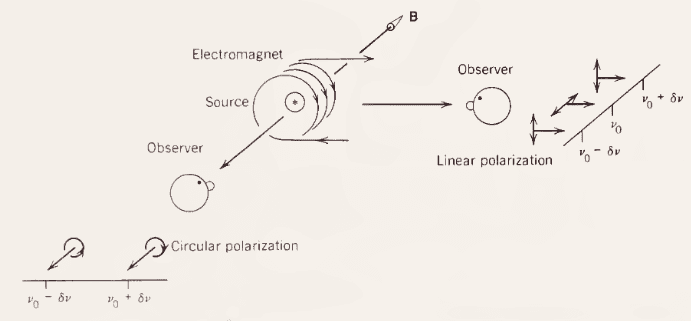
I'll put pictures from the book as I think they are relevant to understand the problem:
kKxhdiY.png

I have trouble understanding the case where the observer watches the source in a direction perpendicular to the magnetic field. The electron will rotate around B axis, so the observer will only see a linear oscillation of the electron hence linearly polarized light.
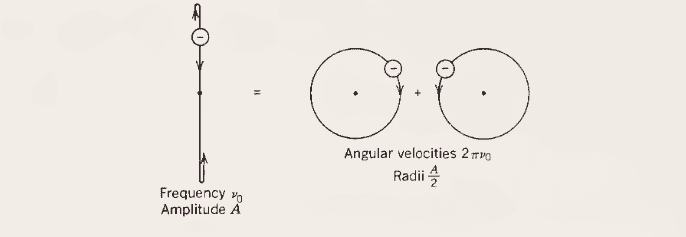
But how can the Lorentz force explain the splitting of spectral lines? The book suggest to view the linear oscillation as a combination of two counter-rotating motions like this:
KC023xR.png

But if this is the case, the Lorentz force would act in a plane perpendicular to the image so it won't explain the change of the frequency of the circular motion of the electron (and so the Zeeman splitting, classically).
Instead the situation is clear when we observe along the direction of B, as in that case Lorentz force would act radially.
 
Physics news on Phys.org
@ValeForce46 this is the quantum physics forum. Why are you using classical physics to analyze this problem?
 
  • Like
Likes   Reactions: vanhees71
PeterDonis said:
@ValeForce46 this is the quantum physics forum. Why are you using classical physics to analyze this problem?
Sorry, I shouldn't have posted here. It was my first impulse, because this is just the introduction to the Zeeman effect and later the book use quantum physics to explain it.
 
If it can't be moved, yes. I'll re-post on classical physics. Sorry.
 
I can move it to classical physics, but the answer there is simple: the Zeeman effect isn't a classical effect so there is no classical explanation for it. Is it even worth moving the thread?
 
  • Like
Likes   Reactions: vanhees71
Well, according to the book I am reading (from which I took the pictures I posted), "Introduction to the Structure of Matter: A Course in Modern Physics" by John J. Brehm and William J. Mullins, there is a classical interpretation, at least for the "normal" version (no spin is involved yet) of the effect where we see splitting in just 3 lines.
 
ValeForce46 said:
according to the book I am reading (from which I took the pictures I posted), "Introduction to the Structure of Matter: A Course in Modern Physics" by John J. Brehm and William J. Mullins, there is a classical interpretation, at least for the "normal" version (no spin is involved yet) of the effect where we see splitting in just 3 lines.
I don't see how there can be a purely classical interpretation since classical physics can't even explain the existence of spectral lines in the first place--or the existence of atoms, for that matter. According to classical physics electrons around an atomic nucleus should emit a continuous spectrum of radiation as they spiral into the nucleus; there should be no spectral lines and atoms should not be stable.

The book might be using a classical approximation of QM for this particular phenomenon, which would be based on an underlying quantum model.
 
  • Like
Likes   Reactions: vanhees71
I guess it's using the old quantum theory a la Bohr and Sommerfeld. I'd not recommend any book, which dwells on this old-fashioned theory, which provides wrong pictures even on the qualitative level. Also one should stress that particularly the Zeeman effect was among the many hints at the failure of these models and was understood only with the modern QT and the introduction of spin, i.e., the Pauli Equation.
 
  • Like
Likes   Reactions: dextercioby
  • #10
Well, thank you anyway for the replies. I suppose, if my questions have no answers, you might as well delete this thread.
 
  • #11
ValeForce46 said:
I suppose, if my questions have no answers, you might as well delete this thread.
On further consideration, the information that there is no classical interpretation of the Zeeman effect might be useful for other readers, so the thread will remain visible.
 
  • Like
Likes   Reactions: vanhees71

Similar threads

  • · Replies 5 ·
Replies
5
Views
2K
  • · Replies 3 ·
Replies
3
Views
3K
  • · Replies 8 ·
Replies
8
Views
1K
  • · Replies 3 ·
Replies
3
Views
2K
Replies
1
Views
2K
  • · Replies 2 ·
Replies
2
Views
3K
  • · Replies 1 ·
Replies
1
Views
2K
  • · Replies 6 ·
Replies
6
Views
2K
Replies
4
Views
3K
  • · Replies 7 ·
Replies
7
Views
4K